
Failed payments are quietly costing you subscription revenue
When people talk about subscription churn, they usually mean customers who decide to cancel. But a large share of lost subscribers never made that decision at all — their card simply failed on the next billing cycle, and the subscription quietly lapsed. That’s involuntary churn, and it’s often the cheapest churn to win back.
How big is the leak?
Subbly’s 2024 merchant data puts the median monthly churn for subscription-box merchants at 7.44%, with curation boxes at a 7.1% median and a worst quartile of 12.8% — and Churnkey’s figures, reported by Swell, put discovery-style boxes at 10–15% (Everboost’s summary collects both). Curation churns roughly twice as fast as replenishment, because it depends on novelty rather than on a consumption habit. Treat those as ranges across other people’s stores rather than a target for yours.
A meaningful slice of that churn is involuntary: expired cards, insufficient funds, a bank declining a recurring charge it doesn’t recognize. Across Recurly’s network of subscription businesses, average monthly churn ran at 3.60% in July 2026 — 2.34% voluntary and 1.25% involuntary (Recurly churn rate benchmarks, retrieved 25 August 2026). Divide the one into the other and involuntary churn is roughly a third of all churn on that network. That is one billing platform’s mix across many industries rather than a benchmark for your store, but the shape is the point: a large, recoverable slice of lost subscribers never decided to leave. Every one of them is a customer who still wanted the product and just needs a nudge or an updated card. The leak bites hardest on thin-margin, high-frequency subscriptions, where the shipping cost is paid on every renewal and there’s little room to absorb a lost one — coffee subscriptions are the clearest case.
Why cards fail more on subscriptions
Recurring billing is uniquely exposed to payment failures because:
- Cards expire on a fixed schedule, but your subscribers don’t re-enter them.
- Banks sometimes flag repeat charges as suspicious.
- A customer’s default card can change without them thinking to update it.
The longer the subscription runs, the more likely a card detail goes stale. Left alone, one failed charge becomes a silent cancellation.
What good dunning does
Dunning is the system that recovers failed payments. Done well, it:
- Retries intelligently — on a schedule that maximizes success (banks often approve on a later attempt) rather than hammering the card and getting the account flagged.
- Emails the customer with a clear, one-click way to update their payment method — before you lose them.
- Keeps the subscription alive during the recovery window instead of cancelling on the first decline.
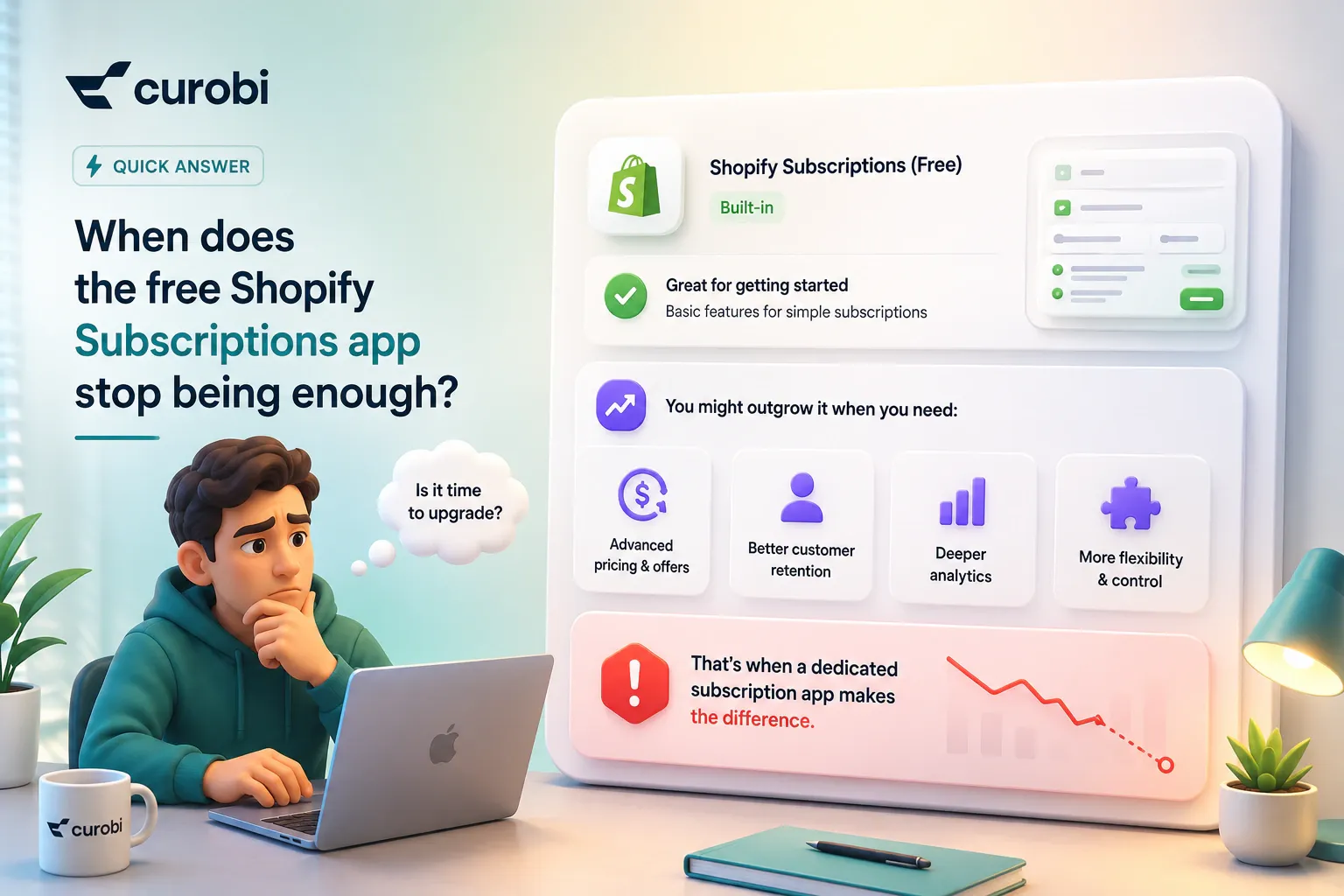
Shopify’s native subscriptions offer little of this, which is one of the main reasons growing stores add a subscription app. Curobi’s failed-payment recovery runs smart retries and customer emails automatically, so charges that would otherwise lapse get reclaimed.
The mechanics matter more than they look: which decline codes are worth retrying, how long the recovery window actually is, and the limits Shopify puts on re-billing a card are all specific enough to get wrong. The step-by-step version is in how to recover failed subscription payments on Shopify.
The takeaway
If you’re not actively recovering failed payments, you’re donating a chunk of your monthly revenue to expired cards. It’s also the easiest churn to fix, because the customer already wants to stay. Dunning handles the involuntary side; the voluntary side — people who mean to cancel — is best fought with skip and pause, covered in the skip button is your best retention tool. For the full picture on keeping subscribers, see our guide on reducing subscription churn on Shopify.
One caveat before you read a bad week as churn: when failures land in a cluster rather than one at a time, check the timestamps against your vendors’ status pages first. An infrastructure failure dunned as if it were a dead card costs twice — once in the payment and once in the email — which is the lesson in GitHub’s seven-and-a-half-hour outage.
Sources: Everboost: DTC subscription churn benchmarks (collecting Subbly’s 2024 merchant data and Churnkey’s figures via Swell), Recurly churn rate benchmarks (July 2026 data). Everboost retrieved 19 August 2026; Recurly retrieved 25 August 2026.