
Why UK Coffee Subscriptions Are Hard to Run Profitably (and How to Fix It)
UK coffee subscriptions look like one of the cleanest recurring-revenue businesses in retail. People drink coffee every day, run out on a predictable schedule, and care enough about quality to commit to a roaster they trust. Turn that habit into a repeating order and you have forecastable demand, a reason to buy green coffee with confidence, and a customer who does not have to think about their next bag. On paper, it is close to an ideal subscription.
In practice, many roasters find the same programme is quietly unprofitable — or profitable only on the subscribers who would have reordered anyway. The reasons are rarely dramatic. They are small, structural costs that stack up: coffee that stales before it is drunk, cards that fail at renewal, a delivery cadence that ships too much, and a parcel that tips a few millimetres over a Royal Mail threshold. None of these show up as a single obvious problem. Together, they decide whether a coffee subscription compounds or leaks.
This is the operational and retention picture behind UK coffee subscriptions: why the margin is thinner than it looks, where it leaks, and what a roaster can actually change. It ties together the shorter, focused pieces in our coffee subscriptions cluster — from the month-three churn cliff to failed payments — into one map.
Quick answer: why coffee subscriptions are harder to run profitably than they look
UK coffee subscriptions are harder to run profitably than they appear because four costs work against the model at the same time:
- Volatile input cost. Green coffee has traded at record highs and remains volatile, so the cost under a fixed subscription price keeps moving.
- Steep early churn. Coffee subscribers cancel disproportionately in the first few cycles, so a large share of acquisition spend never earns back.
- Silent payment failure. A meaningful portion of renewals fail on expired or declined cards, cancelling customers who never decided to leave.
- Unforgiving shipping economics. In the UK, a coffee bag that slips from a Royal Mail Large Letter into a Small Parcel raises the delivered cost of every order.
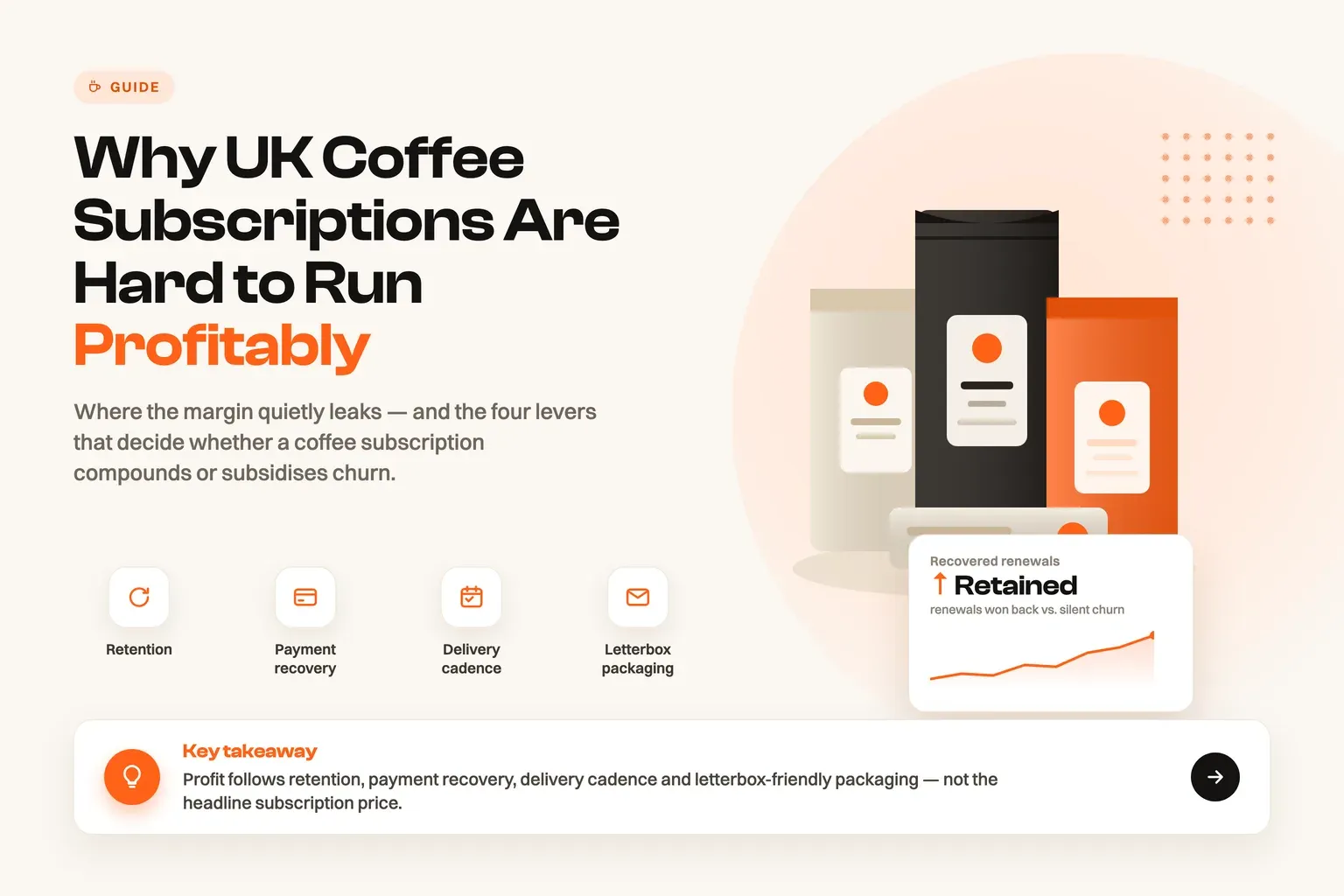
The lever that matters is not the headline subscription price. It is the combination of retention, payment recovery, delivery cadence and letterbox-friendly packaging. Get those right and the recurring revenue is real; get them wrong and the programme subsidises churn. The rest of this article works through each problem and what to do about it.
Why UK coffee subscriptions look easier to run than they are
Coffee is a genuinely strong subscription product, and the UK is a genuinely strong market for it. The British Coffee Association estimates the country drinks around 98 million cups of coffee a day, and demand has shifted steadily towards higher-quality, traceable coffee bought from independent roasters rather than only from supermarket shelves. That demand is exactly what makes a recurring plan plausible: the consumption is habitual, frequent and quality-sensitive. The recurring format has been growing around that habit, too: Royal Mail’s subscription box research valued the UK subscription box market at £1.2 billion in 2024 and forecast growth of more than 16 percent a year through 2033 (Royal Mail).
The difficulty is that the same product carries costs most subscription categories do not. Two are worth naming up front because they set the margin ceiling before a single retention decision is made.
The first is input-cost volatility. Arabica futures topped US$4 per pound for the first time in early 2025, reaching around US$4.41/lb in February — roughly double a year earlier — driven by tight supply after drought in Brazil (Perfect Daily Grind). The International Coffee Organization’s market reports also show elevated month-to-month price volatility through 2025 (ICO Coffee Market Report). For a roaster who has committed to a fixed subscription price for the next twelve months, a moving green-coffee cost means the gross margin on each recurring bag is not a constant — it is a variable the customer never sees.
The second is perishability, which we return to in detail below. Unlike supplements or household goods, coffee has a short quality window, so a subscription cannot simply ship whatever is on the shelf on billing day. That constraint interacts with cadence, forecasting and shipping in ways that generic subscription playbooks ignore.
Neither of these is a reason to avoid coffee subscriptions. They are a reason to run them deliberately. The sections that follow are the specific places margin leaks, in rough order of how much they tend to cost.
Here is the map before the detail:
| Problem | What it costs the roaster | The main lever |
|---|---|---|
| Early churn | Acquisition spend that never earns back | Cadence fit, flexibility, first-box value |
| Failed payments | Involuntary cancellations of willing customers | Automatic retries and card-update prompts |
| Freshness vs cadence | Staling coffee, quality complaints, churn | Frequency matched to real consumption |
| Shipping bands | Higher delivered cost on every order | Letterbox-friendly packaging and weight |
| Discount dependency | Margin given away without loyalty | Small discount plus real reasons to stay |
| Operational load | Support time on skips, swaps, grind changes | Self-service portal |
| Poor visibility | Problems seen only after cancellation | Subscription analytics |
| Weak self-service | Cancellations that should have been tweaks | Customer-controlled changes |
Problem 1: Coffee subscription churn clusters early, and coffee has its own version of it
Coffee subscription churn is not spread evenly across a customer’s life — it concentrates in the first few cycles. The first delivery rides on novelty, the second still feels new, and by around the third the subscription has to justify itself. If the only thing that has arrived is coffee in a bag, with no context and no sign it is fresher or more considered than a supermarket option, the customer quietly decides it is not worth it. We call this the month-three churn cliff, and it is the single most expensive pattern in the model, because every subscriber lost early wasted the cost of acquiring them.
Coffee has specific triggers for early churn that go beyond the general pattern:
- Cadence mismatch. A monthly bag is too much for a light drinker and too little for a household. Overstock is a particularly common complaint in coffee-subscriber discussions — the “I still have three bags” problem — and overstocked customers cancel rather than pause.
- Product fatigue. A subscriber who receives the same coffee every time can lose interest; a subscriber on a rotating club can receive something they simply do not like. Both are churn risks, pulling in opposite directions.
- Friction at cancellation, and the lack of a softer option. If the only controls a customer can find are “keep paying” or “cancel”, a temporary problem — travel, overstock, a tight month — becomes a permanent loss.
The practical response is to give customers reasons to stay and lighter-touch alternatives to leaving. Roast-date transparency, tasting notes and origin storytelling reframe a delivery as an experience rather than a refill. And crucially, a prominent skip or pause turns a would-be cancellation into a delay. As we argue in the skip button is your best retention tool, the option to not receive this month’s bag is often what keeps the subscription alive for the next one. The wider playbook lives in our guide to reducing subscription churn.
Problem 2: Failed card payments quietly cancel subscribers who never chose to leave
A share of coffee subscriptions end not because the customer decided to leave, but because a renewal payment failed and was never recovered. This is involuntary churn, and it is easy to miss because there is no cancellation email — just a card that expired, a bank that declined, or an account without funds on billing day.
The scale is significant. Across Recurly’s network of subscription businesses, average monthly churn ran at 3.60% in July 2026, split 2.34% voluntary and 1.25% involuntary (Recurly churn rate benchmarks, retrieved 25 August 2026) — putting involuntary churn at roughly a third of all churn on that network, with expired cards, fraud flags and insufficient funds the common causes. That is one platform’s mix across many industries rather than a benchmark for a UK roastery, but applied to a coffee subscription, that means a meaningful slice of the subscribers a roaster loses each month are people who still wanted the coffee. They are the cheapest customers to keep, because no persuasion is required — only a working card.
It helps to understand how this works on Shopify specifically. A subscription runs as a Subscription Contract, and each renewal is a billing attempt — Shopify defines it as “an attempt at executing a billing cycle and charging the customer payment method for a subscription contract.” A billing attempt resolves to either successful, which creates an order, or failed, at which point Shopify emits a failure event with an error code such as a processor decline (Shopify subscription contracts documentation). Shopify’s native tooling can retry and notify, but the built-in dunning is intentionally basic: a simple retry schedule and standard emails.
The margin-relevant point is that recovery is a deliberate process, not an automatic outcome. A considered dunning sequence — several retries timed to when funds are more likely available, each paired with a clear prompt to update the card — recovers revenue that would otherwise vanish silently. We cover the mechanics in failed payments are costing you revenue, and Curobi’s approach to automatic payment recovery is built for exactly this leak.
Problem 3: Delivery frequency versus coffee freshness is a problem no generic app solves
Coffee is perishable in a way most subscription products are not, so delivery frequency is not just a convenience setting — it is a quality-control decision. Beans are at their best within a few weeks of roasting. Ship too often and the customer overstocks and drinks stale coffee; ship too rarely and they run out and top up at the supermarket, which weakens the whole reason to subscribe. Either way, the roaster’s core promise — better, fresher coffee — is undermined by a cadence that does not match consumption.
The difficulty is that consumption varies enormously between subscribers. A single person working through a 250g bag and a two-coffee-a-day household on a 1kg bag are on completely different clocks, and a single default frequency cannot serve both. This is the freshness-versus-cadence problem, and it is specific to coffee. A supplements brand can ship a 30-count pack monthly and be roughly right; a roaster cannot, because “roughly right” means someone is brewing month-old beans.
There is also an operational dimension. The upside of a subscription is that you know who is billing and when, which lets you roast to a delivery date rather than pulling older stock off a shelf. Realising that upside depends on grouping recurring orders and forecasting from them — which only works if the subscription tool surfaces upcoming orders usefully, and if customers can adjust cadence themselves before an unwanted bag is roasted.
Practical measures that help:
- Offer a realistic range of frequencies at sign-up (for example every two, three or four weeks) rather than a single monthly default.
- Make skip, pause and reschedule effortless so an overstocked customer self-corrects instead of cancelling.
- Print and lead with the roast date, which is the clearest signal that a subscription bag is fresher than a shelf alternative.
Variety and personalisation sit inside this same problem. Rotating coffees keeps a club interesting but is genuinely hard to plan around finite micro-lots — see variety rotation is the hardest part of a coffee subscription — and getting roast and grind right for each subscriber is the other half of the fit, covered in the personalisation generic apps get wrong.
Problem 4: Shipping economics quietly destroy coffee subscription margin
In the UK, the difference between a coffee subscription that makes money and one that does not is often a few millimetres of packaging thickness. Royal Mail prices by format, and the jump between formats is large relative to the margin on a bag of coffee.
Royal Mail’s Large Letter format allows items up to 353 × 250 × 25mm and 750g. Exceed any one of those — most commonly the 25mm thickness limit — and the item becomes a Small Parcel, which is priced higher. According to Royal Mail size guidance, keeping a product within Large Letter rather than Small Parcel can save around a quarter of the per-item postage cost, and a Large Letter fits through a standard letterbox, avoiding the failed-delivery-and-redelivery costs of a parcel that needs someone home to receive it (Royal Mail size guide).
For a coffee subscription this matters more than for almost any other category, for three reasons:
| Factor | Why it hits coffee subscriptions hard |
|---|---|
| Low unit margin | A bag of specialty coffee has thin margin to begin with; a step up in postage band can consume a large share of it. |
| High frequency | The shipping cost is paid on every renewal, so a small per-order difference compounds across the customer’s lifetime. |
| Thickness risk | A 250g or larger valved bag can easily exceed 25mm once filled, silently pushing orders into the parcel band. |
The design response is to treat packaging as a margin decision, not just a branding one. Flatter, lay-flat or lower-profile bags, box sizing that keeps thickness under 25mm, and weight kept within the Large Letter band where the coffee quantity allows, can hold a single-bag order in the cheaper, letterbox-friendly format. For multi-bag or 1kg orders that cannot fit, the trade-off is explicit: those plans carry a higher fulfilment cost that the subscription price needs to cover. The mistake is not charging a parcel rate when necessary; it is unknowingly paying a parcel rate on an order that could have shipped as a Large Letter.
Shipping band also interacts with cadence. A customer who takes one larger, less frequent delivery may cost less to serve than one taking smaller, more frequent letterbox shipments — or more, depending on the maths. This is why cadence and packaging should be designed together rather than in isolation, and why per-transaction app fees on top of postage are worth avoiding on a product this margin-sensitive — see how much subscription apps really cost and our guide to avoiding Shopify subscription transaction fees.
Problem 5: Discount dependency confuses acquisition with loyalty
A subscribe-and-save discount can win a first order, but it does not, on its own, keep a subscriber — and over-relying on it gives away margin the model can rarely spare. This is a nuanced point, not a blanket rule. A modest recurring discount lowers the barrier to committing, which is genuinely useful at the acquisition stage. The problem is treating the discount as the retention strategy.
A price cut does nothing to fix the actual reasons coffee subscribers leave. It does not correct a cadence that ships too much, it does not make a supermarket-style refill feel considered, and it does not stop a failed card from cancelling a customer. A subscriber who stays only for the discount is also the subscriber most likely to leave for a competitor’s larger discount, which starts a race no roaster with real coffee costs wants to run — particularly with green prices where they have been.
The more durable structure is a discount small enough to protect margin, paired with reasons to stay that do not cost per order: freshness and roast-date transparency, flexibility to skip and pause, personalisation of roast and grind, and coffee the customer looks forward to receiving. Prepaid plans are a useful alternative here, because they trade a modest incentive for improved cash flow and the removal of the monthly cancel decision — see prepaid subscriptions for how that mechanic works.
Problem 6: The operational load of skips, swaps, grind and address changes
Every change a coffee subscriber wants to make — skip a month, swap the beans, change the grind, adjust quantity, update an address — is either a self-service action or a support ticket, and at any volume the difference is decisive. Coffee generates more of these requests than most categories, because the product invites them: people travel, taste changes, a French press replaces an espresso machine, a household grows.
When those changes live behind an email to the roaster, three things happen. Support time scales with subscriber count, which erodes the operating margin the subscription was supposed to create. Response lag means a customer who wanted to change their order instead cancels it while waiting. And the roaster becomes the bottleneck on routine adjustments that have nothing to do with roasting coffee.
The fix is a self-service customer portal where subscribers can skip, pause, reschedule, swap product or variant, change grind and update payment details without contacting anyone. This is not only a support-cost saving; it is a retention mechanism, because the easiest save is the one the customer performs themselves before they ever consider cancelling. General-purpose subscription management that treats grind and variant changes as first-class actions is what keeps that load off the roastery.
Problem 7: You cannot fix what you cannot see — subscriber visibility and analytics
Most of the problems above are invisible in a standard Shopify order report, which is why roasters often discover them only after the revenue has already gone. A list of orders tells you what shipped. It does not tell you how many subscribers you have, how much recurring revenue is committed for next month, how many renewals failed and were recovered, or where in the lifecycle customers are cancelling.
Running a coffee subscription without that view is like roasting without a thermometer. You cannot see the month-three cliff forming until customers have already dropped off it. You cannot tell whether a spike in cancellations is voluntary — a product or cadence problem — or involuntary, a payment problem, which have completely different fixes. And you cannot forecast green-coffee purchasing from committed recurring demand if you cannot see that demand cleanly.
The visibility that actually informs decisions includes active subscriber count, monthly recurring revenue, upcoming charges, churn broken down by reason, and how much failed-payment revenue was recovered. Subscription analytics built for recurring revenue, rather than one-off orders, is what turns a subscription programme from something you react to into something you can steer — and what lets a roaster buy green coffee against demand they can actually measure.
Problem 8: Weak self-service turns fixable moments into cancellations
Many coffee subscription cancellations are not rejections of the product — they are the customer choosing the only clearly available option when a simpler change was what they actually needed. “This roast was too dark,” “I’m away next month,” “I’ve got too much coffee,” and “my card expired” are all recoverable moments. Whether they are recovered depends entirely on what the customer can do without help.
If the portal offers a genuine alternative — pause instead of cancel, swap to a lighter roast, push the next delivery back a fortnight, update the card in two taps — the moment resolves and the subscription continues. If the only visible control is a cancel button, the roaster loses a customer who would have stayed for a change that cost nothing to offer. This is where explicit cancellation prevention — offering the right alternative at the moment of intent to cancel — earns its place, not as a dark pattern that traps people, but as a way of surfacing the option the customer would have preferred anyway.
The through-line across problems six, seven and eight is the same: control and visibility. Give the customer control over their orders, and give the roaster visibility into the programme, and most of the leaks above become manageable.
Which coffee subscription model fits your roastery? A decision framework
The subscription format you choose shapes several of the problems above at once — how much you forecast, how much variety you plan around, how customers pay, and how early churn behaves. There is no single best model for coffee; the right one follows your range and how your customers buy. Use this as a starting point.
| Model | Best for | Cash flow | Forecasting | Early-churn risk | Main operational challenge |
|---|---|---|---|---|---|
| Recurring delivery (chosen coffee) | Regulars who know what they like | Monthly | Straightforward | Cadence mismatch and overstock | Matching frequency to consumption |
| Prepaid multi-month | Gifting and committed drinkers | Strong upfront | Very predictable | Lower — no monthly cancel decision | Setting the right course length |
| Curated club (roaster’s choice) | Discovery, showcasing sourcing | Monthly | Easiest to plan | Product fatigue or a disliked coffee | Rotation and micro-lot planning |
| Build-your-own | Enthusiasts who want control | Monthly | Hardest — high variety | Lower when fit is good | Managing beans, roast and grind variety |
A simple way to decide:
- Choose recurring delivery when you have a clear house coffee or a customer who already knows their order, and you want the lowest-friction way to convert a repeat buyer into a subscriber.
- Choose a prepaid plan when cash flow matters, you sell a lot of gifts, or you want to carry committed drinkers past the early-churn window — prepayment removes the monthly cancel decision that causes so much of it.
- Choose a curated club when discovery and storytelling are central to your brand and you want the easiest programme to forecast and roast for.
- Choose build-your-own when your customers are enthusiasts who value control of beans, roast and grind, and you can operationally handle the variety that control creates.
- Consider running two together — most commonly a curated club to acquire and showcase sourcing, plus a recurring or build-your-own plan to retain the regulars. Our comparison of build-your-own versus curated boxes walks through the trade-offs in depth.
Whichever model you choose, the profitability levers are the same: fit the cadence, recover the payments, protect the shipping band, and give customers control.
How Curobi helps coffee roasters run subscriptions profitably
The problems above are operational, so the response is operational too. Curobi is a Shopify subscription app built to run on Shopify’s native Subscription Contracts and native checkout, which means Curobi is never in the payment flow — billing stays on Shopify, so there is no separate payment layer to reconcile and no risk of the app double-charging a subscriber. Here is how its capabilities map to the specific leaks in a coffee subscription:
- Early churn and flexibility. A self-service portal lets subscribers skip, pause, reschedule, and swap product, variant or grind themselves — turning the overstock and “wrong roast” moments that drive early cancellations into two-tap adjustments. Cancellation prevention offers the right alternative at the moment someone intends to cancel.
- Failed payments. Automatic payment recovery runs retries and card-update notifications on top of Shopify’s billing, so involuntary churn from expired or declined cards is worked rather than absorbed.
- Freshness and cadence. Flexible frequencies and easy rescheduling let each subscriber’s cadence match how fast they actually drink, and upcoming-order visibility supports roasting to a delivery date rather than from stock.
- Shipping-sensitive plans. Recurring, prepaid and box plans can be configured on any product, a specific variant such as grind or size, or a whole collection, so packaging and quantity can be designed around the Royal Mail band that keeps postage economical.
- Formats for discovery and retention. Curated boxes and build-your-own boxes support both the acquisition club and the enthusiast plan under one system.
- Visibility. A merchant analytics dashboard surfaces subscribers, MRR, upcoming charges and churn-and-recovery figures, so the leaks are visible before they become cancellations.
- Margin. Curobi charges 0% transaction fees on a flat plan with no cut of each recurring bag — which matters most on exactly this kind of low-margin, high-frequency product. It is free to install with a 14-day trial, and offers CSV migration from Recharge, Appstle, Loop, Bold and Seal on its Pro plan for roasters switching apps.
To be clear about the limits: no app guarantees retention or revenue, and none eliminates churn. Green-coffee cost, cadence design, packaging and the quality of the coffee itself remain the roaster’s to manage. What a well-built subscription system does is remove the mechanical losses — the failed payments, the cancellations that should have been skips, the invisibility — so that the retention work you do actually compounds. For the step-by-step setup, see our guide on running a coffee subscription on Shopify. Pricing is on the pricing page.
Frequently asked questions
Why are UK coffee subscriptions hard to run profitably?
The revenue looks predictable, but four costs work against it at once. Green coffee prices have been high and volatile, so the input cost moves under you. Early churn is steep, so much of the acquisition spend never earns back. A share of renewals fail silently on expired or declined cards, cancelling customers who never chose to leave. And shipping economics are unforgiving in the UK, where slipping from a Royal Mail Large Letter into a Small Parcel raises the cost of every bag. Profit depends less on the headline price than on retention, payment recovery, delivery cadence and packaging that keeps each order in the cheaper postage band.
What is involuntary churn, and how much coffee subscription cancellation does it cause?
Involuntary churn is when a subscriber is cancelled by a failed payment rather than by a decision to leave — usually an expired, blocked or insufficient-funds card at renewal. Recurly’s published benchmarks put average monthly churn across its network at 3.60 percent in July 2026, split 2.34 percent voluntary and 1.25 percent involuntary, so involuntary churn accounted for roughly a third of all churn there — one billing platform’s mix across many industries rather than a benchmark for any single store. For coffee, this means a meaningful slice of lost subscribers are people who still wanted the coffee. Recovering those payments with automatic retries and prompts to update the card wins back revenue that was never truly lost.
How often should a coffee subscription deliver?
Delivery frequency should follow how fast the customer actually drinks the coffee, not a default monthly cycle. A single person on a 250g bag and a couple getting through a 1kg bag consume at very different rates, so a fixed cadence leaves some subscribers overstocked with staling coffee and others running out. The practical fix is to offer a realistic range of frequencies at sign-up and let customers skip, pause and reschedule from a self-service portal, so the cadence corrects itself instead of triggering a cancellation.
Does letterbox-friendly packaging really matter for coffee subscription margins?
Yes. Royal Mail’s Large Letter format allows items up to 353 by 250 by 25mm and 750g, and anything that exceeds one of those limits becomes a Small Parcel at a higher price. A coffee bag kept under the 25mm thickness limit can post as a Large Letter, which is roughly a quarter cheaper per item than a Small Parcel and fits through the letterbox, avoiding failed deliveries and redelivery costs. On a low-margin, high-frequency product, that per-order shipping difference compounds across every renewal and can decide whether a plan is profitable.
Are subscribe-and-save discounts bad for coffee subscriptions?
Discounts are not inherently bad, but they are an acquisition tool, not a retention strategy. A modest subscribe-and-save price can lower the barrier to a first recurring order, which is useful. The risk is depending on the discount to hold customers, because a price cut does not fix a cadence that ships too much coffee or a box that feels like a supermarket refill. The durable approach is a discount small enough to protect margin, paired with genuine reasons to stay — freshness, flexibility and coffee worth looking forward to.
How do you reduce early churn on a coffee subscription?
Coffee subscription churn clusters in the first few cycles, so the priority is giving subscribers a reason to stay past the point where novelty fades. The most effective levers are matching delivery frequency to real consumption, making skip and pause effortless so an overstocked customer pauses instead of cancelling, telling the story of each coffee with roast dates and tasting notes so a box feels different from a shelf product, and recovering failed payments automatically so nobody lapses by accident. Personalisation of roast, grind and quantity also helps, because it makes the box feel made for that customer.
Does Shopify handle failed subscription payments automatically?
On Shopify, a subscription runs as a Subscription Contract, and each renewal is a billing attempt that resolves to either successful, creating an order, or failed. Shopify’s native tooling can retry a failed attempt and notify the customer, but the built-in dunning is intentionally basic — a simple retry schedule and standard emails. Most roasters use a subscription app to run a more deliberate recovery sequence: multiple retries timed to when funds are likely available, clear prompts to update the card, and visibility into what was recovered, all while billing stays on Shopify’s native checkout.
Which subscription model is best for a coffee roaster?
There is no single best model — the right one depends on your range and how your customers buy. Recurring delivery of a chosen coffee suits regulars who know what they like. A prepaid multi-month plan suits gifting and committed drinkers, and improves cash flow because it removes the monthly cancel decision. A curated roaster’s-choice club suits discovery and is easiest to forecast. Build-your-own suits enthusiasts who want control of beans, roast and grind. Many roasters run a curated club to acquire and a recurring or build-your-own plan to retain.
The takeaway
A UK coffee subscription is not hard to run profitably because coffee is a poor subscription product — it is one of the best. It is hard because several small, structural costs act at the same time and mostly out of sight: a volatile green-coffee price under a fixed plan, churn that clusters in the first few cycles, renewals that fail on expired cards, and postage bands that punish a bag a few millimetres too thick. None of them is fatal on its own. Together, they decide the outcome.
The roasters who make it work treat the subscription as an operation, not a toggle. They match cadence to how people actually drink, recover failed payments instead of absorbing them, design packaging around the shipping band, use a small discount rather than depending on it, and give customers enough self-service control that a problem becomes a change instead of a cancellation. Do that, and the recurring revenue coffee promises on paper becomes the recurring revenue you actually keep.