
Can an AI agent buy your Shopify subscription?
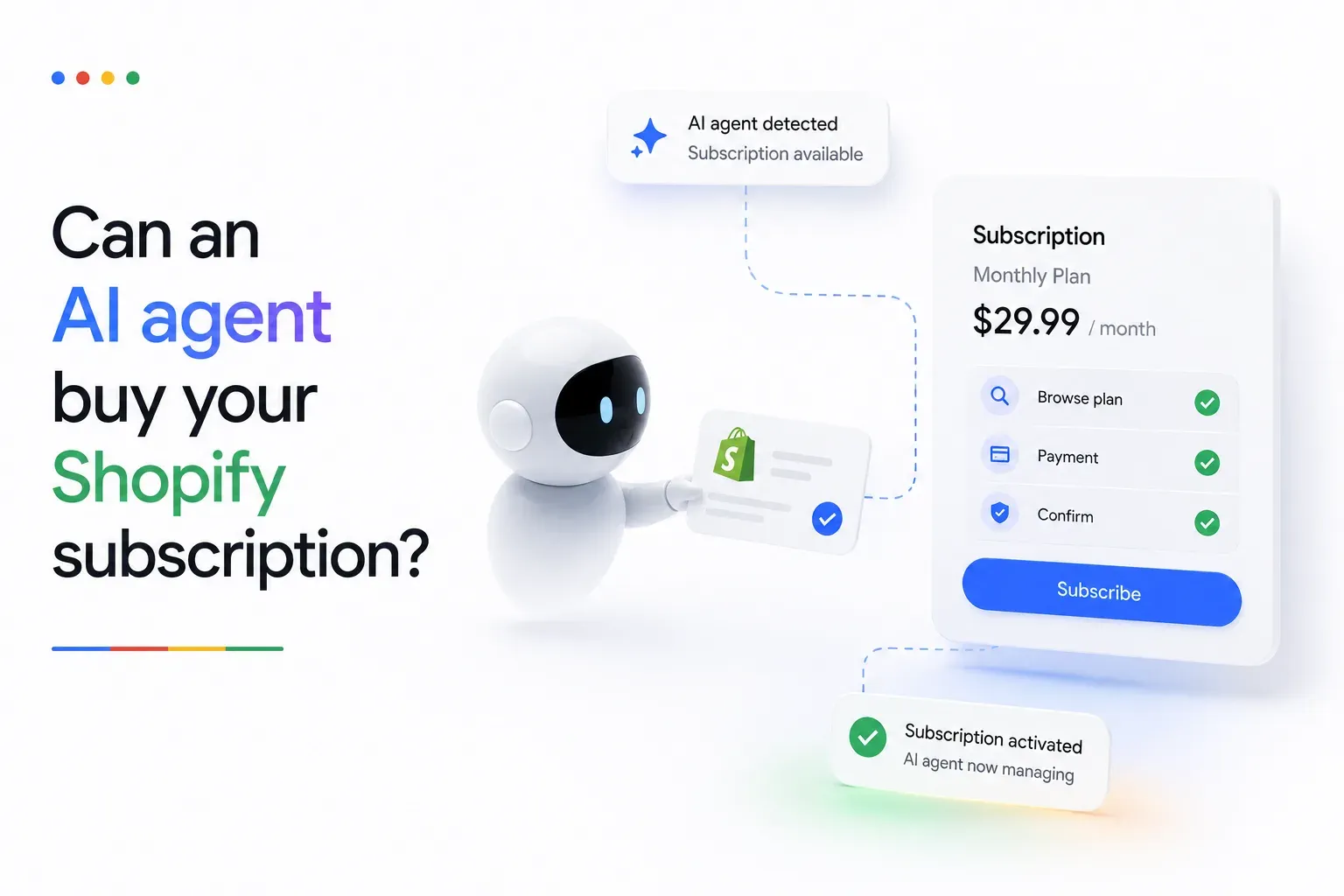
An AI agent can find your subscription product, read its selling plans and build a checkout session — but as of August 2026, it cannot complete the subscription purchase inside the assistant on any Shopify AI channel that documents a built-in checkout. All three channels with a Shopify-powered direct checkout — Google AI Mode and Gemini, Microsoft Copilot and Meta — list Subscriptions among the product types that checkout does not support, and the ChatGPT channel has no built-in checkout at all — Shopify calls it “a discovery-focused referrer platform” and sends customers to your online store checkout to buy.
You will read the opposite, including from Shopify. That contradiction is worth resolving before anything else, so we do it below — the short version is that the “yes” describes the protocol, and the “no” describes the checkout your buyer actually meets.
That single fact reorganises what a subscription merchant should do about agentic commerce, and it is not what most of the advice currently says.
Agentic traffic is real and growing quickly. On Shopify’s Q2 2026 earnings call, president Harley Finkelstein said AI-driven traffic and orders to Shopify stores had tripled year over year, while traditional search kept growing and held roughly a third of storefront sessions. But if that traffic cannot buy a subscription in the conversation, then the entire question for a subscription merchant becomes: what does the agent see, where does it send the buyer, and what does that buyer land on?
Quick answer: what an agent can and cannot do with your subscription
| Action | Can an agent do it today? | Where this is defined |
|---|---|---|
| Find your subscription product | Yes — automatically, by default | Shopify Catalog |
| See your selling plans and cadences | Only in the single-store catalog, not in cross-merchant discovery | Storefront Catalog extension |
| Build a cart with a selling plan on the line item | Yes, at the protocol level | Storefront Catalog extension |
| Complete the subscription inside the assistant | No on every channel Shopify documents | Google/Gemini, Copilot, Meta |
| Send the buyer to your checkout to subscribe | Yes — this is the actual path | ChatGPT channel |
| Pause, skip or cancel an existing subscription | Not through the protocol — no such capability exists | UCP reference |
Why you will read that subscriptions are supported
Search this question and you will find a confident yes, sourced — reasonably enough — to Shopify itself. Two sentences are doing most of that work:
- Shopify’s UCP page: “Discounts, loyalty programs, subscriptions, fulfillment options and terms are all supported by UCP so customers have what they need to convert.”
- Shopify’s 11 January 2026 announcement: customers “will be able to: submit discount codes, input loyalty credentials, select preferred subscription billing cadences, or confirm selling terms like final sale or pre-order timing in chat.”
Note the tense in the second one, and note what layer both are describing. They are statements about the protocol — what UCP is designed to be able to carry between an agent and a merchant — not about what any AI channel’s checkout accepts from a shopper today. Three things have to line up before someone can subscribe inside a chat window:
- The protocol has to model recurring purchases. The published UCP capability reference lists cart, catalog search, catalog lookup, checkout, order, payment and identity linking, with extensions for discounts, fulfillment, buyer consent and AP2 mandates. There is still no subscription capability and no subscription extension in it.
- The platform has to expose selling plans to agents. Shopify does — through the Storefront Catalog extension, covered in the next section but one. This is the step that genuinely works.
- The channel’s checkout has to accept a line item carrying a selling plan. Every channel whose limitations Shopify documents says it does not.
One of the three is true. That is the entire gap between “supported by UCP” and “supported in Google AI Mode’s checkout,” and it is why so much of the secondhand coverage lands on the wrong answer: the marketing sentence is quotable and indexed, while the limitation sits in a Help Center page three clicks down that no one links to.
The distinction matters practically, not just pedantically. UCP is a negotiation model, so a capability being expressible in the protocol tells you what may eventually be declarable — it does not tell a merchant what a buyer can do this quarter. Everything below is the second thing.
What actually changed, and when
Two things happened in 2026, and only one of them was announced loudly.
The protocol. Shopify published the Universal Commerce Protocol in January 2026, co-developed with Google and open to everyone. UCP is a negotiation model: a business publishes a machine-readable profile at /.well-known/ucp declaring which capabilities it supports, an agent publishes its own profile, and the two intersect. As covered above, the marketing describes UCP as covering subscriptions while the published capability reference defines none. Everything subscription-shaped that exists today is a platform-specific extension layered on top — which is exactly where Shopify put it.
The default. Shopify’s Help Center states plainly that “agentic storefronts is active by default for eligible stores,” and that eligible products are automatically included in Shopify Catalog with no action required. Every store also serves an agent-facing file at /agents.md — Shopify manages it by default and mirrors it to /llms.txt and /llms-full.txt — publishing your UCP discovery URL and MCP endpoint to any agent that asks.
So the honest summary is that your store was connected to this without a project, a launch, or a decision. What was not connected was your subscription offer.
Where your selling plan is visible — and where it isn’t
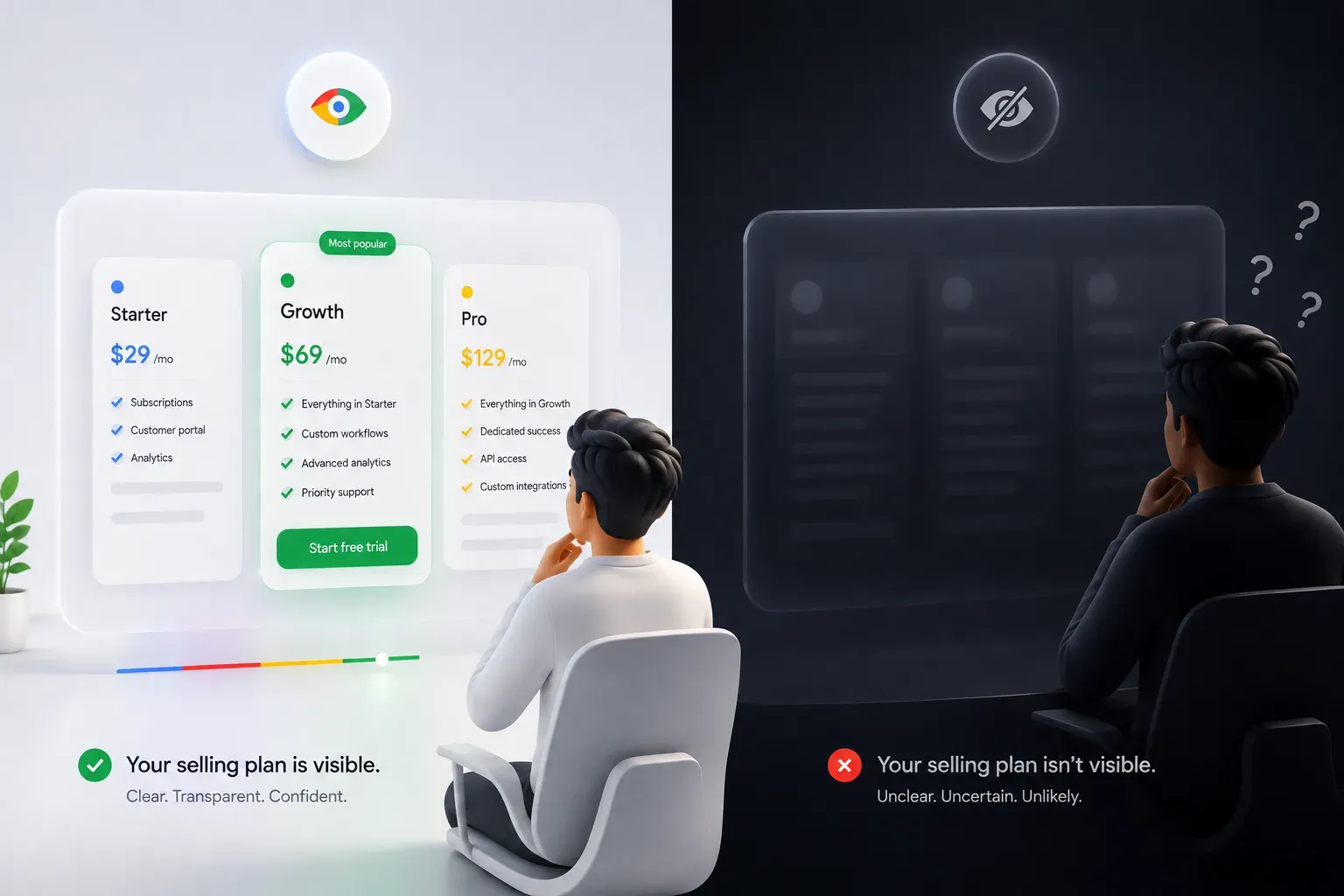
Shopify runs two catalog interfaces for agents, and the gap between them is the most consequential detail in this whole subject.
Global Catalog is cross-merchant. It is what an agent queries when a shopper says “find me a single-origin Ethiopian coffee under £20” — results are clustered across all Shopify merchants by a Universal Product ID. The Global Catalog extension adds inferred product attributes, tech specs, top features, unique selling points, condition labels, seller identity and an eligible.native_checkout flag. It documents no selling-plan fields whatsoever.
Storefront Catalog is scoped to one merchant. The Storefront Catalog extension adds, on each variant:
requires.selling_plan— “Whether a selling plan must be selected. When true, include aselling_plan_idon the checkout line item.”selling_plans— “Available purchase options (subscriptions). Only onget_productresponses — userequires.selling_planin search to detect availability.”checkout_url— a direct checkout URL for the variant.
Each selling plan carries id, name (Shopify’s own example is “Subscribe & save 15%”), group, a recurring boolean, description, options, and a price adjustment object.
Read those two paragraphs together and the shape of the problem appears:
Your subscription is legible to an agent that has already been pointed at your store, and invisible to the agent doing the comparison that decides which store to point at. And even within your own store, selling plans are absent from search results — an agent must fetch a specific product before it learns that a subscription exists at all.
This is the inverse of how most subscription merchants have built their acquisition. The subscribe-and-save offer is usually the reason to choose one roaster over another. In the discovery layer where that choice now increasingly happens, it is not one of the inputs.
Where the subscription sale actually completes
Shopify’s AI channels split into two behaviours, and a subscription merchant should treat them as two different businesses.
| Channel | Checkout | What happens to a subscription |
|---|---|---|
| ChatGPT | None — “a discovery-focused referrer platform”; customers are “redirected to buy products in your online store checkout” | Completes normally. The buyer reaches your PDP and your subscription widget |
| Google AI Mode and Gemini | Direct checkout in the conversation, on by default for eligible stores | Subscriptions listed as unsupported. The subscription cannot complete in-channel |
| Microsoft Copilot | Direct checkout in the conversation | Subscriptions listed as unsupported, alongside product bundles, customizable products and B2B-only products |
| Meta | Shopify-powered direct checkout on Meta surfaces, “such as shoppable ads on Instagram and Facebook” | Subscriptions listed as unsupported, with the same four exclusions as Copilot |
| Shop | Governed by your existing Shop channel settings | Governed by the same catalog eligibility |
| Perplexity — not one of Shopify’s documented agentic channels | “Instant Buy, a new feature built with PayPal as the payment method” | Shopify says checkout there “is handled through PayPal’s Instant Buy, not through Shopify’s checkout, so those orders are managed through PayPal rather than your Shopify admin.” A purchase that never passes through Shopify checkout cannot create a Shopify subscription contract |
The pattern is consistent across all three channels whose direct-checkout limitations Shopify documents in detail: the more capable the in-conversation checkout, the less likely it is to sell your subscription. Direct checkout is optimised for the simple, one-time, physically-shipped purchase. Subscriptions, bundles, and customisable products — which is to say build-your-own boxes and the rest of the interesting half of subscription commerce — sit on the unsupported list together, for the same underlying reason: they need state the conversation does not carry.
There is a second gate worth knowing about, on the protocol side. Shopify classifies agent traffic into three tiers — Token, Signed and Anonymous. Only a Token-tier agent whose credential “has been granted the required permission to complete purchases on the shop’s behalf” can call complete_checkout at all. Everything below that receives a checkout in a requires_escalation state and a continue_url, and Shopify’s guidance is explicit: “directing buyers to that URL is how checkout completes; you do not call complete_checkout.”
For most agents, most of the time, the endgame is a link to your storefront. The merchant of record is still you, and the conversion still happens on your page.
The consequence: your product page is now the subscription sales page
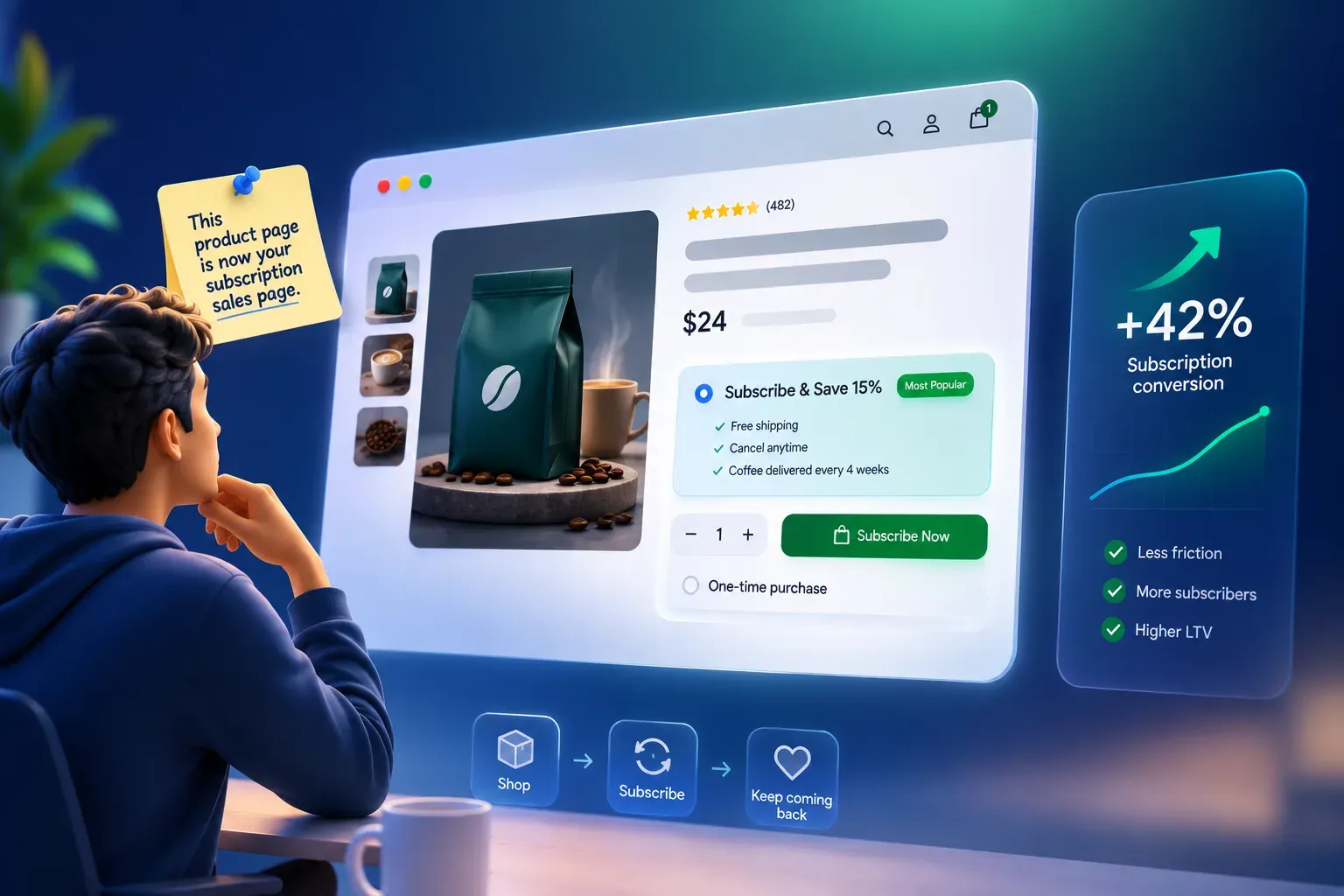
Half of AI-referred sessions land directly on a product detail page — 2.5 times the rate Shopify sees from traditional search. Finkelstein also noted that 75% of AI-attributed purchases in Q2 2026 happened outside the top 100 categories, which is the most encouraging sentence in this entire article if you are a small roaster: the long tail is where agent-referred demand is landing.
But it lands on the PDP. Not the homepage, not the quiz, not the “how our subscription works” page, not the carefully-built onboarding funnel. A visitor arriving from an agent has already had the comparison conversation somewhere else and shows up at the bottom of your funnel with the top of it skipped.
For a subscription merchant, that inverts a decade of practice. If your subscription proposition lives in a landing page, an email sequence, or a quiz that determines grind and cadence, an agent-referred buyer will never encounter it. The product page widget is not a conversion detail any more; it is the offer.
Three practical consequences follow:
- Everything that explains the subscription has to be on the product page, in text a machine can read before a human ever renders it. Cadence, quantity, what actually arrives, what it costs after any introductory discount, and how to skip or cancel. The specific facts to publish, and the structured data that carries a recurring price, are in getting your subscription offer cited by AI.
- A subscription-only variant is a dead end for an agent. If
requires.selling_planis true and the channel’s checkout does not support selling plans, the agent has nothing it can complete. A variant that can also be bought once gives it a purchasable object — and gives you a first order to convert. - Your introductory discount is now competing in a comparison you cannot see. Because the Global Catalog carries price but not selling-plan price adjustments, a “first bag 30% off, then £18” offer is likely being compared on the £18. Whether that is good or bad for you depends entirely on whether your one-time price is competitive.
Can an agent cancel a subscription? An honest answer
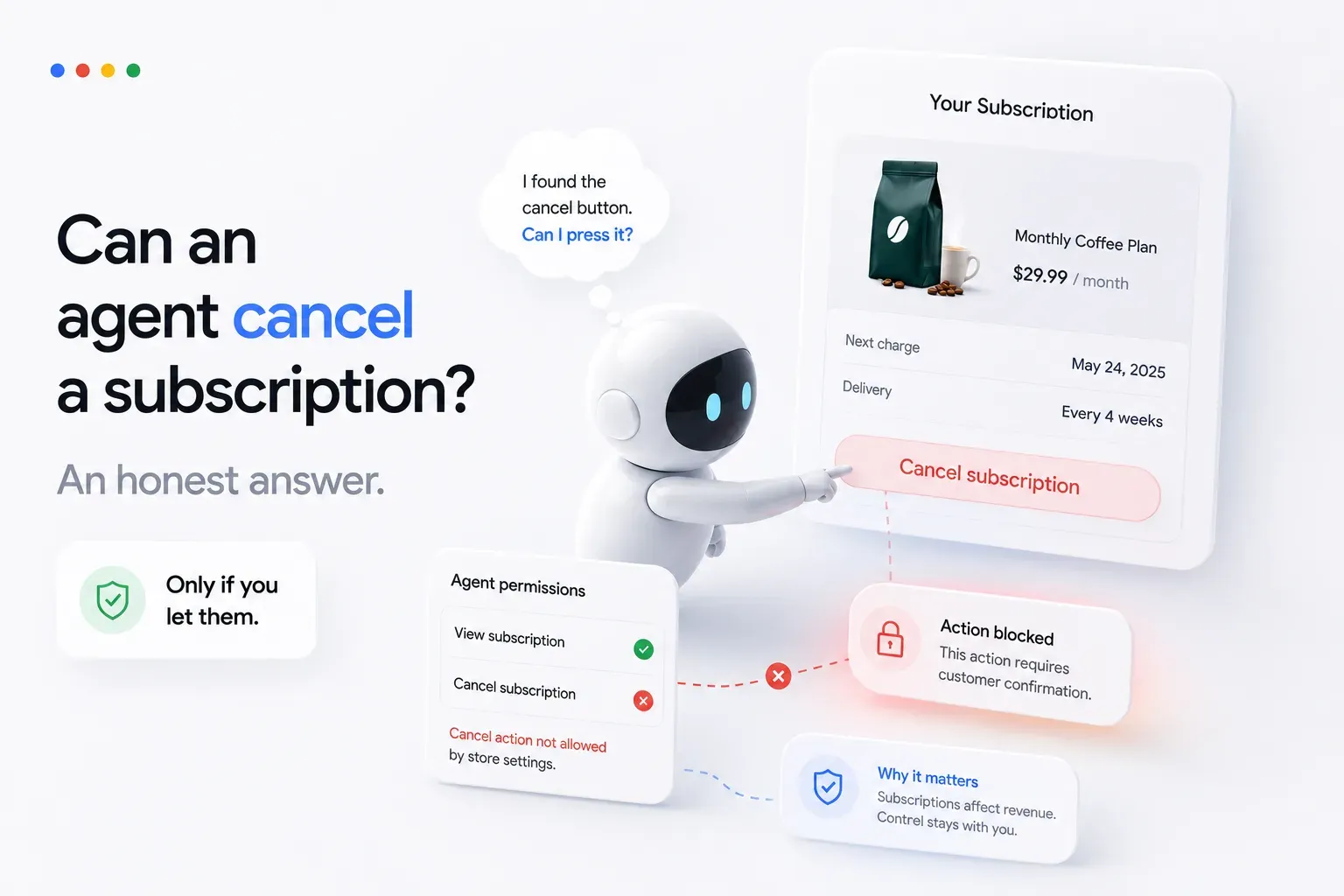
This is the question that gets the most alarming coverage and has the least evidence behind it, so it is worth separating what is documented from what is being asserted.
What is documented. There is no subscription-management capability in UCP. The order capability covers asynchronous order lifecycle updates — shipping, delivery, returns — not recurring contracts. An agent operating through the protocol cannot pause, skip, reschedule or cancel a subscription contract. Shopify’s order tools are also restricted to Token-tier agents holding the read_global_api_orders scope, and even then “order access is restricted to orders placed through your agent.”
What is plausible but unproven. A general-purpose agent driving your customer portal in a browser, the way a person would, needs no protocol support at all. Consumer-side services that cancel subscriptions and negotiate bills on a customer’s behalf already exist — Pine AI is the most visible, and the company says its agents have saved users roughly $400 on average, a claim it has not published a dataset behind. Note what those services actually target: telecoms, insurance, utilities, streaming — accounts with phone trees and retention departments, not a £16 monthly bag of coffee.
Meanwhile the standalone agentic browser has not settled into a habit. OpenAI retired ChatGPT Atlas less than a year after launching it, folding its browsing capabilities back into ChatGPT rather than continuing a separate product.
What we will not quote. A set of figures circulates widely on this topic — a “2.3x higher cancellation rate via agent than manual,” “34% of subscriptions agent-managed by 2027,” “61% of consumers would let agents manage subscriptions.” We traced all of them to a single vendor blog post that cites no study, dataset or source for any of the four. The direction they point in is defensible. The numbers are not evidence, and we are not going to launder them by repeating them with a link.
What we think, labelled as opinion. The regulatory drift is one-way even where the rules are unsettled: the FTC’s click-to-cancel rule was vacated by the Eighth Circuit in July 2025 on procedural grounds, and the Commission restarted the rulemaking with an advance notice in March 2026 while continuing to enforce under ROSCA. Cancellation is getting easier as a matter of law, independent of agents. Add software that can operate a portal on a customer’s behalf, and any retention that depends on the customer not getting around to cancelling has a visible expiry date. That is not a forecast about 2027 volumes; it is an argument for building retention that survives a zero-friction cancel button — which is the same argument the skip button and a real save flow were always making.
Making a subscription offer legible to an agent
Eight steps, in the order we would do them. None of them requires an agentic-commerce strategy; they are ordinary merchandising and data hygiene aimed at a reader that happens to be software.
- Read your own agent-facing files. Open
/agents.md,/llms.txtand/.well-known/ucpon your own domain. That is the description of your store every agent receives, including your UCP discovery URL and MCP endpoint. Most merchants have never looked at it. - Set your channel and direct-checkout preferences deliberately. In Shopify admin,
Sales channels > Agenticlets you choose, per channel, whether you sell there and whether direct checkout is on. For a subscription-led store there is a real case for turning direct checkout off, because a redirect to your checkout is the only path on which a subscription can actually complete. - Give subscription-only variants a purchasable path. A variant flagged
requires.selling_planhas nothing an in-channel checkout can complete. Add a one-time option, or accept that the channel’s role for that product is referral only. This is a genuine trade-off — a one-time option can cannibalise signups — so decide it against where your acquisition really comes from. - Move the subscription value into product data. Cadence, quantity, what arrives, and the skip/cancel terms belong in the product title, description and options, not only in a widget. Anything living in metafields or metaobjects can be surfaced through Shopify Catalog Mapping.
- Rebuild the product page as the subscription sales page. Assume the buyer arrives here first and has read nothing else. Server-rendered text, not a script that populates after load.
- Mark up recurring pricing in structured data. Schema.org’s
UnitPriceSpecificationcarriesbillingDurationandbillingIncrement, which exist precisely to model subscription and payment-plan pricing. That makes “£18 every four weeks” machine-readable instead of implied by the phrase subscribe and save. - Report agentic traffic as its own channel. Shopify’s agentic dashboard breaks out sessions, orders and conversion per AI channel. The number to watch is subscription attach rate on agent-referred sessions versus everyone else — if it is materially lower, your PDP is the reason, and that is fixable. The rest of the measurement discipline is in subscription analytics.
- Remove retention that depends on friction. Audit the cancellation path and assume it will eventually be operated by software. Replace obstacles with alternatives: skip, pause, change cadence, change size — the mechanics in reducing subscription churn.
A decision framework, by what you sell
Agentic exposure is not one decision. It depends on how your catalogue is built.
If you sell the same product one-time and on subscription — most coffee roasters, most supplements — you are in the best position. Leave discovery on, leave direct checkout on where you like, and treat agent-referred one-time orders as the top of a funnel you already know how to convert. The first bag is the acquisition; the subscription is the follow-up.
If your subscription is the only way to buy — clubs, curated-only boxes — direct checkout does nothing for you and a redirect is your only completing path. Prioritise the PDP and the customer portal, and consider adding a one-time entry product specifically so agents have something to sell.
If your subscription is configured, not chosen — build-your-own boxes, quizzes, grind-and-roast preferences — you are the furthest from agent-completable, because “customizable products” sit on the unsupported list next to subscriptions. Your realistic goal is to be found, then to make the configuration step fast enough to survive a visitor who arrived mid-funnel with no context.
If you sell B2B recurring orders — B2B-only products are excluded from agentic storefronts outright. Nothing to do here yet, which is itself worth knowing before someone builds a plan around it.
How Curobi thinks about this
Curobi is a Shopify subscription app, so treat this section as a vendor describing its own product rather than neutral advice.
The practical implication of everything above is that the subscription offer has to be legible on the product page — in markup, in text, in structured data — rather than assembled by JavaScript after a human arrives. That is a design constraint on a subscription widget, not a feature: what the widget renders is what an agent, a crawler and an answer engine can read about your offer. It is the same constraint answer-engine optimisation has always imposed, arriving from a new direction — and what the widget has to make legible is the selling plan behind the offer.
The second implication is retention. If the cancel button trends toward zero friction — by regulation, by platform design, or eventually by software acting for the customer — then the save flow, the skip, and the ability to change cadence or size without talking to anyone stop being nice-to-haves and become the whole retention strategy. We wrote about the mechanics of that in why coffee subscribers quit in month three, well before agents were the reason.
We are not going to claim Curobi makes you visible to AI agents. Nobody’s subscription app does that today, because the field that would carry your selling plan into cross-merchant discovery does not exist yet in Shopify’s Global Catalog. What is real is the work in the eight steps above, and most of it is yours to do on your product pages.
Frequently asked questions
Can an AI agent buy a Shopify subscription?
Not inside the assistant, on any channel Shopify documents. An AI agent can discover a subscription product, retrieve its selling plans and build a checkout session, but all three Shopify AI channels with a Shopify-powered direct checkout — Google AI Mode and Gemini, Microsoft Copilot, and Meta — list Subscriptions among the product types that checkout does not support. The ChatGPT channel does not have a built-in checkout at all: Shopify describes it as a discovery-focused referrer, and customers are redirected to buy in your online store checkout. You will also read that subscriptions are supported, because Shopify’s own UCP marketing says they are: that is a claim about what the protocol is designed to carry between an agent and a merchant, not about what a channel’s checkout accepts from a shopper, and the published UCP capability reference still defines no subscription capability and no subscription extension. So a subscription sale that starts in an assistant finishes on your storefront, in your own checkout, with your own subscription widget. That is the answer as of August 2026, and it is the reason the product detail page now matters more than the landing page.
Do AI agents see my subscribe-and-save option?
It depends on which catalog the agent is using, and the difference is significant. Shopify’s Storefront Catalog extension — the single-merchant interface an agent uses when it already knows your store — exposes a selling_plans array on variants with the plan id, name, group, description, options, price adjustment and a recurring flag, plus a requires.selling_plan boolean. Shopify’s Global Catalog extension, which is the cross-merchant discovery surface where a shopper says “find me a coffee subscription,” documents no selling-plan fields at all. In practice that means your subscription offer is legible once an agent is pointed at your store, and invisible in the comparison layer where the shopper is choosing between merchants.
Is my Shopify store already exposed to AI agents?
Almost certainly yes, without any action on your part. Shopify’s Help Center states that agentic storefronts is active by default for eligible stores, and that products reach AI channels through Shopify Catalog, which eligible products are automatically included in. Every store also serves an agent-facing description at /agents.md — Shopify manages that file by default and mirrors it to /llms.txt and /llms-full.txt — which publishes your Universal Commerce Protocol discovery URL and MCP endpoint. You can manage individual channels under Sales channels > Agentic in your admin, turn direct checkout off per channel, or deactivate Shopify Catalog access entirely, in which case Shopify says it can take up to seven days before your product data stops being shared.
Can an AI agent cancel a customer’s subscription?
Not through Shopify’s agent protocol, because no such capability exists in it. The published Universal Commerce Protocol reference lists cart, catalog search, catalog lookup, checkout, order, payment and identity linking capabilities, with extensions for discounts, fulfillment, buyer consent and AP2 mandates. There is no subscription capability and no subscription-management capability, so an agent cannot pause, skip, reschedule or cancel a subscription contract through the protocol. What can happen instead is a general-purpose agent driving your customer portal in a browser the way a person would. Consumer-side services that cancel subscriptions and negotiate bills on a customer’s behalf already exist, but they are currently pointed at phone-and-email accounts like telecoms and insurance rather than at physical-goods D2C, and the standalone agentic browser has not settled as a mainstream habit — OpenAI retired ChatGPT Atlas in August 2026, folding its capabilities back into ChatGPT.
Should I stop requiring a selling plan on my subscription products?
If a variant can only be bought on a selling plan, consider adding a one-time purchase option, because a subscription-only variant has no path to completion in an AI channel’s built-in checkout. Shopify’s Storefront Catalog extension marks these variants with requires.selling_plan set to true, and the direct-checkout channels list subscriptions as unsupported, so an agent that reaches a subscription-only variant has nothing it can complete in the conversation. A variant that can also be bought once gives the agent a purchasable object and gives you a first order to convert into a subscription afterwards. The trade-off is real and it is yours to weigh: adding a one-time option can cannibalise subscription signups from buyers who would have subscribed, which is why this is a decision about where your acquisition actually comes from rather than a default to apply blindly.
Related reading
- How to get your subscription offer cited by AI — what to do about the catalog asymmetry described above: the facts to publish, the schema worth emitting, and how to audit it
- Shopify subscription analytics: what to measure, and how to calculate it — including how to report a new channel without corrupting your churn baseline
- The skip button is your best retention tool — retention that does not depend on friction
- Build-your-own-box subscriptions on Shopify — the model furthest from agent-completable, and why that is survivable
- How to run a coffee subscription on Shopify — the operator guide underneath all of this
- Selling plan and subscription contract — the two Shopify objects this article turns on
Every Shopify capability described here was verified against Shopify’s developer documentation, Shopify’s Help Center — including the Google AI Mode and Gemini, Microsoft Copilot and Meta channel pages — and the published UCP specification on 20 August 2026. Agentic commerce is moving quickly; where a claim depends on a documented limitation, the link goes to the page that documents it so you can check whether it still holds.