
How to raise subscription prices without losing subscribers

Raising the price of an existing Shopify subscription is two jobs, and merchants usually plan only the second. The persuasive job is the email, the reasoning and the offer of an alternative. The technical job is that on Shopify, editing a selling plan price changes nothing for anyone who is already subscribed: Shopify’s documentation states that “subscription contracts are detached from the original selling plan” and that “updates to the original selling plan don’t modify pre-existing subscription contracts.” The new price applies to new checkouts. Moving existing subscribers is a separate, per-contract edit that your subscription app has to perform — and that edit, not the plan change, is what needs notice, a reason and a measured follow-up.
Get those two backwards and one of two things happens. Either you announce a price rise that never actually takes effect and quietly keep billing the old amount, or you edit contracts first and let subscribers discover the new number on a card statement. The second one is how a repricing becomes a cancellation wave.
This is written for coffee roasters, because coffee is where the pressure is sharpest right now, but the mechanics apply to any Shopify subscription.
Quick answer: what each kind of price edit actually changes
| What you edit | Who it affects | What existing subscribers pay |
|---|---|---|
| The selling plan’s price or subscribe-and-save discount | New checkouts only | No change — their contract is detached from the plan |
The currentPrice on a subscription contract line | That one subscriber | The new price, from their next billing attempt |
| A single upcoming billing cycle | That one subscriber, once | A one-off amount for that cycle only |
| Deleting or replacing the selling plan | New checkouts only | No change — the contract survives the plan |
| The product’s own price in Shopify | New checkouts only | No change — the contract holds its own line price |
The pattern is consistent: on Shopify, price lives on the contract, not on the plan or the product. The contract line carries its own currentPrice, described in the Admin API as “the price per unit for the subscription line in the contract’s currency.” Nothing upstream of that field reaches an existing subscriber.
Why coffee subscriptions are repricing in 2026
The cost relief roasters were promised this year has largely evaporated.
Arabica “C” futures set an all-time record above $4.40/lb in February 2025, a level Perfect Daily Grind described at the time as a new era for coffee. On 20 August 2026 they were trading at about $3.28/lb, roughly 12% below where they stood a year earlier (Trading Economics, retrieved 20 August 2026).
The dip in between is the part that matters, because a great deal of 2026 planning was done during it. The International Coffee Organization’s composite indicator fell to 231.96 US cents/lb on 9 June 2026 — “the lowest level in nearly two years” — and then rebounded 17.4% within the same month, reaching 272.39 cents/lb by the end of June (ICO Coffee Market Report, June 2026). The ICO attributes the reversal to Super El Niño concerns and above-average rainfall slowing Brazil’s harvest. US certified arabica stocks fell 13.3% across the month to 0.41 million bags, the lowest since February 2024.
For scale on the same index: the ICO composite averaged 135.34 US cents/lb across 2007–2018, and 107.25 cents/lb in coffee year 2019/20 (ICO Coffee Market Report, September 2020). Green coffee in mid-2026 is running at roughly twice the level roasters wrote their existing price lists against.
The trade press has caught up with what that means at the counter. Perfect Daily Grind reported in April 2026 on roasters turning the price increase itself into communication — New York’s Sey Coffee itemising tariff surcharges inside its pricing details, others publishing farmgate or FOB figures to show where the money went.
A correction worth recording: the common 2026 read — that green coffee fell steadily through the first half of the year and settled somewhere near its June low — describes a single week. The ICO composite bottomed on 9 June and gained 17.4% before the month was out. Anyone building a price list off the June figure is planning off a number that no longer exists; check the front month on the day you build the model.
Why a subscription price rise is harder than a shelf price rise
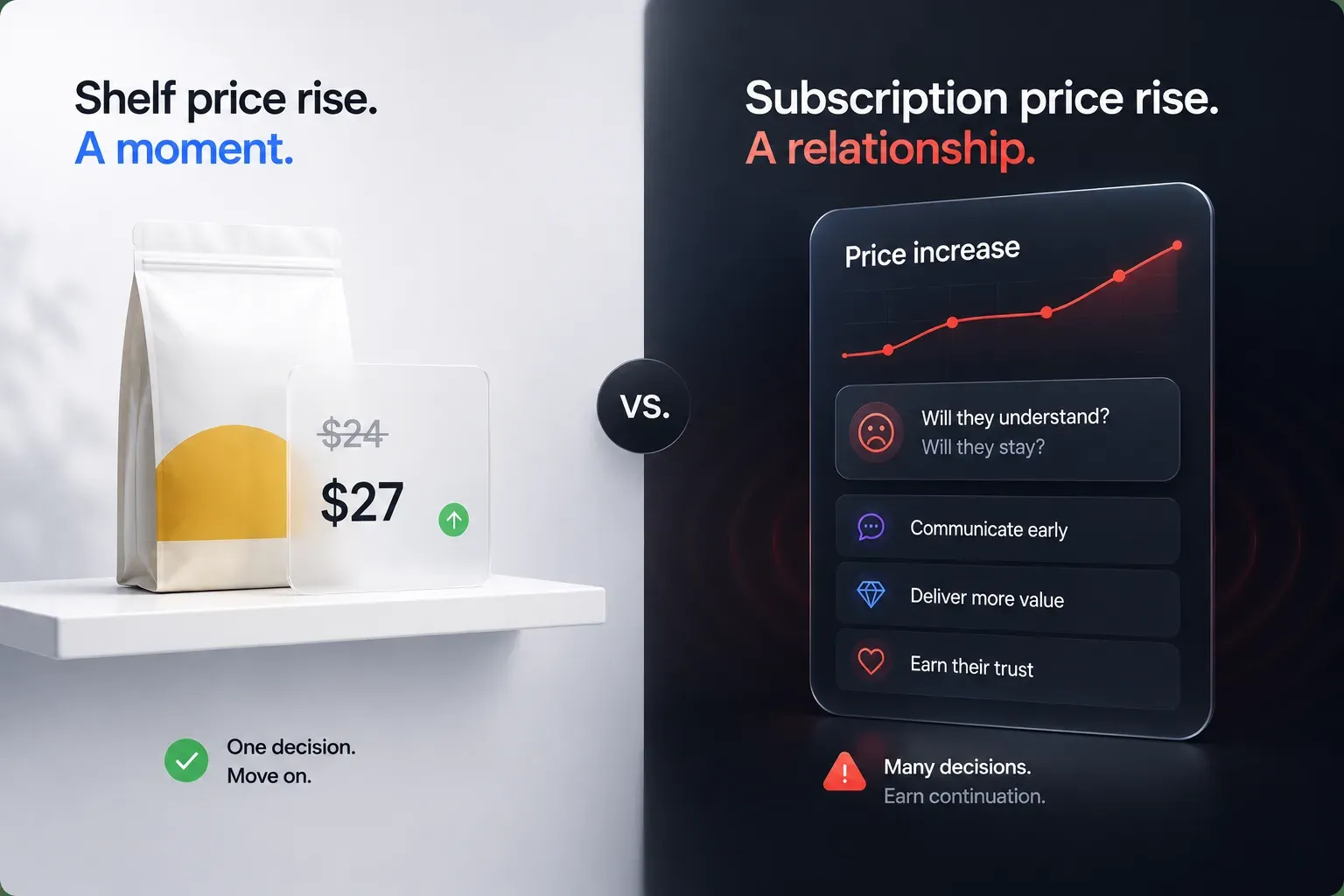
Three structural differences, and they compound.
The customer has a reference price they explicitly agreed to. A shelf price is a fact about the shop. A subscription price is a term of an arrangement the customer consented to, on a specific date, at a specific number. Changing it is changing a deal, and it is processed as such.
The cancel button is already open. A supermarket shopper who dislikes the new price has to remember to buy elsewhere next time. A subscriber can act on the feeling immediately, from the email, in one click — and increasingly must be able to, by law. Price is already the single most-cited cancellation reason in subscription commerce: LoopWork’s April 2026 analysis across 1,000-plus DTC Shopify brands, drawing on Chargebee’s retention benchmarks, put price at 31% of stated cancel reasons, ahead of product piling up (16%) and wanting more variety (15%) — the mix we go through in the skip button is your best retention tool.
The reason you give determines whether it is accepted. This is the best-evidenced part of the whole subject and the part most price-increase advice skips. Kahneman, Knetsch and Thaler’s 1986 study of community fairness standards — Fairness as a Constraint on Profit Seeking: Entitlements in the Market, American Economic Review 76(4) — found that in customer markets “it is acceptable for a firm to raise prices (or cut wages) when profits are threatened, and to maintain prices when costs diminish,” while “it is unfair to exploit shifts in demand by raising prices.”
Two things follow directly for a roaster. First, a price rise framed as our green coffee cost went up sits inside what people judge fair; the same rise framed as we’re repositioning as a premium brand does not. Second — and this is the one nobody plans for — the same research says holding your price when costs fall is also judged acceptable. You do not owe your subscribers a decrease the moment the C market dips, and you are not breaking an implicit bargain by not offering one. That is worth knowing before you promise a review in six months you may not want to honour.
What Shopify does, and doesn’t do, when you change a price
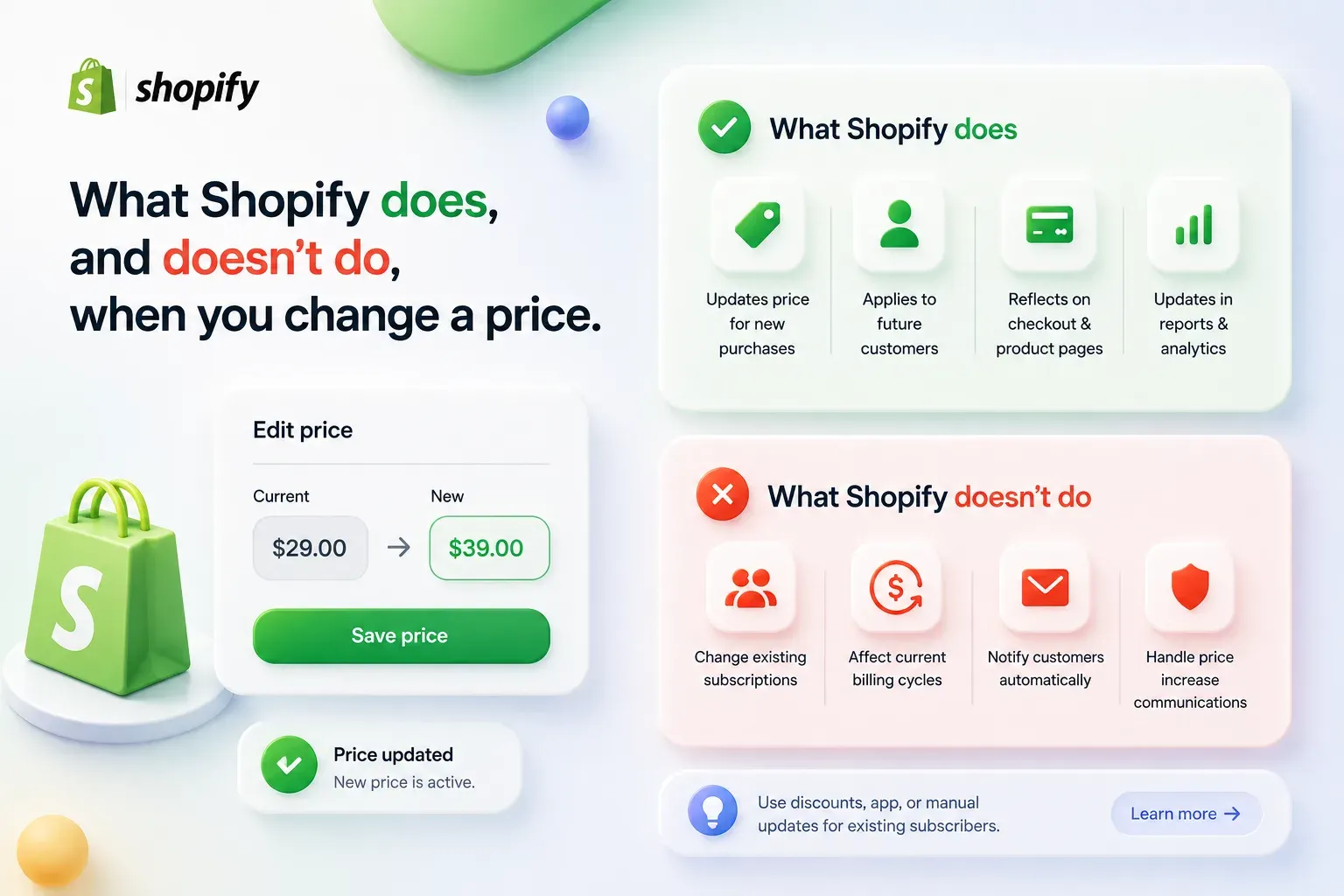
Editing the plan is not editing the subscriber
Worth restating because it is the trap: a subscription contract is created at checkout from a selling plan and then goes its own way. Shopify’s guidance is explicit that updates to the selling plan do not modify pre-existing contracts. Practically, that means the clean way to introduce a new price is to build a new selling plan at the new price and leave the old one alone — not to overwrite the old plan, which changes nothing for existing subscribers while destroying your record of what they actually agreed to.
Repricing an existing subscriber is an app-level contract edit
To change what a current subscriber pays, something has to write a new currentPrice onto their contract line. Shopify exposes two routes for apps:
- The subscription draft flow:
subscriptionContractUpdatecreates “a draft of an existingSubscriptionContract” that “captures the current state of the contract and allows incremental modifications,” which the app then edits withsubscriptionDraftLineUpdate— whose input object carriescurrentPrice,quantity,productVariantId,sellingPlanIdandpricingPolicy— and finalises withsubscriptionDraftCommit. - The newer subscription calculation API, documented in update a subscription contract: submit the changes to
subscriptionContractUpdateCalculate, review the calculated result — Shopify notes that “a successful calculation can contain warnings” identifying “disabled currencies, delivery configuration problems, or other existing contract data that Shopify preserved instead of blocking the update” — then apply withsubscriptionContractCalculationCommit.
Both are app operations. Which one you get, whether it can run in bulk, and whether it is exposed in the admin at all depend entirely on your subscription app. Check this before you announce anything. If your app can only edit contracts one at a time through a merchant UI, a 900-subscriber repricing is a week of clicking, and that constraint should shape your plan rather than surprise you halfway through it.
Shopify’s own Subscriptions app is a case in point. Its Help Center documentation for managing subscription contracts describes editing the products, the product quantity and the delivery frequency of a contract, along with skipping an upcoming order and pausing, resuming or cancelling it. Editing the price of an existing contract is not among the documented merchant actions.
One-cycle changes are a separate, useful tool
Shopify also supports editing a single billing cycle without touching the contract behind it. A billing cycle contract “inherit[s] the contract lines, pricing policy, and delivery policy from the billing cycle’s source subscription contract,” and committing an edit “applies the edit to the targeted cycle only. It doesn’t change the source contract or other cycles” (manage billing cycle contracts). Contract-level attributes such as the billing policy, delivery policy and payment method cannot be changed this way, and prepaid contracts and past cycles are out of scope.
That is exactly the shape of a goodwill gesture: hold the first order after the increase at the old price, or apply a one-cycle credit, without creating a second permanent price tier you then have to maintain forever.
Selling plans can also schedule a price step for new subscribers
For new signups, SellingPlanRecurringPricingPolicy carries an afterCycle field — “cycle after which this pricing policy applies” — so an introductory rate that steps up at a stated cycle can be encoded in the plan itself and disclosed at checkout. That is a much better structure than an open-ended discount you later have to withdraw by hand, because the customer agrees to the step-up when they subscribe.
The repricing sequence
Eight steps, in the order we would run them. Steps 1–5 are the ones that decide the outcome.
- Decide what actually has to change. There are four levers — headline price, pack size, delivery cadence, and the subscribe-and-save discount — and they are not interchangeable. Trimming the subscription discount from 15% to 10% raises what subscribers pay without changing your retail price, but it also weakens the reason they subscribed. Lengthening the default interval from every two weeks to every three reduces the annual bill without touching the unit price at all, and often fixes a “too much coffee piling up” problem at the same time.
- Decide who the new price applies to. New subscribers only, everyone, or everyone after a grandfather window. This is the decision that sets both the cost and the risk, and once notices are out it cannot be walked back quietly.
- Build the new price as a new selling plan. Leave the old plan in place and unedited, so you retain a record of what existing subscribers agreed to.
- Set the effective date, then count backwards to the notice date. Start from the first billing date the new price applies to. Subtract the notice period, then subtract your billing cutoff buffer so nobody receives a notice after their charge has already been queued.
- Send the notice before any contract is edited. Old price, new price, the date, the reason, and a working link to manage or cancel. Send it as a deliberate campaign from the store rather than relying on an app’s transactional templates — you want control of the wording, and most subscription apps do not fire a “your price changed” email on a contract edit at all.
- Edit the contracts — or don’t. If you are moving existing subscribers, run the contract edits after the notice period has elapsed. If you are grandfathering, this step does not exist: the new plan simply governs new checkouts.
- Watch the first two billing cycles as a cohort. Tag the affected contracts before you touch them. Compare cancellations, skips and failed payments in the two cycles after against the two before.
- Compare the loss against your break-even loss. Not against zero. The share of subscribers you can lose while still holding revenue flat is the price increase divided by one plus the price increase, and the gross-profit version of that number is considerably more forgiving. Both are worked out in the measurement section below.
Grandfathering: three options, priced
| Option | What it means | What it costs you | Where it fits |
|---|---|---|---|
| Permanent | Existing subscribers keep the old price indefinitely | A second price tier forever, in every report, discount rule and future app migration | Small legacy cohort, strong founder-customer relationship, increase driven by growth rather than survival |
| Time-boxed | Old price held for a stated number of cycles, then the new price applies | One quarter or so of forgone increase, and a second notice at the end of the window | The default for most roasters — most of the goodwill, none of the permanent split |
| None | Everyone moves on the same date | Highest short-term churn risk | When the cost increase is large enough that a legacy tier defeats the purpose — pair with longer notice and a real alternative |
One warning that comes from the migration side of the business rather than the pricing side: grandfathered pricing is one of the hardest things to reproduce if you ever change subscription apps. Legacy rates live on individual contracts, not on plans, so they have to be rebuilt deliberately on the new platform and verified subscriber by subscriber — the risk we set out in switching subscription apps without losing subscribers. Every permanent legacy tier you create is a permanent line item in a future migration.
How much notice, and what the rules require
Thirty days plus one full billing cycle is a defensible default for a monthly subscription. But in some markets the notice window is a legal requirement with an upper bound as well as a lower one, which surprises merchants who assume more notice is always safer.
California. The Automatic Renewal Law, as amended by AB 2863, requires that “in the case of a change in the fee charged under an existing automatic renewal or continuous service offer that has been accepted by a consumer in this state… the business shall provide, no less than 7 days and no more than 30 days before the fee change takes effect, the consumer with both of the following: (A) A clear and conspicuous notice of the fee change. (B) Information regarding how to cancel in a manner that is capable of being retained by the consumer.” The amendments apply to contracts entered into, amended or extended on or after 1 July 2025. Two practical consequences: a notice sent 45 days ahead does not satisfy the requirement on its own, and the cancel path has to be in the notice, not merely available somewhere.
United States, federally. The FTC’s click-to-cancel rule was vacated by the Eighth Circuit in July 2025 on procedural grounds, and the Commission restarted the rulemaking with an advance notice in March 2026 while continuing to enforce under ROSCA. The direction of travel — clearer disclosure, easier cancellation — is not in doubt even where the specific rule is.
United Kingdom. The subscription contracts regime under the Digital Markets, Competition and Consumers Act 2024 has been pushed back again: after the government’s April 2026 announcement on secondary legislation, commencement is now expected in spring 2027. It will bring statutory reminder notices and cooling-off requirements. Nothing about it makes an unannounced price change safer in the meantime.
This is a description of published rules, not legal advice. Confirm your own obligations for the markets you sell into — and note that Shopify adds a purchase options cancellation policy to your store automatically when you set up subscriptions, which is the document your price-change terms should be consistent with.
Should you shrink the bag instead?
The advice to reduce the pack size rather than raise the price is common and, for a subscription, close to backwards. The research splits cleanly, and the split is the whole answer.
Downsizing works because people don’t notice. Janssen and Kasinger analysed a decade of US retail scanner data — roughly four million products across as many as 50,000 US stores, 2010–2020 — and report that “product downsizing typically occurs without a corresponding decrease in price,” so “consumers end up paying more per unit volume,” and that “consumers are more responsive to price adjustments than to changes in product size” (Janssen & Kasinger, Shrinkflation and Consumer Demand, Marketing Science 45(1):142–158, 2026; open-access copy). The size of that asymmetry, as reported in coverage of the study, is roughly two to one: a benchmark sales-weighted price elasticity of −1.19 against a pooled size elasticity of 0.56. Downsizing is an effective margin strategy, and it rests on shopper inattention.
Downsizing is judged more unfair than the equivalent price rise once it is noticed. Evangelidis, in Marketing Science 43(2) (2024), ran five preregistered experiments and found that “whereas the vast majority of people judge price increases in response to cost increases as fair, this pattern is attenuated — or even reversed — for product downsizing,” and that the effect is “predominantly driven by consumers’ beliefs that product downsizing (versus price increases) is a deceptive practice.” The two moderators he identifies are the transparency of the change and the presence of a genuine cost increase (Evangelidis, Frontiers: Shrinkflation Aversion, Marketing Science 43(2), author copy).
Now apply both to a coffee subscription. Your subscriber receives the same bag from the same roaster on a schedule and compares it against the last one. They have a shelf, a grinder, a routine, and often a dose they weigh. A subscription systematically removes the inattention that makes downsizing work, while leaving intact the deception judgement that makes it backfire. That is the worst combination available.
The verdict: for an existing subscription, raise the price rather than shrink the bag. If you genuinely need a smaller pack — because a 250g bag is more coffee than a single-cup household gets through before it goes stale — then introduce it as a new, clearly labelled option at a lower price, announced as a choice, and let subscribers move to it. That satisfies both of Evangelidis’s moderators. Quietly moving 250g to 227g at the same price satisfies neither.
The notice email
Not a template to copy. The components, and why each is there.
- The number, twice. Old price and new price, side by side, in the first two lines. Not “a small adjustment.” If a subscriber has to open a spreadsheet to work out what changed, you have already lost the fairness argument.
- The date it takes effect, expressed as the billing date they will recognise, and where the notice window has an upper bound, sent inside it.
- The reason, specific and costed. “Our green coffee cost has risen” is weak. “The lots we buy have gone from X to Y per kilo since our last price change” is what the fairness research says people actually accept. If you publish FOB or farmgate figures, this is where they earn their keep.
- What is not changing. Same roaster, same origins, same weight, same cadence. Loss aversion runs in both directions; naming the things that are staying put reduces the sense that the whole arrangement is being reopened.
- The alternatives, before the cancel link. A smaller pack, a longer interval, a pause. Most of the people about to cancel over price are solving a “too much coffee, too expensive” problem that a cadence change solves better — the argument in why coffee subscribers quit in month three.
- A working cancel or manage link. Include it. Withholding it does not save the subscriber; it converts a cancellation into a chargeback, and where the California rule applies it is required in the notice anyway.
- No discount code. Attaching a save offer to the announcement teaches your base that the published price is negotiable and invites everyone to ask. Hold save offers for the cancellation flow, where they are aimed at the people actually leaving.
Send it once, then send a short reminder a few days before the first affected charge. Anyone who reads only one of the two should still not be surprised by their bank statement.
How to measure whether it worked
Judge the outcome against the loss you could afford, not against zero.
Revenue-neutral loss. If you raise the price by a proportion D, revenue holds flat if you lose no more than D ÷ (1 + D) of your subscribers.
| Price increase | Revenue-neutral subscriber loss | Gross-profit-neutral loss at 50% margin | At 35% margin |
|---|---|---|---|
| +5% | 4.8% | 9.1% | 12.5% |
| +10% | 9.1% | 16.7% | 22.2% |
| +12.5% | 11.1% | 20.0% | 26.3% |
| +15% | 13.0% | 23.1% | 30.0% |
| +20% | 16.7% | 28.6% | 36.4% |
Gross-profit-neutral loss is the more honest number, because a subscriber who leaves takes their green coffee, packaging and shipping with them. If m is your gross margin on the old price, gross profit holds flat up to a loss of D ÷ (m + D). That is the arithmetic behind the last two columns — our calculation, not a benchmark, and it assumes unit cost of goods is unchanged.
The practical point: a 12.5% increase that costs you 8% of subscribers looks like a disaster in a churn report and is a clear gross-profit win. Reporting it only as churn will make you reverse a decision that worked.
How to run the measurement. Tag the affected contracts before the change, then track the cohort for two full billing cycles — the price-change cohort is its own thing and will corrupt your baseline churn rate if you leave it mixed in. Split the loss two ways:
- Voluntary — people who chose to leave. This is the price signal.
- Involuntary — failed payments. A price rise inflates these mechanically, because a higher charge is more likely to breach a card limit or a balance, and because some subscribers respond by killing the payment method rather than cancelling. Failures in the weeks after a repricing are not all price rejections, and treating them as such will overstate the damage. The recovery mechanics are in recovering failed subscription payments.
Both splits, and the cohort view that makes them readable, are defined in Shopify subscription analytics. If your reporting cannot separate a cancelled contract from a failed one, fix that before the repricing, not after.
A decision framework
If your cost increase is under about 10% and your margin has room — hold the price and take the margin hit this cycle, then reprice new subscribers only via a new selling plan. Attrition moves the base for you over 12–18 months at no announcement cost. This is the cheapest option and it is under-used.
If you need 10–20% from the existing base — time-boxed grandfathering, 30 days’ notice, cadence and pack-size alternatives offered in the notice, contract edits after the window. This is the standard play.
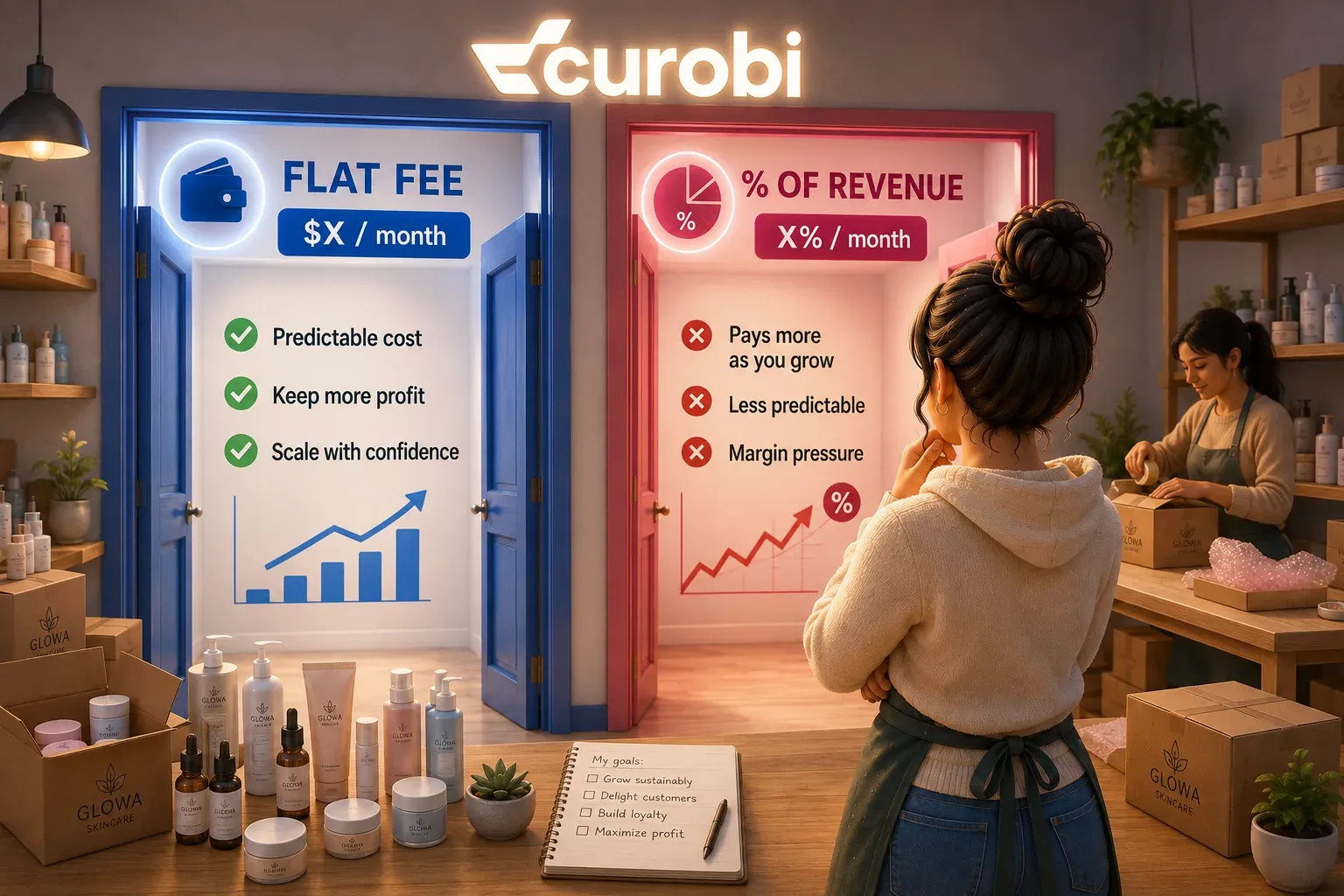
If you need more than 20%, or your unit economics are underwater — the price is not the only thing that is wrong. Shipping economics and discount dependency destroy more coffee-subscription margin than the green price does, and they are covered in why UK coffee subscriptions are hard to run profitably. Fix the structural leaks in the same pass, or you will be back here in six months. While you are counting costs, a percentage-of-revenue subscription app quietly takes a share of the increase you just fought for — the arithmetic is in flat fee vs percentage of revenue.
If churn is already elevated before the increase — deal with that first. A price rise applied to a base that is already leaving produces a number you cannot interpret, because you will not know which loss was which. The playbook is how to reduce subscription churn.
How Curobi fits
Curobi is a Shopify subscription app, so read this as a vendor describing its own product rather than neutral advice.
Repricing exposes three things about whatever app you run, and they are worth checking against any vendor including this one. Can it edit contract prices in bulk, or only one at a time? Can you segment and tag a cohort before the change so the measurement is possible afterwards? Does the customer portal let a subscriber switch to a smaller pack or a longer interval themselves, at the moment they open the notice email — or does every alternative route through your inbox?
That last one does most of the work. The subscriber deciding what to do about a price increase is making the decision in the ninety seconds after they read the email. If the only two buttons available are accept and cancel, some share of the people who would have happily moved to a three-weekly cadence will cancel instead, and you will record it as price churn.
Concretely, in Curobi’s portal pause, skip, cancel and frequency changes are available on every plan; quantity changes, product swaps and customer-editable delivery dates are part of Pro, as are cancellation save flows. The reasoning is the same one behind skip and pause: put the smaller decisions in the customer’s hands so the big one comes up less often. That is a design position, not a claim about your churn rate — we have no first-party repricing dataset, and we are not going to imply one.
Frequently asked questions
Does changing a Shopify selling plan price change existing subscriptions?
No. Shopify’s developer documentation states plainly that subscription contracts are detached from the original selling plan, and that updates to the original selling plan don’t modify pre-existing subscription contracts. A price or discount edit on a selling plan therefore applies to new checkouts only. Every existing subscriber keeps paying the price recorded on their own contract line until something edits that line. This is the single most misunderstood mechanic in subscription repricing, and it cuts both ways: it means you cannot accidentally reprice your whole base, and it means a deliberate repricing is a per-contract job that your subscription app has to carry out one contract at a time.
How much notice should I give before raising a subscription price?
Thirty days plus one full billing cycle is a defensible default for a monthly subscription, and in some jurisdictions a notice window is a legal requirement rather than a courtesy. California’s Automatic Renewal Law, as amended by AB 2863 with effect from 1 July 2025, requires that for a change in the fee charged under an existing automatic renewal offer the business provide, no less than 7 days and no more than 30 days before the fee change takes effect, both a clear and conspicuous notice of the fee change and information regarding how to cancel in a manner capable of being retained by the consumer. If you sell to California customers, that upper bound matters: a notice sent 60 days ahead does not satisfy it on its own. This is a description of a published rule, not legal advice — check your own obligations for the markets you sell into.
Is it better to raise the price or make the bag smaller?
For a subscription, raise the price. The evidence on package downsizing splits in a way that is decisive for recurring purchases. Janssen and Kasinger, writing in Marketing Science on a decade of US retail scanner data, report that product downsizing typically happens without a corresponding decrease in price, so consumers end up paying more per unit volume, and that consumers are more responsive to price adjustments than to changes in product size — coverage of the study puts the gap at roughly two to one, a benchmark price elasticity of minus 1.19 against a size elasticity of 0.56. That advantage rests on shoppers not noticing. Evangelidis, in Marketing Science in 2024, ran five preregistered experiments and found that while most people judge cost-driven price increases as fair, that acceptance weakens or reverses for product downsizing, because consumers read downsizing as deceptive. A coffee subscriber receives the same bag from the same roaster on a schedule, weighs it against the last one, and is the least likely shopper in the market to miss 40 grams. The inattention that makes shrinking work on a supermarket shelf is exactly what a subscription removes.
Should I grandfather existing subscribers at the old price?
Grandfathering is a real strategy with a real running cost, and the honest way to choose is to price it. Permanent grandfathering protects your most loyal cohort and permanently splits your base into two price tiers that every future migration, discount and report has to account for — legacy pricing is one of the highest-risk items to reproduce when you change subscription apps. A time-boxed grandfather, where existing subscribers hold the old price for a stated number of cycles and then move, gets most of the goodwill without the permanent split, and it is the option we would default to. No grandfathering at all is defensible when the cost increase is large enough that carrying a legacy tier would erase the point of the exercise, but it should then be paired with a longer notice period and a genuine alternative such as a smaller pack or a longer interval.
How much churn should I expect after a subscription price increase?
There is no credible published benchmark for this, and any figure presented as one should be treated with suspicion until you can see its dataset. What you can calculate exactly is the loss you can absorb. If you raise the price by a proportion D, revenue stays flat at a subscriber loss of D divided by one plus D — a 10% increase breaks even at 9.1% attrition, a 20% increase at 16.7%. On gross profit the tolerance is much wider, because a departing subscriber takes their cost of goods with them: at a 50% gross margin, a 10% price rise stays profit-neutral up to a 16.7% subscriber loss, and a 20% rise up to 28.6%. Measure the actual outcome as a cohort over the two cycles following the change, split voluntary from involuntary loss, and compare it against those numbers rather than against zero.
Related reading
- How to run a coffee subscription on Shopify — the operator guide this sits inside
- Shopify subscription analytics: what to measure, and how to calculate it — the cohort and churn definitions the measurement step depends on
- Why coffee subscribers quit in month three — the perceived-value problem a price rise makes visible
- Switching subscription apps without losing subscribers — why grandfathered rates are the hardest thing to carry across
- Subscriptions for coffee roasters — where the coffee-specific mechanics live
- Selling plan and subscription contract — the two Shopify objects this article turns on
Shopify mechanics were verified against shopify.dev and the Shopify Help Center on 20 August 2026. Coffee prices were retrieved on 20 August 2026 and move daily — check the front month before you build a model on them. The two shrinkflation findings are Janssen & Kasinger, “Shrinkflation and Consumer Demand,” Marketing Science 45(1):142-158 (2026), and Evangelidis, “Frontiers: Shrinkflation Aversion,” Marketing Science 43(2):280–288 (2024). Legal requirements are summarised from published sources and are not legal advice.