
Recharge alternatives for coffee roasters (2026)
If you roast coffee and sell it on Shopify through Recharge, you are probably not looking for an alternative because the software stopped working. You are looking because a percentage of every recurring bag now shows up as a four-figure line, because Recharge bought Skio in April 2026 and the “independent challenger” you might have been eyeing is gone, or because the app handles replenishment fine but fights you the moment you try to run a real rotating coffee club. Those are three different problems, and they point to different alternatives.
This article lays out the genuine Recharge alternatives on Shopify in 2026, what each one actually costs, how the fee models differ, and — the part most roundups skip — which of them fit the specific way a coffee roastery runs a subscription. It is a comparison, not a pitch: on price alone, some of these apps beat Curobi, and the honest answer says so.
Quick answer: what’s the best Recharge alternative for a coffee roaster?
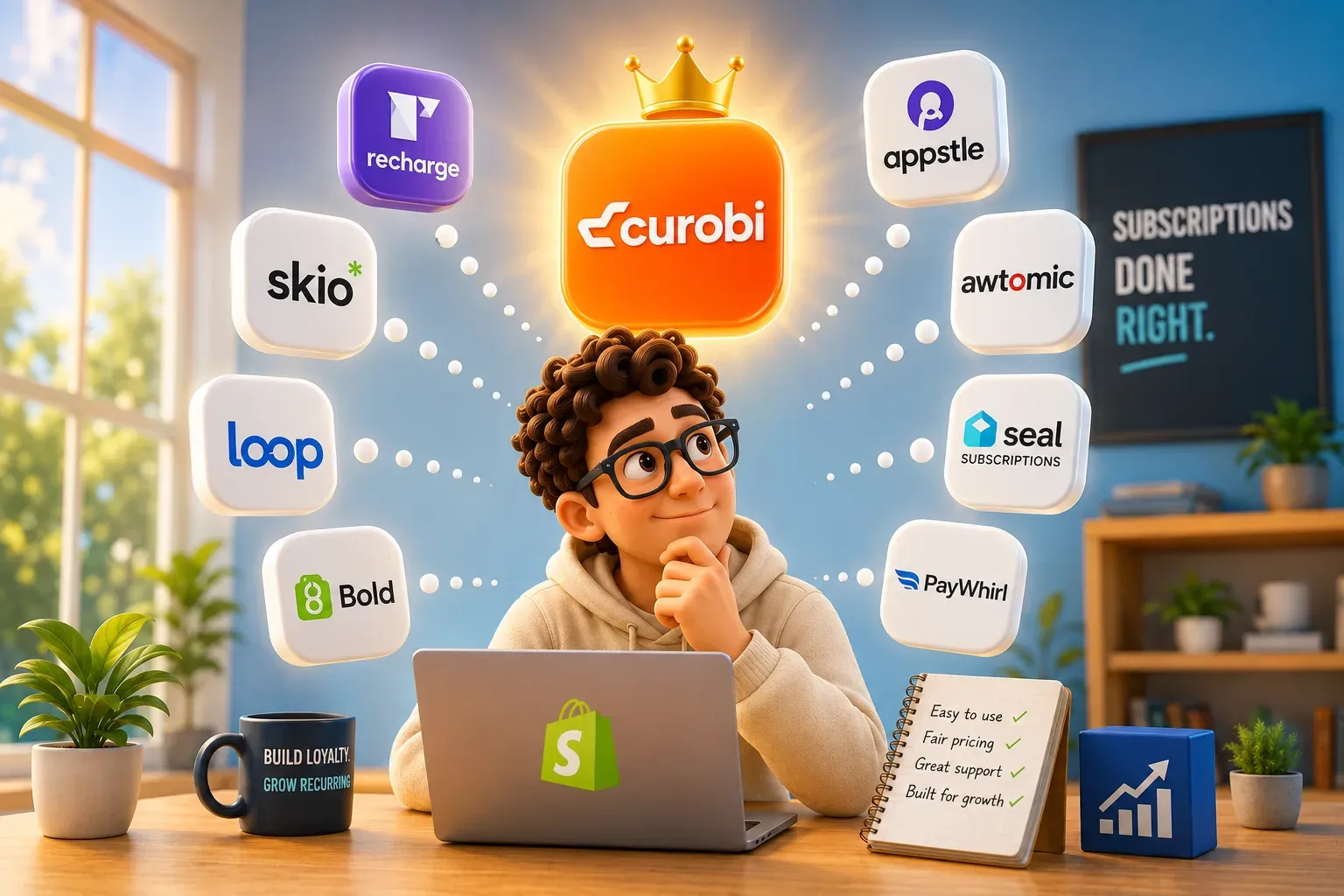
There is no single best alternative — the right one depends on which problem you are actually solving. The main independent options on Shopify in 2026 are Loop, Appstle, Seal, Shopify’s own native Subscriptions app, and Curobi, with Skio no longer independent after the Recharge acquisition.
A short version of the decision:
- If the problem is the fee bill, move to a flat-fee, 0% app. Seal and Appstle are the cheapest; Curobi is flat too and adds box tooling.
- If the problem is that you can’t run a proper curated or build-your-own coffee box, you need an app with native curated-box and build-your-own-box builders, not a replenishment-only app.
- If the problem is price and nothing else, Seal and Appstle undercut almost everyone.
- If you need curated boxes, customer choice, skip/pause, failed-payment recovery, and predictable pricing all at once, shortlist the apps that do all of it without charging separately for each piece.
The rest of this piece works through the options and the numbers so you can match the right one to your roastery.
Why coffee roasters leave Recharge
Recharge is a capable, widely used platform, so it is worth being precise about what actually pushes roasters to look elsewhere. Three triggers come up repeatedly.
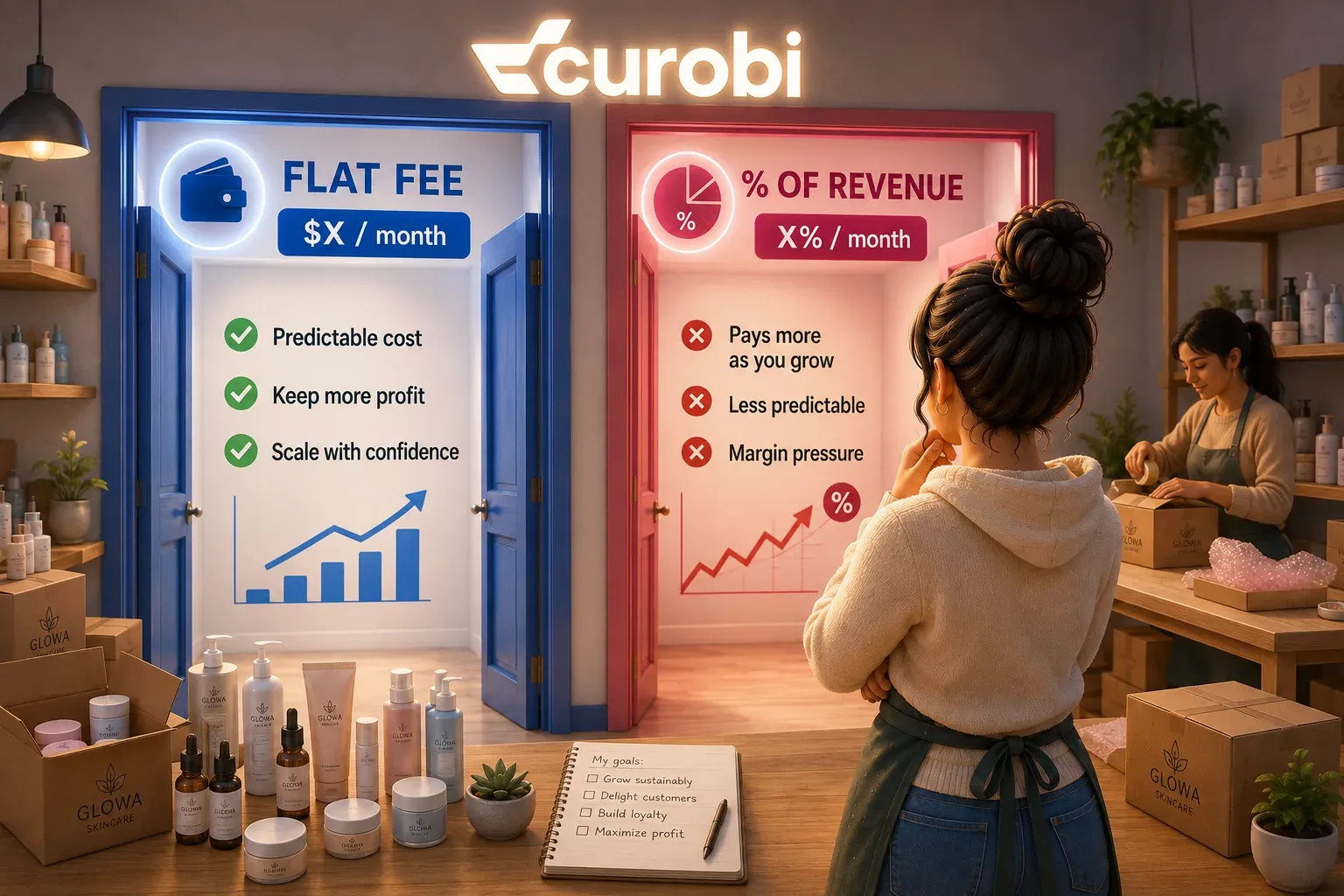
The percentage fee scales with your success. Recharge’s published pricing is $99 per month plus 1.49% + 19¢ per transaction on the Starter plan, and $499 per month plus 1.34% + 19¢ on Plus (Recharge billing and pricing). The percentage applies to the whole recurring order, every cycle, so the bill grows as your subscription revenue grows — the opposite of what you want from software that does the same work on order #1 and order #500. We break down exactly how that compounds in how much Recharge actually costs.
The independence argument changed. Recharge acquired Skio on 30 April 2026, folding the market’s best-known independent challenger into the incumbent. If part of your interest in switching was landing on a modern, independent platform, the shape of the market shifted — we covered what that does and doesn’t mean in Skio is now part of Recharge. It is a reason to re-evaluate, not to panic-migrate.
The coffee-specific operations don’t fit. Most subscription apps, Recharge included, are built for consistent SKUs on a fixed replenishment schedule. Coffee is neither: single-origin micro-lots sell out, seasonal rotation is the whole reason people subscribe, and each box needs to be locked before billing so you can commit a finite lot without overselling. That mismatch is the hardest part of running a coffee subscription, and no amount of general-purpose polish fixes it.
What a coffee roaster actually needs from a subscription app
Before comparing prices, it helps to fix the evaluation criteria, because the cheapest app is not automatically the best one for a roastery. A coffee subscription tool should let you:
- Run a curated “roaster’s choice” box where the whole cohort advances through a rotation you set, rather than tracking a different position for every subscriber.
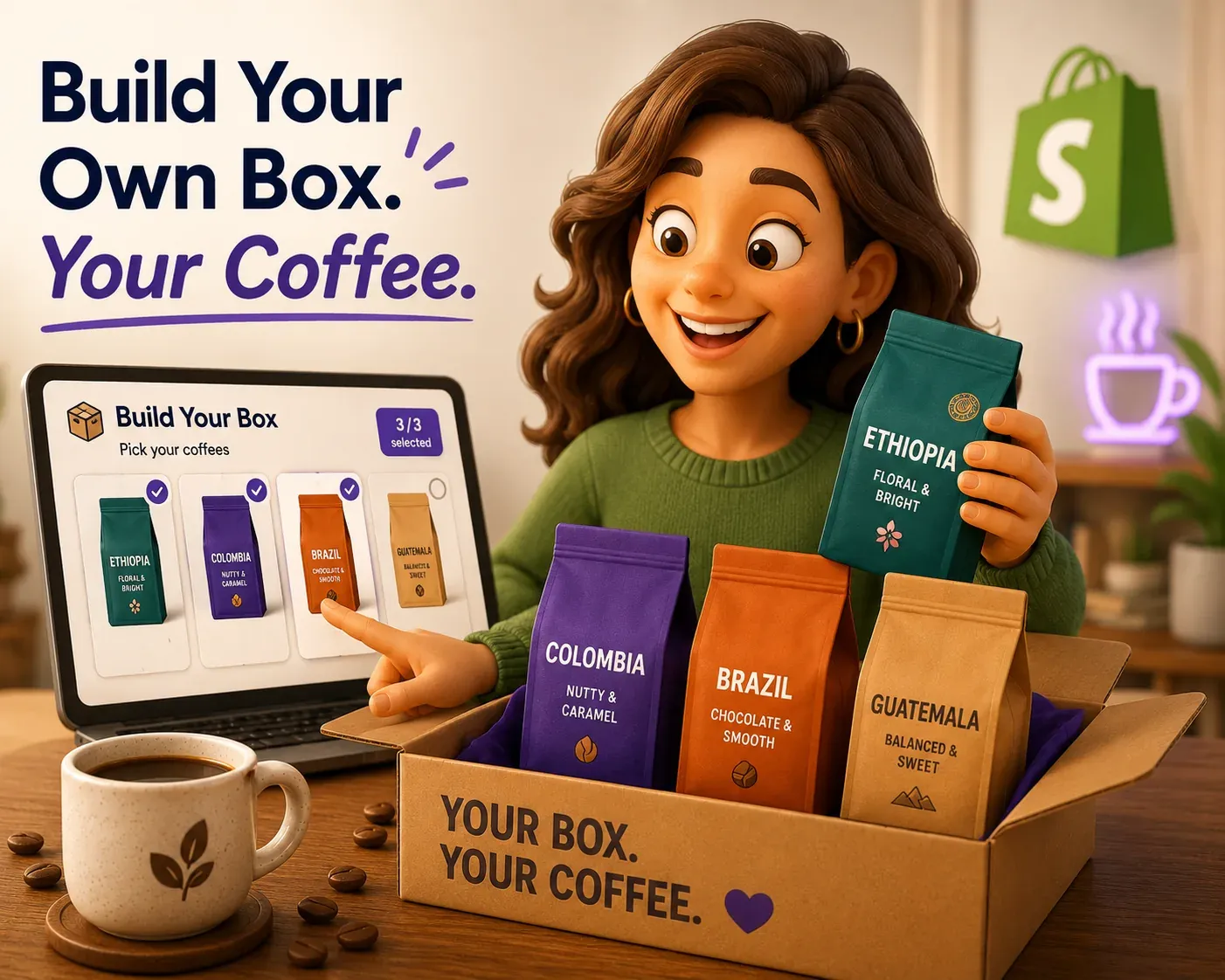
- Let customers build their own box and choose grind, roast, and quantity — the antidote to “same beans again” and “coffee I didn’t want” cancellations.
- Enforce a billing cutoff, the point before the recurring charge is created where each box locks, so you know how many bags of a finite lot are going out before you commit it.
- Recover failed payments automatically, because involuntary churn from expired or declined cards is a large share of total churn and has no product problem to fix.
- Offer skip and pause in a self-service portal, because a customer who can’t skip one delivery cancels the whole subscription instead.
- Bill on Shopify’s native checkout, which keeps Local Pickup and Local Delivery working for roasters with a café or local delivery run.
- Price predictably, so a good month doesn’t quietly raise your software bill.
Hold each alternative against that list, not against a generic feature grid.
The main Recharge alternatives, compared
The table below uses each vendor’s published 2026 pricing. Transaction-fee and price figures change, so confirm the current listing before you decide; a dash means the vendor does not publish a comparable figure or the item does not apply.
| App | Starting paid price | Transaction fees | Independent in 2026? | Curated + build-your-own boxes | Fee model |
|---|---|---|---|---|---|
| Recharge | $99/mo (Starter) | 1.49% + 19¢ per order | Yes (now owns Skio) | Yes, on higher tiers | Percentage of revenue |
| Loop | Free up to 50 subs; $99/mo above that | 0% free tier, then 1.0% (no per-order fee) | Yes | Yes | Percentage of revenue |
| Appstle | Free to $500/mo revenue, then ~$10–$100/mo | 0% | Yes | Yes | Flat, tiered by revenue |
| Seal | Free, then $5.95–$24.95/mo | 0% | Yes | Limited | Flat, tiered by subscriber count |
| Shopify Subscriptions (native) | Free app | Shopify payment processing only | Yes (Shopify) | No box builder | No app fee |
| Curobi | $29.99/mo; $69.99/mo Pro | 0% | Yes | Yes, on Pro | Flat |
A fair, factual read of each:
Loop is the closest like-for-like replacement for Recharge and the one most roasters compare against it. It is free for stores with 50 or fewer active subscriptions; above that it charges $99 per month plus 1.0% with no per-order fee, and $399 per month plus 0.75% on its higher tier (Loop pricing). It is independent and full-featured, but past the free tier it keeps the same structural issue that pushed you off Recharge: the fee is still a percentage of your recurring revenue.
Appstle is one of the two budget champions. It is free until $500 per month in subscription revenue, then roughly $10 to $100 per month, and it advertises no transaction fees on every plan. For a roaster whose main complaint is the fee bill, Appstle is a strong, low-cost answer; confirm on its Shopify listing which box-building features sit on which tier before you commit.
Seal is the other budget option: a free tier and paid plans from $5.95 to $24.95 per month, all with 0% transaction fees (Seal Subscriptions on the Shopify App Store). It is genuinely inexpensive and reliable for straightforward recurring plans, but it is lighter on curated-box and rotation operations, which is exactly where coffee gets hard.
Shopify’s native Subscriptions app is free and bills on native checkout, which is why many roasters start there. It has no curated-box or build-your-own-box builder and thin recovery and analytics, so most coffee businesses outgrow it — we cover the exact ceilings in Shopify Subscriptions vs. a subscription app.
Skio is worth naming only to remove it from the list: after the April 2026 Recharge acquisition it is no longer an independent alternative. If independence from Recharge was your reason for switching, Skio no longer satisfies it.
How the fee models actually differ (a worked coffee example)
The single most useful thing to understand is that flat and percentage pricing diverge as you grow. Take a roaster with 400 active subscribers each paying $32 a bag, billed monthly — that is $12,800 in recurring revenue a month. Rough monthly app cost:
- Recharge Starter: $99 + 1.49% of $12,800 ($190.72) + 400 × 19¢ ($76) ≈ $366/mo, and it rises every time you add subscribers or raise prices.
- Loop: $99 + 1.0% of $12,800 ($128) ≈ $227/mo, also revenue-linked.
- Appstle: a flat paid tier (its plans top out around $100/mo), 0% fees.
- Seal: roughly its $24.95 tier for this subscriber count, 0% fees.
- Curobi Pro: flat $69.99/mo, 0% fees.
Two honest conclusions come out of that. First, the percentage-fee apps (Recharge, Loop) are the most expensive here and get more so as you scale — that is the real case for leaving them. Second, 0% transaction fees are not a differentiator on their own. Seal and Appstle also charge 0% and, at this volume, cost less than Curobi. If price is your only criterion, one of them is your answer, and any roundup that pretends otherwise is selling you something.
The reason a roaster might still choose a flat-fee app that isn’t the absolute cheapest is everything in the criteria list above — curated rotation, build-your-own boxes, cutoffs, recovery, save flows — bundled at one predictable price instead of assembled from three apps or gated tier by tier.
A decision framework: which alternative fits which roaster
- Choose Seal or Appstle if your subscriptions are straightforward replenishment, price is the deciding factor, and you don’t need curated-box or rotation tooling. They are the cheapest credible way off Recharge.
- Choose Loop if you want a near drop-in Recharge replacement with a deep feature set and you can accept a percentage fee — just know you are keeping the fee model you left Recharge to escape.
- Stay on Shopify’s native app only while your program is simple; plan to move before you need boxes, rotation, or serious recovery.
- Choose a flat-fee app with native curated and build-your-own boxes — such as Curobi — if you need curated “roaster’s choice” boxes, customer choice, cutoffs, and failed-payment recovery together, at a price that doesn’t climb with your revenue.
- Don’t rush off Recharge purely because it bought Skio. Re-evaluate, watch your renewal, and migrate on a plan, not a reflex.
How Curobi fits
Curobi is an independent Shopify subscription app built by Vibhora, priced flat at $29.99 or $69.99 per month with 0% transaction fees, and it was designed around the coffee-roaster criteria above rather than adapted to them. Curated boxes advance the whole cohort through a rotation you set, build-your-own boxes let regulars assemble their own bags and choose grind, and both enforce a billing cutoff so each box locks before the recurring charge runs — which is what lets you commit a finite micro-lot without overselling. It bills on Shopify’s native checkout, includes failed-payment recovery and cancellation save flows, and offers CSV migration from Recharge on the Pro plan.
Curobi’s case is for the roaster who wants the coffee-specific operations and the predictable flat fee in one app. You can see the full head-to-head in Curobi vs Recharge and the roaster-specific view on Curobi for coffee.
Whichever app you land on, the move itself is the risky part. Before you switch, read how to switch subscription apps without losing subscribers so your live subscribers keep billing through the change instead of restarting.
Frequently asked questions
What’s the best Recharge alternative for a coffee roaster?
There is no single best alternative — the right one depends on what breaks first for your roastery. If the problem is a percentage fee that grows with your recurring revenue, a flat-fee app such as Curobi, Appstle or Seal removes it. If the problem is that you cannot run a proper curated “roaster’s choice” box or let customers build their own bag selection, you need an app with native curated-box and build-your-own-box tooling rather than a replenishment-only app. If the problem is only price, Seal and Appstle are cheaper than most. A coffee roaster who needs curated boxes, customer choice, skip and pause, failed-payment recovery, and predictable pricing at the same time should shortlist the apps that do all of those without gating each behind a separate plan.
Is there a cheaper alternative to Recharge?
Yes. Recharge’s Starter plan is $99 per month plus 1.49% + 19¢ per transaction, so the bill grows with your recurring revenue. Several apps are cheaper and charge no transaction fee: Seal starts free and its paid tiers run $5.95 to $24.95 per month, Appstle is free until $500 per month in subscription revenue and then $10 to about $100 per month, and Curobi is $29.99 or $69.99 per month — all with 0% transaction fees. A flat-fee app is usually cheaper than Recharge once a store has meaningful recurring volume, because a percentage fee keeps scaling while a flat fee does not.
Do I have to leave Recharge now that it owns Skio?
No. Recharge acquired Skio in April 2026, and both companies have said the platforms keep running and nothing changes operationally in the short term. An acquisition is a reason to re-evaluate, not an emergency. Migrating live subscribers carries real risk, so the sensible default is to watch what happens to your pricing at renewal, your support, and the combined roadmap, and to prepare a migration plan without executing it unless something you depend on actually changes.
Which subscription app is best for a coffee subscription box?
For a coffee subscription box specifically, look past the generic feature list and check three things: whether the app can run a curated “roaster’s choice” box where the whole cohort advances through a rotation you set, whether it lets customers build their own box and choose grind, and whether it enforces a billing cutoff so you can lock each box before the recurring charge runs and commit a finite lot without overselling. Apps built purely for replenishment handle fixed SKUs well but struggle with rotation and scarcity, which are the parts unique to coffee.
Can I move my subscribers off Recharge without losing them?
Usually yes, but it requires planning rather than a single export. A migration has to recreate your selling plans, import every subscription contract with the correct cadence and next billing date, and re-establish a valid payment authorization for each subscriber. Payment continuity is the hard part, because payment tokens are not freely portable between apps, so how each subscriber keeps billing depends on the migration path and the payment provider. The safest sequence is to recreate plans first, import contracts against them, verify every record, keep a list of anyone who was mid-dunning so they are not lost, and only then switch the storefront over.