
Flat fee vs. % of revenue: subscription app cost
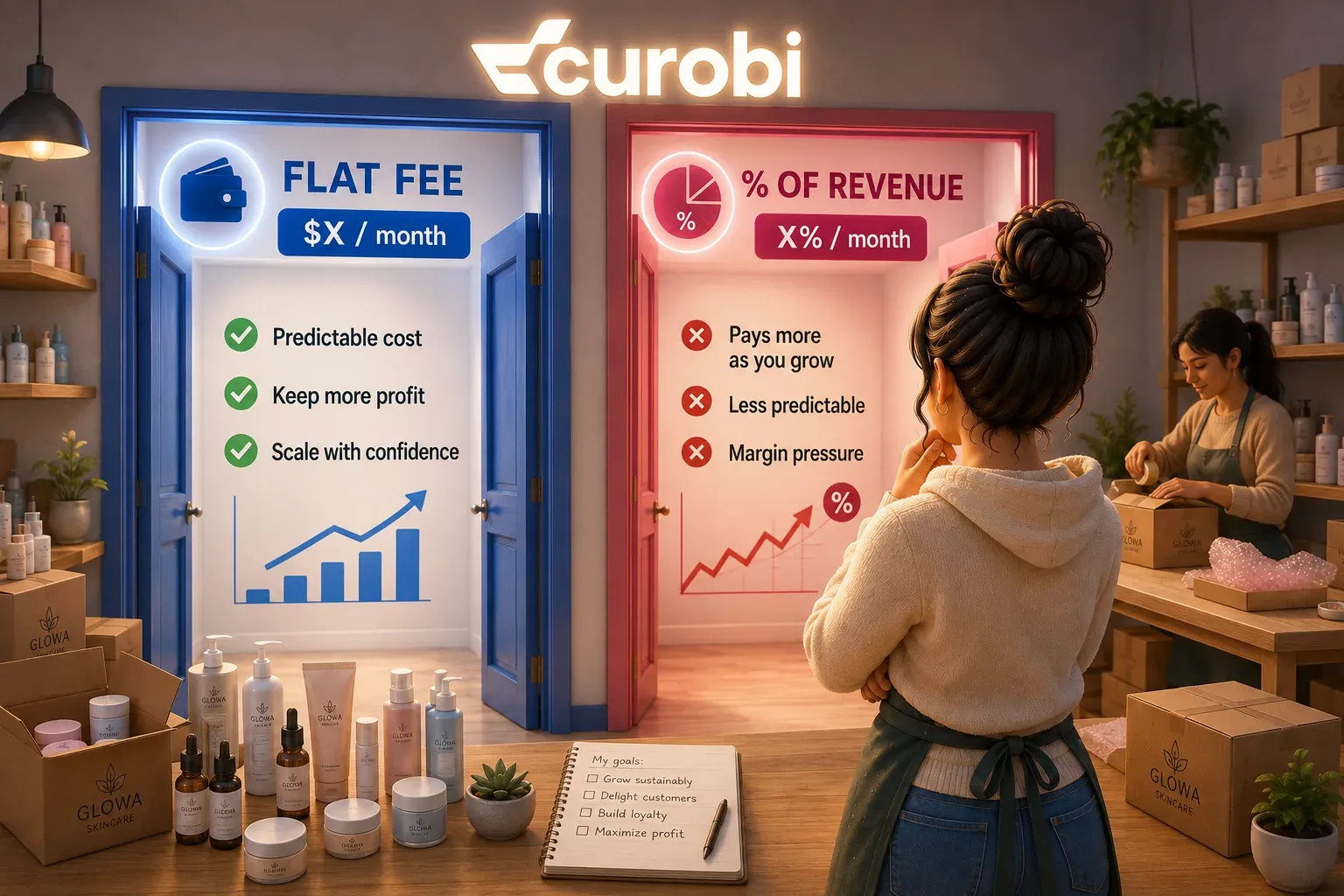
Most merchants choose a Shopify subscription app on the number printed on the pricing page — the monthly plan fee — and discover the number that actually mattered a year later, on an invoice that has quietly tripled. The reason is that subscription apps are sold under two very different pricing models, and only one of them shows you your real cost up front. A flat fee stays the same whatever you sell. A percentage of revenue takes a cut of every recurring order, so it grows every time you add a subscriber, raise a price, or improve your retention. This article works out the real monthly math for both, shows where they cross over, and gives you a way to price your own store before you commit.
Quick answer: flat fee vs. percentage of revenue
A flat fee costs the same no matter how much you sell; a percentage fee scales with your recurring revenue, so it starts cheap and gets more expensive as you grow. The real monthly cost of a percentage-of-revenue app is not its headline plan price — it is:
base fee + (percentage rate × monthly recurring revenue) + (per-order fee × number of orders)
The real monthly cost of a percentage-of-revenue app
For a store with 500 subscribers each paying $40 a month ($20,000 in recurring revenue), a percentage app priced at $99/month + 1.49% + 19¢ per order costs about $492 a month. A flat $69.99 app costs $69.99 at the same volume — and stays there at 1,000 subscribers, while the percentage app climbs past $880. The percentage model is usually cheaper only while you are small; the flat model is usually cheaper once you have real volume. The rest of this piece shows the crossover and how to find yours.
The two pricing models, defined
Subscription apps on Shopify almost all fall into one of two camps.
Percentage of revenue. You pay a monthly base plus a transaction fee on every recurring order — typically a percentage plus a small flat per-order charge. Recharge, for example, publishes $99/month plus 1.49% + 19¢ per transaction on one paid tier and $499/month plus 1.34% + 19¢ on the next (Recharge on the Shopify App Store and Recharge pricing, both retrieved 25 August 2026 — the two sources give those tiers different names, so the fee structure is what to match on). Loop uses the same shape with different numbers: $99/month + 1.0% with no per-order fee, and $399/month + 0.75% on its higher tier (Loop pricing, retrieved 25 August 2026). The defining feature is that the fee is charged on the order value, every cycle, for the life of the subscription.
Flat fee. You pay a fixed monthly amount and no per-transaction cut — 0% transaction fees. Several apps price this way, ranging from free tiers up to roughly $100 per month. Curobi, for instance, is $29.99 or $69.99 per month with 0% fees; Appstle and Seal also charge 0% on every plan and are cheaper still on their lower tiers (both retrieved 25 August 2026). The defining feature is that your bill does not move when your sales do.
The distinction matters because a subscription is, by design, a repeat transaction. The whole point of the model is that one customer bills you 12, 24, or 36 times. Under a percentage app, every one of those cycles carries a fee. Under a flat app, none of them does.
The real monthly math, at several revenue levels
Headline prices hide the difference; a worked table exposes it. The comparison below holds the store constant — an average recurring order of $40, billed monthly — and grows the subscriber count. The percentage column uses a $99/month + 1.49% + 19¢ structure; the flat column uses a $69.99/month, 0% structure. Both are real 2026 price points; the point is the shape, not the specific vendor.
| Active subscribers | Monthly recurring revenue | Percentage app / mo | Flat app / mo | Extra cost per year on the percentage app |
|---|---|---|---|---|
| 100 | $4,000 | $177.60 | $69.99 | ~$1,291 |
| 250 | $10,000 | $295.50 | $69.99 | ~$2,706 |
| 500 | $20,000 | $492.00 | $69.99 | ~$5,064 |
| 1,000 | $40,000 | $885.00 | $69.99 | ~$9,780 |
| 2,500 | $100,000 | $2,064.00 | $69.99 | ~$23,928 |
Each percentage figure is $99 + 1.49% of revenue + $0.19 × orders; at 500 subscribers that is $99 + $298 + $95 = $492. The flat figure never changes. The final column is simply the monthly difference multiplied by twelve — the amount the pricing model, not the software, costs you each year. At 500 subscribers it is about $5,000 a year; at 2,500 it is close to $24,000.
Why merchants call it a “success tax”

Look at the same numbers as an effective rate — what each app costs as a percentage of the revenue it is billing — and the reason the percentage model frustrates growing merchants becomes obvious.
| Active subscribers | Percentage app, effective rate | Flat app, effective rate |
|---|---|---|
| 100 | 4.44% | 1.75% |
| 250 | 2.96% | 0.70% |
| 500 | 2.46% | 0.35% |
| 1,000 | 2.21% | 0.17% |
| 2,500 | 2.06% | 0.07% |
The flat app’s effective rate falls toward zero as you grow, because a fixed fee spread over more revenue shrinks as a share of it. The percentage app’s effective rate falls too at first — the monthly base amortizes — but then it flattens out and stops falling, because the 1.49% and the per-order fee are a floor it can never drop below. Past a certain size you are paying roughly the same rate on every new dollar of recurring revenue, forever.
That is what the term “success tax” describes: the better your subscription business does, the more you pay for software that does exactly the same work on order #1 as on order #10,000. Adding subscribers raises the bill. Raising prices raises the bill. Improving retention — keeping customers billing longer — raises the bill. None of those improvements make the app do anything new; they just enlarge the base the fee is charged on. A flat fee inverts that relationship: scaling makes your software cheaper per order, not more expensive.
When a percentage app is actually cheaper
The honest counterpoint, and the reason percentage pricing exists at all: at low volume it can be the cheaper option. A small percentage of a small revenue is a small number, and some percentage apps pair it with a low entry price. Recharge, for example, lists a $25/month Starter tier for stores with up to 50 active subscribers, at 0% transaction fees (Shopify App Store listing, retrieved 25 August 2026). A store with 40 subscribers at $40 a month would pay roughly $25 + 1.49% of $1,600 + $0.19 × 40 ≈ $56 on that tier — less than a $69.99 flat plan.
But notice how narrow that window is. The Starter tier caps at 50 subscribers; cross it and you are moved to the $99 base, at which point the percentage app is more expensive than the flat app at every subsequent level of volume — because a $99 base already exceeds a $69.99 flat fee before a single transaction fee is added. So the case for percentage pricing is real only while you are genuinely tiny, and it evaporates around the point most stores are trying to reach. If your goal is to grow, you are choosing the model that penalizes the outcome you want.
This is also why 0% transaction fees is not, by itself, a reason to pick an app. Plenty of flat-fee apps charge 0% and cost less than others — Appstle and Seal both undercut Curobi at low volume, as we lay out in Recharge alternatives for coffee roasters. The fee model tells you how your bill will behave as you grow; it does not tell you which app is cheapest today. You still have to run your own numbers.
The costs that never make the pricing page
The plan fee and the transaction rate are the visible costs. A full total-cost-of-ownership comparison has to account for the ones that are not printed anywhere.
- The fee applies to the whole order, every cycle. A percentage transaction fee is charged on the recurring order value — which for many apps includes the shipping billed in the order — and it is charged again on every renewal, not just the first sale. The compounding across cycles is the part merchants most often underestimate. Our breakdown of what Recharge actually costs walks through one store’s cycle-by-cycle bill.
- Your own price increases raise your software bill. Raise a $40 box to $44 and a 1.49% app quietly takes a cut of the increase. You did the work of justifying a higher price; the app shares the upside. Getting that increase to reach the subscribers you already have is its own exercise — editing the selling plan does not reprice a single existing contract, which we cover in raising subscription prices without losing subscribers.
- Features gated behind higher tiers. The plan you can afford may not include the box builder, the failed-payment recovery, or the analytics you need, pushing you to a higher base than the comparison implied. Compare like-for-like feature sets, not just entry prices.
- Migration and lock-in. The cost of being on the wrong app is not only this month’s fee — it is the friction of leaving. Payment tokens are not freely portable between apps, which is what makes switching feel risky and keeps merchants paying a fee they have already decided is too high. We cover why that fear is usually overstated in migration fear is why you’re overpaying, and the mechanics in the guide to avoiding transaction fees on Shopify subscriptions.
How to price your own store in four steps
You do not need a calculator app to get an accurate number. Use your real figures.
- Find your monthly recurring revenue (MRR). Average recurring order value × number of orders billed per month. If your billing is not monthly, normalize to a month.
- Compute the percentage app’s real monthly cost:
base fee + (rate × MRR) + (per-order fee × monthly orders). Use the current published rate, and confirm what the fee is charged on. - Compare it to the flat app’s fixed price at the tier that includes the features you actually need.
- Multiply the monthly gap by 12, then project it forward at your expected subscriber growth. The right question is not “which is cheaper today,” but “which is cheaper at the size I am trying to reach.”
If the percentage app is cheaper at your current size but you expect to grow, find the crossover: set flat fee = base + (rate × MRR) + (per-order fee × orders) and solve for the MRR where they match. Below it, percentage wins; above it, flat wins — and revenue only moves one way if the business is working.
The coffee-roaster case
For a coffee roastery the math bites a little harder, because coffee subscriptions tend to have a higher order value and strong repeat behavior — exactly the two things a percentage fee feeds on. Take 400 subscribers at $32 a bag billed monthly: $12,800 in recurring revenue. A $99 + 1.49% + 19¢ app costs about $99 + $190.72 + $76 = $366 a month and rises with every new subscriber; a $69.99 flat app stays at $69.99. Over a year that is roughly $3,500 that a roaster on percentage pricing pays purely for the pricing model — money that would otherwise cover green coffee, better packaging, or the shipping subsidy that keeps a subscription competitive. The tighter your margins per bag, the more the fee model matters, which is one reason we treat it as central in why UK coffee subscriptions are hard to run profitably.
How Curobi fits
Curobi is priced flat — $29.99 or $69.99 per month, 0% transaction fees on every plan — specifically so that your software bill stops mattering as your subscription program grows. What you get for the flat fee is the operational tooling a growing program needs bundled at one price rather than gated tier by tier: curated boxes and build-your-own boxes, failed-payment recovery, cancellation save flows, and billing on Shopify’s native checkout. You can see the direct cost comparison in Curobi vs. Recharge and the plan detail on the pricing page.
The honest boundary, worth repeating: a flat fee is not automatically the cheapest fee. If your store is small and staying small, a percentage app’s low tier or a cheaper flat app like Seal or Appstle may cost you less this year. Curobi’s case is for the merchant who intends to grow and does not want a fee that grows with them. If that is you, the flat-fee math is on your side — and the further you scale, the more it is.
Frequently asked questions
How much does a Shopify subscription app actually cost per month?
It depends on which pricing model the app uses, not just its headline price. A flat-fee app charges a fixed monthly amount regardless of how much you sell — commonly somewhere between free and about $100 per month. A percentage-of-revenue app charges a monthly base plus a cut of every recurring order, so the real bill is base + (rate × monthly recurring revenue) + (per-order fee × number of orders). At 500 subscribers each paying $40 a month, a percentage app at $99/month + 1.49% + 19¢ per order works out to roughly $492 a month, while a flat $69.99 app stays at $69.99. To get your own number, multiply the percentage rate by your monthly recurring revenue and add the per-order fee times your order count — that is the figure that scales with you.
Is a flat fee or a percentage of revenue cheaper for a subscription app?
For most stores with meaningful recurring volume, a flat fee is cheaper, because a percentage fee keeps climbing as your revenue grows while a flat fee does not. The exception is a very small store: at low volume a percentage app with a low base can undercut a flat app, because a small percentage of a small revenue is trivial. The crossover happens fast, though — once your recurring revenue passes a few thousand dollars a month, the percentage typically overtakes the flat fee, and from there the gap only widens. The honest rule is to run your own numbers rather than trust either sticker price, because the cheapest model depends entirely on your volume.
What is a subscription “success tax”?
“Success tax” is the term merchants use for a percentage-of-revenue app fee, because the better your subscription business performs, the more you pay for software that does the same work on order #1 as on order #10,000. A percentage fee is charged on the whole recurring order every billing cycle, so adding subscribers, raising prices, or improving retention all increase your app bill even though the app is doing nothing new. A flat fee behaves the opposite way: as your revenue grows, the fee shrinks as a share of it, so scaling makes the software cheaper per order rather than more expensive.
Do subscription app transaction fees apply to shipping and tax?
Percentage transaction fees are generally charged on the recurring order value, which for many apps includes shipping charged in the order, and the flat per-order component is charged on every order regardless of size. That is part of why the true cost is higher than the headline percentage suggests: the fee applies to the full amount the customer is billed each cycle, not just the product subtotal, and it applies again on every renewal rather than only on the first sale. Always confirm the exact base each app applies its fee to on its current pricing page before you compare.
At what point does a percentage fee cost more than a flat fee?
A percentage app becomes more expensive than a flat app once its base fee plus percentage plus per-order fees exceed the flat monthly price. When the percentage app already has a higher base — for example a $99/month base against a $69.99 flat fee — it costs more at every level of volume. When the percentage app has a lower base, there is a crossover: below it the percentage app is cheaper, above it the flat app wins. You can find your own crossover by setting the two monthly costs equal — flat fee = base + (rate × recurring revenue) + (per-order fee × orders) — and solving for the revenue where they match. For most growing stores that point arrives early and the flat fee stays cheaper from then on.