
How to keep Black Friday subscribers: a 90-day plan, renewal by renewal
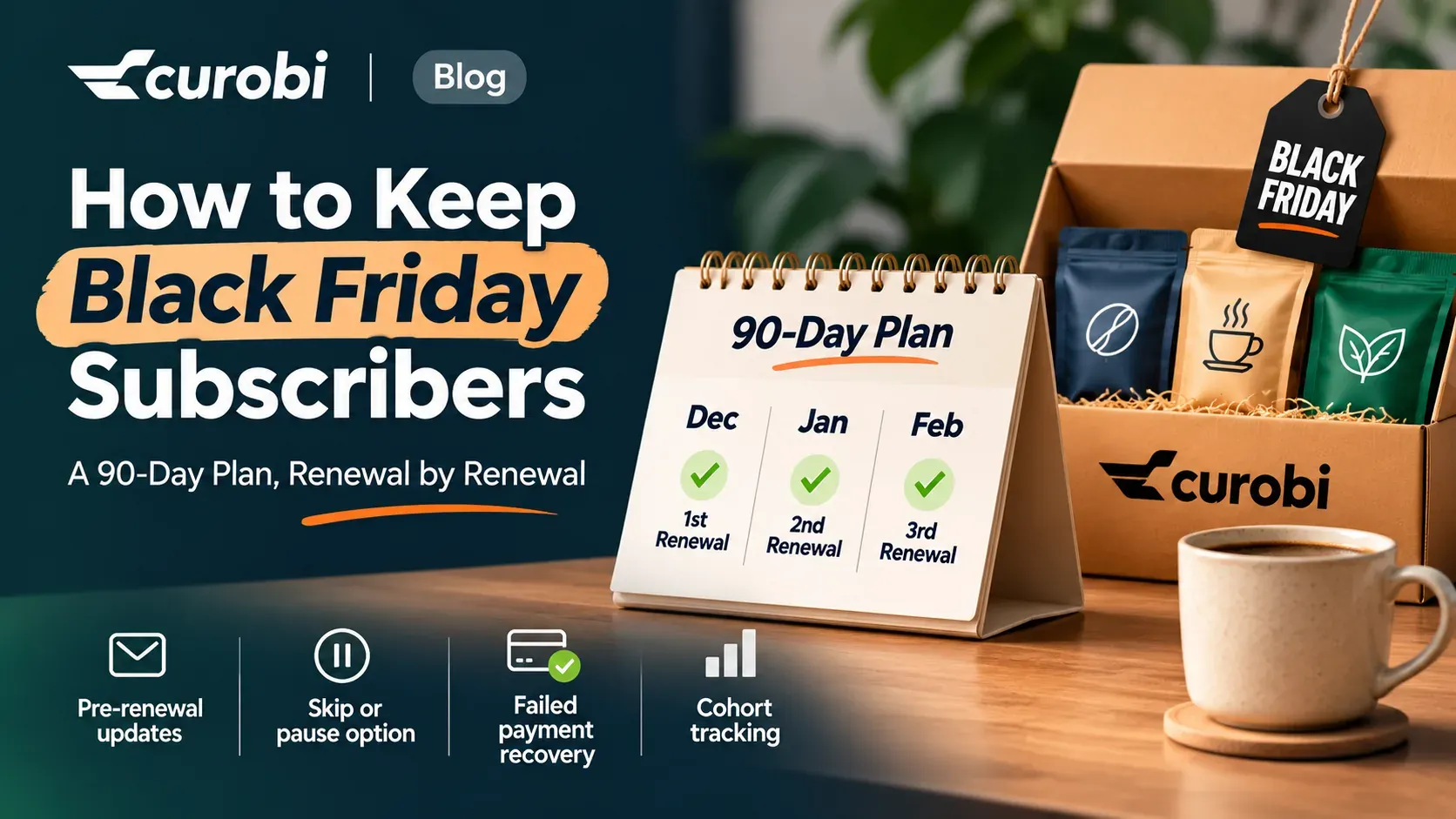
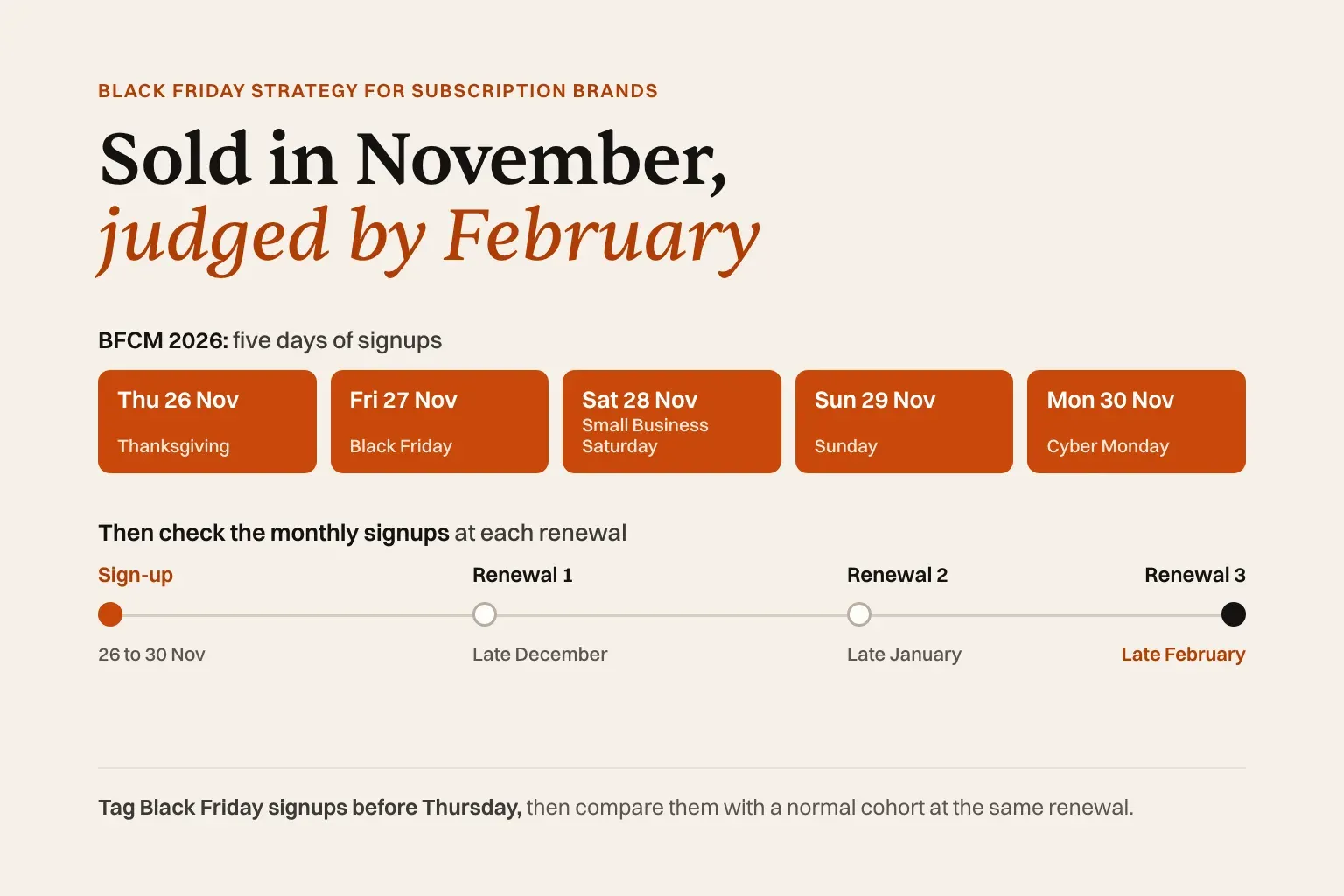
To keep monthly subscribers who join on Black Friday, prepare for their first three renewals in late December, January and February. Before each one, tell subscribers the charge date and price, offer a skip or pause before they reach cancel, and have failed-payment retries running. If a sale price ends, give 10 to 21 days’ notice before the first full-price charge.
The first two of those renewals carry most of the risk. Recharge, a subscription app that competes with Curobi, reports from renewal cycles on its own platform between July 2025 and March 2026 that about 61% of voluntary cancellations happened at a subscriber’s first two renewals (Recharge, July 2026). For a monthly subscriber who joins on 27 November, those fall around 27 December and 27 January.
This plan uses 2026 dates: Black Friday is 27 November and Cyber Monday 30 November. It picks up where our Black Friday strategy guide for subscription brands stops. The guide covers which offer to run and how to tag the signups; this post covers what to do with them afterwards. Sources were checked on 8 November 2026.
Quick answer: how do you keep Black Friday subscribers?
- Say what happens next. Every email states the next charge date, the price, and how to skip, pause or cancel.
- Offer a skip, or a January date, before the December renewal bills, not only inside the cancel flow.
- Give notice 10 to 21 days before the first full-price charge when a promotional price ends, and again if a skip or a new date moves that charge.
- Watch renewals 1 and 2, where Recharge’s data puts about 61% of voluntary cancellations, and expect some January declines from cards that expired in December.
- Compare the cohort with another at the same renewal number, split into cancellations, failed payments and skips.
- Time win-back from the day each subscriber left, and don’t send the Black Friday price back to everyone who leaves.
The 90-day timeline for a subscriber who joins on 27 November
The table follows one monthly subscriber who joins on Friday 27 November 2026 on a rolling schedule, which bills each subscriber from their own signup date. On a fixed-calendar schedule, move each row to your charge day. Quarterly subscribers first renew in late February, and prepaid subscribers when their prepaid deliveries run out (around 27 January for a two-delivery monthly plan). Delivery times vary by store, so treat the dates as approximate. The step-up notice is the email that tells a subscriber when their promotional price ends and what they will pay after it.
| When (2026–27) | Moment | What to send | What to check |
|---|---|---|---|
| By Wed 25 Nov | Before the sale | Build the confirmation, the December email, the step-up notice and the charge reminder. Switch on signup tagging | A test order with the sale code is tagged, and its confirmation shows both prices |
| Fri 27 Nov | First order | Confirmation: what they paid, the later price, the next charge date (27 December), and how to skip, pause or cancel | The code’s recurring-payments limit is the one you intended |
| Early Dec | First box arrives | How to use it, and where to manage the subscription | Delivery problems and support tickets |
| 6 to 17 Dec | 10 to 21 days before renewal 1 | An offer to skip December or move the order into January, plus the step-up notice if the price rises at renewal 1 | Skips, date changes and cancellations before the charge. Anyone whose first full-price charge moved gets the notice again before the new date |
| About 24 Dec | A few days before renewal 1 | Charge reminder with the amount, the date and a manage link | The amount shown matches the charge |
| About 27 Dec | Renewal 1 | Receipt with the amount charged and how to cancel | Checkpoint 1: share renewed, failed, skipped and cancelled |
| 28 Dec to early Jan | Failed renewal-1 charges | Card-update emails while retries run | Share recovered within 14 days of the failure |
| About 27 Jan | Renewal 2 | Charge reminder with the skip link, then a receipt with the amount charged and how to cancel | Checkpoint 2, and whether December skippers paid |
| 6 to 17 Feb | Before renewal 3, if three orders were discounted | Step-up notice | Cancellations before the first full-price charge |
| About 27 Feb | Renewal 3 | Receipt with the amount charged and how to cancel | Checkpoint 3, against the comparison cohort |
What should Black Friday subscribers hear before their first renewal?
A Black Friday subscriber needs at least three messages before the first renewal in late December: a confirmation on the day they join with what they paid, the later price and the next charge date; an email 10 to 21 days before the charge offering a skip or a January date; and a charge reminder a few days before it bills.
Recharge reports, from monthly plans on its own platform between 2022 and 2024, that 46.8% of Black Friday subscribers (those who joined between Thanksgiving and Cyber Monday) reached a second order, against 43.4% of subscribers who joined the rest of the year (Recharge, September 2026). Even in the stronger cohort, more than half never placed one. Recharge’s advice is to have “the post-purchase sequence, the upcoming-order reminder, and failed-payment recovery live before the week, not bolted on in December.”
One study suggests customers who join on a free offer respond to contact. Studying a digital TV service, Datta, Foubert and van Heerde (2015) found that free-trial customers’ average lifetime value was 59% lower than regular customers’, but that they were more responsive to marketing communication (Tilburg University record). It studied free trials of a TV service, not discounted boxes, so read it as a hint for boxes and refills rather than a benchmark.
Day 0: a confirmation that answers the next questions
The confirmation should state what the subscriber bought, what they paid today, what they will pay from the next order, the date of that charge, and how to skip, pause or cancel, each with a link. California requires an acknowledgment the customer can keep, with the terms, the cancellation policy and how to cancel (what to disclose next to a promo-priced subscription). What makes the second order feel worth paying for starts with the first box, as the month-3 churn cliff explains.
Two to three weeks out: offer a skip or a January date before the charge
Renewal 1 lands around 27 December, between Christmas and New Year, when some subscribers are away and some still have stock from the sale. If cancel is the only control that stops that charge, some of them will use it. Send a short email 10 to 21 days ahead that offers to skip December or move the order into January; the skip button is your best retention tool sets out which control fits which situation. If the price rises at renewal 1, put the step-up notice in the same email. If a subscriber then skips December or moves the order into January, their first full-price charge moves too, so send the step-up notice again 10 to 21 days before the new date. A December skip only counts as a save if the January charge goes through, so follow the December skippers through renewal 2.
The last few days: the charge reminder
Keep the reminder that goes out a few days before each charge, with the amount, the date and a link straight to skip. It arrives too late to serve as notice of a price change, but it catches the subscriber who forgot the date.
What happens when the Black Friday price ends?
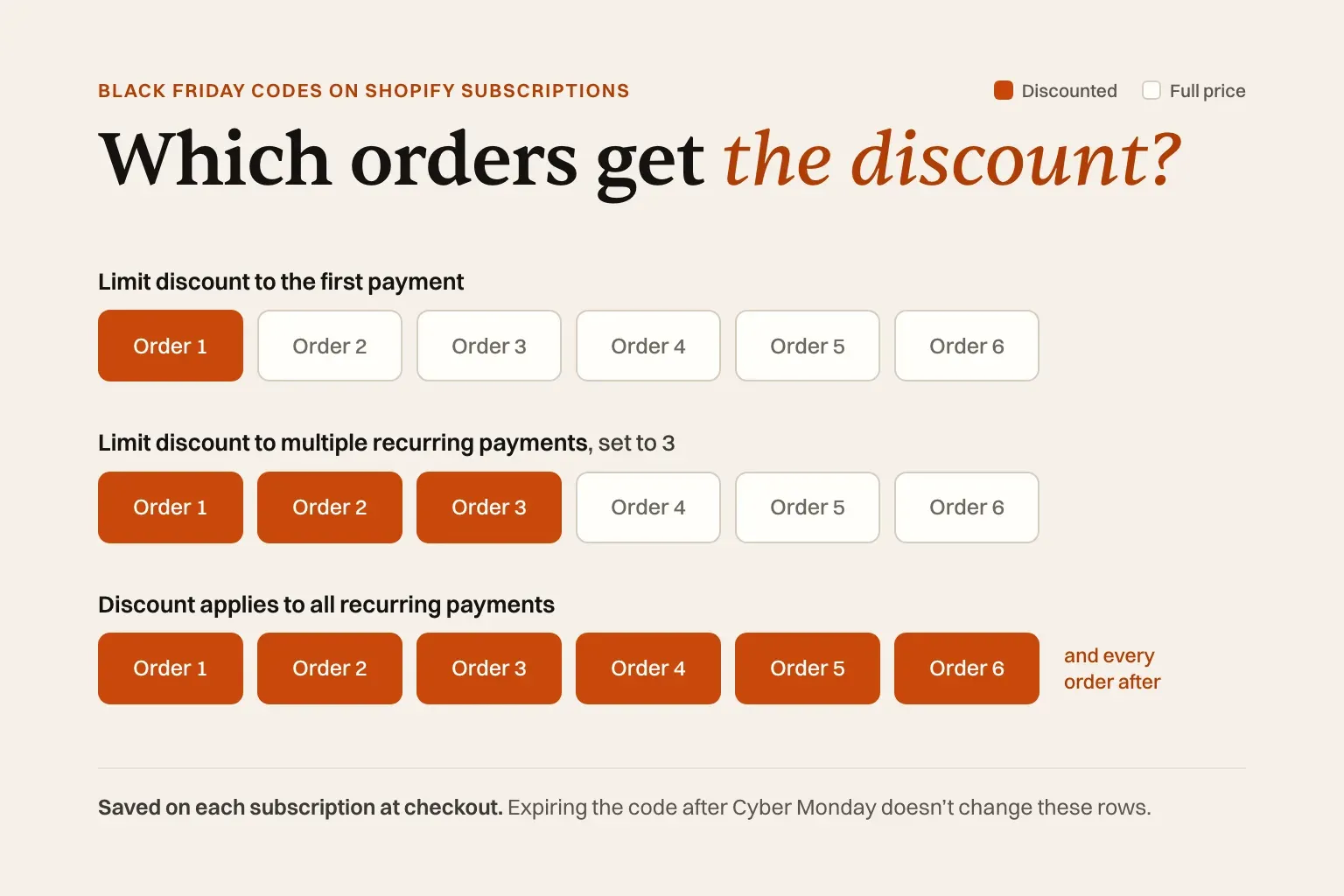
A first-order discount makes renewal 1, about 27 December, the first full-price charge. Three discounted orders move the step to renewal 3 in late February, and a code applied to all recurring payments never steps up. Shopify’s documentation says the code’s Recurring payments for subscriptions setting, saved with the discount on each subscription at checkout, decides which, as our guide to Black Friday codes on Shopify subscriptions explains. Whether the step comes from a code’s limit or from an introductory offer built into the plan, your subscription app applies it at renewal, so bill a test subscription past the step before the sale.
What the data says about the first full-price renewal
Recharge reports, across about 29.8 million subscriptions on its platform first paid between July and December 2025, that the share reaching a first renewal “is roughly flat down to about 40% off, then falls hard at free and near-free first orders” (Recharge, July 2026). Comparing subscribers inside the same store, across 350 stores, those whose first order was 60% off or more reached their first renewal at 55.1%, against 64.1% for those discounted under 20%, and 248 of the 350 stores showed the gap. Recharge calls this a strong association, not proof of cause. A near-free first box, more than a modest discount, is the offer whose step-up needs the most careful notice.
What the rules say about notice before a promotional price ends
This summarises published US rules as of 8 November 2026. It is information, not legal advice; the full summary is in our Black Friday strategy guide.
- California (Bus. & Prof. Code § 17602): if a promotional price applied for more than 31 days, a notice is due 3 to 21 days before it ends, stating the amount and how to cancel, with a cancellation link or another electronic way to cancel if emailed. One discounted monthly box probably falls under 31 days; three discounted months do not. A change in the fee charged needs 7 to 30 days’ notice, “including changes the consumer affirmatively consented to”, so treating even a one-box step-up as a fee change is the cautious reading.
- New York State (Gen. Bus. Law § 527-a): a temporary price needs “a clear and conspicuous explanation of how and when the price will change” before the customer agrees, and a price increase needs notice five business days to 30 days ahead, though whether a step-up disclosed at signup counts isn’t settled. New York City’s rule, in force since 1 October 2026, is similar.
- Massachusetts (940 CMR 38.00): an offer at a reduced charge for a limited time counts as a trial offer, which needs the calendar date to cancel by and the calendar date charges begin, given before the customer accepts. For plans that renew every 31 days or less, it also asks for either a notice 5 to 30 days before the cancel deadline or, at least as often as you charge, the amount charged and how to cancel, so put both in every renewal receipt.
A notice sent 10 to 21 days before the first full-price charge fits inside all of these windows. That is our reading of the overlap, not a legal standard. For a 27 November signup, it means 6 to 17 December after a first-order discount, or 6 to 17 February after three discounted orders.
How to word the step-up notice
Put the price and the date in the subject line, so the email works even unopened. Send it as its own message rather than inside a promotion, and send it to every affected subscriber, including those who unsubscribed from marketing email. Keep the cancel link in it, because California requires the cancellation route in the notice itself. A later price rise for existing subscribers is a separate job, covered in how to raise subscription prices without losing subscribers.
Example (illustrative, matching the offer in our strategy guide): Subject: Your next box is $45.00 on 27 December
Your Black Friday price of $27.00 covered your first box. From your next box, your subscription renews at the regular price of $45.00 every month until you cancel. Your next charge is on 27 December 2026.
Away for the holidays, or still have plenty? Skip December, or move your next box into January.
To stop before the $45.00 charge, cancel from your account by 26 December 2026: [Cancel subscription]. Questions? Reply to this email.
Why do Black Friday subscribers cancel in January and February?
Measured as a share of the subscribers who reach each renewal, Recharge’s cancellation rate peaks at the second renewal: 27.1% of subscribers who reached it cancelled, against 24.1% at the first, and roughly 72% of voluntary cancellations came within the first four renewals (Recharge, July 2026). For a 27 November signup, the second renewal is about 27 January, the subscriber’s third delivery. By then the first boxes have lost their novelty and the subscription has to earn its place on what arrives. Our post on why coffee subscribers cancel around month 3 covers what makes a third delivery worth keeping. With a Black Friday cohort you know the date in advance, so plan the January box and the email before it.
Failed payments after the holidays
Some January losses are involuntary churn: a renewal fails on an expired, declined or blocked card, and the subscriber never chose to leave. No source we checked compares subscription decline rates in January with other months, so plan from your own failed-payment rate. Two things are predictable. A card that expires at the end of December 2026 can fail at the January renewal: Shopify Payments works with the major card networks to update saved cards, which Shopify describes as widely supported in the US, so expect fewer expired-card declines, not none, and check what your gateway does. And renewal 1 is the first time a Black Friday subscriber’s card is charged without them at checkout.
A recovery sequence retries the declines that can change, such as insufficient funds, a few days apart, and emails a card-update link for the ones that can’t. How to recover failed subscription payments on Shopify covers which decline codes to retry and how to measure recovery per subscription. Count the cohort’s failed payments apart from its cancellations, because they need different fixes.
How do you tell whether a Black Friday cohort is holding up?
Tag Black Friday signups as they join and compare them with a normal cohort at the same renewal number, as set out in how to tell whether a Black Friday offer worked. For a renewal-by-renewal read, add two things. Count a failed payment as lost only if it isn’t recovered within 14 days of the failure; a fixed window measures every cohort the same way. And record skips and pauses on their own, because a December skip is only a save if January is paid. Shopify subscription analytics defines the underlying measures, including voluntary churn.
No comparison is clean. October signups had your normal offer but renew on a different calendar; last year’s Black Friday cohort met the same holidays, perhaps with a different offer. Use both if you can. With 40 Black Friday signups, each subscriber moves a rate by 2.5 points, so read the direction rather than the decimals.
What Recharge’s data says to expect
Recharge’s monthly-plan cohorts, from brands on its own platform between 2022 and 2024, don’t show Black Friday subscribers as weaker. Its Black Friday cohort covers signups from Thanksgiving to Cyber Monday (Recharge, September 2026):
| Monthly-plan cohort | Reached order 2 | Active at month 3 | Active at month 6 | Active at month 12 |
|---|---|---|---|---|
| Black Friday | 46.8% | 27.1% | 16.5% | 9.4% |
| Rest of year | 43.4% | 24.0% | 14.9% | 8.7% |
| New Year | 40.5% | 22.2% | 13.6% | 8.0% |
Recharge says part of the gap is category mix: its New Year monthly cohort was 51.6% food and beverage against 37.8% at Black Friday, and food and beverage retains worst. Category by category, the picture is mixed. Share of monthly subscribers still active at month 12:
| Category | Black Friday | New Year | Rest of year |
|---|---|---|---|
| Pet | 16.9% | 15.9% | 15.4% |
| Home | 17.9% | 22.2% | 21.3% |
| Health and wellness | 12.3% | 11.2% | 12.5% |
| Beauty and personal care | 7.5% | 9.8% | 10.5% |
| Food and beverage | 4.7% | 3.5% | 3.9% |
The same report found that brands which discounted 10 or more points deeper than their usual rate came out a median 2.5 points behind their own rest-of-year retention at month 13, while brands that didn’t discount deeper came out level. Recharge presents all of this as association, not cause, and measures retention by time rather than by renewal number, so compare your cohort with your own cohorts rather than with these figures. If your Black Friday cohort trails, check how far your discount went below your usual rate, and compare against your category’s row above, before blaming the date.
What should you do when a Black Friday subscriber cancels?
At the cancel button, a cancellation save flow that leads with a skip or a pause catches subscribers whose problem is timing. Ask for the reason, and keep answering optional, as Minnesota requires. “I still have plenty” is a skip waiting to happen; “too expensive” at the step-up is a price objection that a skip only postpones. Our guide to reducing subscription churn matches reasons to offers. Keep cancel within reach: California requires a “click to cancel” button beside any save offer shown during an online cancellation, and Minnesota requires the subscriber’s permission before one is shown, which you may ask for only once per cancellation attempt (Minn. Stat. § 325G.58).
After they leave, run win-back as a sequence from the day each subscriber left and their reason, rather than as a January broadcast. Someone who cancelled with stock in the cupboard may be ready again in one or two of their old intervals, when the stock runs out. Don’t send the Black Friday price back to everyone who cancels. If cancelling always earns the sale price, the sale price becomes the real price for anyone willing to cancel, and full-price subscribers learn that cancelling pays. Where you want an incentive, a non-price extra keeps the recurring price intact. Subscribers lost to a failed payment need a card-update link, not an offer.
What happens when a Black Friday gift subscription ends?
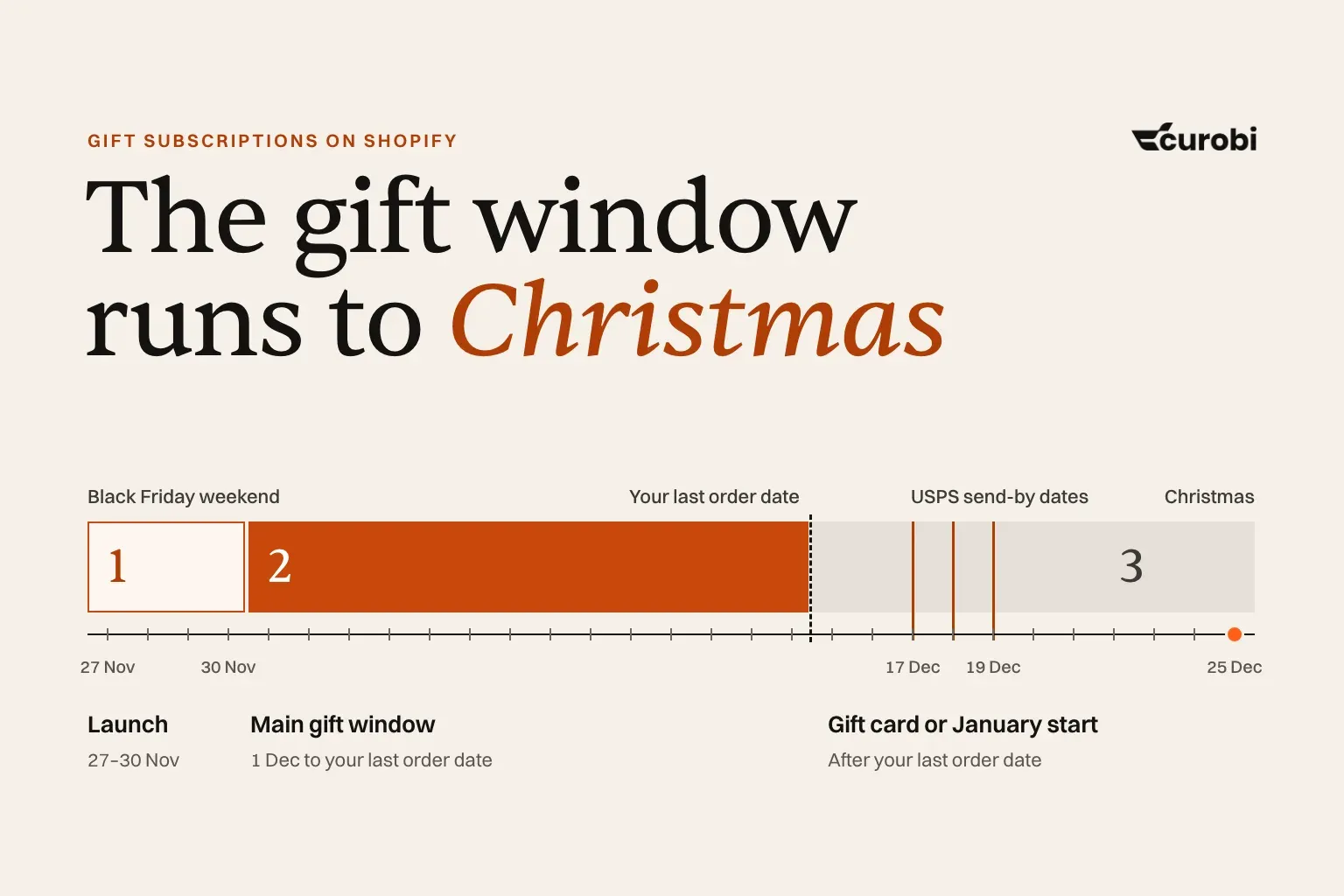
A three-month gift bought on Black Friday ends with its January box, or its February box if the first box was held until January and the billing dates moved with it; a two-month gift ends a month earlier. The recipient never chose to subscribe and the giver isn’t the person who would renew, so the last box is the retention moment. What to put in it, whom you may email and why a gift should never convert by default are covered in inviting the recipient to subscribe when a gift ends. Count gift recipients apart from your Black Friday cohort.
Checklist: keeping a Black Friday cohort through February
- Signup tagging is on before 26 November and tested with a sale-code order.
- The confirmation states both prices, the next charge date and how to skip, pause or cancel.
- A December email offering a skip or a January date is scheduled 10 to 21 days before renewal 1.
- The step-up notice has the price and date in its subject line and a cancel link, and reaches subscribers who unsubscribed from marketing email.
- Subscribers who skip or move the step-up renewal get the step-up notice again before the new date.
- A charge reminder goes out before every renewal, and its amount matches a test charge.
- Every renewal receipt shows the amount charged and how to cancel.
- Failed-payment retries and card-update emails are running before 27 December.
- The save flow leads with a skip or pause and keeps a cancel button beside it.
- Win-back is timed from the day each subscriber left, with no blanket Black Friday code.
- Checkpoints are booked for about 27 December, 27 January and 27 February, with failed payments read again about 14 days after each.
How to do this in Curobi
Curobi is a Shopify subscription app and publishes this blog, so this section describes our own product. The plan above works with any subscription app.
- Skip and pause (Free): subscribers can skip their next order or pause from the customer portal on every plan. A pause has no end date; the subscriber resumes it from the portal.
- Move the December order (Starter, $9.99): subscribers can change their next order date to a later one within a window you set, and change quantities or swap products on regular subscriptions.
- Klaviyo (Free): the Curobi Upcoming Charge metric arrives a few days before each charge with the amount, the date and a manage link. Curobi Subscription Started can start a Klaviyo flow with a time delay for the December email or the step-up notice, and the Curobi Next Charge Date and Curobi Active Subscriber profile fields support segments. A delay counted from signup stops matching once a subscriber skips or moves their date, so check each send against the Curobi Next Charge Date field, and check the amount in a test event first (Klaviyo integration). A notice you may be legally required to send must also reach subscribers who unsubscribed from marketing email: Klaviyo treats a flow email as marketing until it approves the email as transactional, and editing the email removes that status (Klaviyo Help Center).
- Shopify Flow (Free): the Subscription started trigger has a starter template, Tag customers when they start a subscription. Curobi sends Flow events only once a workflow using its trigger is on, with no replay, so switch it on before 26 November.
- Save offers (Starter): Curobi’s cancellation save offers put a pause or a skip in front of a cancellation made in the portal. They don’t include a discount. The cancellation reason survey is on every plan.
- Payment retries (Starter): when a renewal charge fails, Curobi retries it on days 2, 4 and 7, emails the customer a link to update their card, and pauses the subscription if every retry fails. For a charge that fails on 27 December, the retries fall on about 29 December, 31 December and 3 January. More on payment recovery.
- Cohorts (Growth, $19.99): cohort analytics group subscribers by signup month, so the November cohort mixes Black Friday and other signups; read the Black Friday group from the Shopify tag or the Klaviyo segment.
- Win-back (Business, $29.99): up to four emails on days you choose, counted from the date each customer cancelled, paused without resuming, or was lost to a failed payment, not sent as a calendar broadcast. Customers who already have an active subscription are left out, and an offer is optional.
- Minimum orders (every plan): if a plan sets a minimum number of orders, the portal won’t open the cancel flow until it is met and tells the customer how many orders remain. Disclose it before checkout and set it before the sale, because plan changes apply to new signups only. Cancels you make in Curobi’s admin aren’t blocked.
- Limits: Curobi can’t add a one-time item to a subscriber’s next order, change the discount on an existing subscription, pause until a set date or let subscribers change their delivery frequency in the portal, and it has no separate Black Friday cohort view.
Whichever app you use, Curobi included, take a test subscription through a renewal, a skip, a failed payment and, if you set a minimum number of orders, a cancel attempt in the portal before 27 December. The plans are Free ($0), Starter ($9.99), Growth ($19.99), Business ($29.99) and Pro ($69.99), each billed every 30 days; see what each plan includes.
Frequently asked questions
When do Black Friday subscribers usually cancel?
Mostly at their first two renewals. Recharge reports, from renewal cycles on its own platform between July 2025 and March 2026, that about 61% of voluntary cancellations happened at a subscriber’s first two renewals, with the highest rate at the second. For a monthly subscriber who joins on 27 November, those fall around 27 December and 27 January. The figures cover subscribers across brands on Recharge’s platform, not only Black Friday signups.
Do Black Friday subscribers stay longer in some categories than others?
In Recharge’s data, yes. Across monthly plans on its platform from 2022 to 2024, subscribers who joined between Thanksgiving and Cyber Monday were more likely than rest-of-year subscribers to be active at month 12 in pet (16.9% against 15.4%) and food and beverage (4.7% against 3.9%), about level in health and wellness, and less likely in home (17.9% against 21.3%) and beauty and personal care (7.5% against 10.5%). Recharge reports these as associations.
How far ahead should I tell subscribers that their Black Friday price is ending?
Sending the notice 10 to 21 days before the first full-price charge fits every US notice window we reviewed. California requires notice 3 to 21 days before a promotional price ends if it applied for more than 31 days, and 7 to 30 days before a change in the fee charged; New York requires 5 business days to 30 days before a price increase. Whether these cover a step-up agreed at signup isn’t settled. If a subscriber skips or moves that charge, send the notice again before the new date. This is information as of November 2026, not legal advice.
Should I offer a skip before the December renewal?
Yes, before the charge as well as in the cancel flow. A monthly subscriber who joined on Black Friday renews around 27 December, when some are away and some still have stock from the sale. An email 10 to 21 days ahead offering to skip December or move the order into January gives them a way out of one order without cancelling. Then check whether those skippers pay in January.
Should I send the Black Friday discount to subscribers who cancel?
Not as a blanket offer. If cancelling always earns the sale price, the sale price becomes the real price for anyone willing to cancel, and full-price subscribers learn that cancelling pays. Time win-back emails from the day each subscriber left and their reason, offer a skip or pause to people who left over timing, and send a card-update link to people lost to a failed payment.
What should a Black Friday step-up notice say?
The new price, the date of the first full-price charge, that the subscription renews until cancelled, and how to cancel, with a link. Put the price and the date in the subject line, send it as its own email rather than inside a promotion, and send it to every affected subscriber, including those who unsubscribed from marketing email. California requires its notice before a promotional price ends to explain how to cancel.
Sources
- Recharge (vendor data from subscription brands on its own platform, reported as associations): 2026 Black Friday marketing strategy for subscription brands (September 2026, updated October 2026), Subscription churn is front-loaded (July 2026), The first-order discount sweet spot (July 2026)
- Academic: Datta, Foubert and van Heerde (2015), “The Challenge of Retaining Customers Acquired with Free Trials”, Journal of Marketing Research 52(2) (Tilburg University record)
- State and city rules: California Bus. & Prof. Code § 17602; New York Gen. Bus. Law § 527-a; New York City click-to-cancel rule; Massachusetts 940 CMR 38.00; Minnesota Stat. § 325G.58
- Email platform: Klaviyo Help Center, How to use flows to send transactional emails
Checked on 8 November 2026. Dates are for BFCM 2026, and state rules keep changing, so recheck before planning BFCM 2027 from this page.