
Shopify subscription box apps, compared by the kind of box you run
The right Shopify subscription box app depends on which of four kinds of box you run. For a box of the month planned ahead on a calendar, Curobi, Easy Subscriptions and Supr document the feature in the documentation read on 13 November 2026. For contents that rotate through a sequence for each subscriber, Appstle, Loop, Recharge, Seal, Supr and others document swap rules or sequences. For a preset box at a fixed price, Joy, Loop, Recharge, Skio and others document one. For a box the customer builds, most paid subscription apps include a builder, while Bold and Seal rely on a second app. Shopify’s free Subscriptions app supports none of the four.
Curobi, which publishes this page, makes one of the apps compared here. To keep the comparison neutral, every table and list on this page puts the apps in alphabetical order, Curobi included, and every app gets a line on what it does not do. Features, plans and prices come from each vendor’s own pricing page, App Store listing or help centre, read on 13 and 14 November 2026; Curobi’s come from its own product documentation. Where a feature is described as “not in the documentation read”, that is what it means: the page did not mention it, which is not proof the app cannot do it.
This page compares box features only. For the subscription-app field as a whole, see the best Shopify subscription apps, with real costs. For setting one billing date, an order cutoff and a ship day for a box, see how to run a subscription box on one billing date. If you have not launched yet, the decisions that come before the app, from the kind of box to what one box earns after postage, are in how to start a subscription box business on Shopify.
Quick answer: which apps document which kind of box?
| Kind of box | What it means | Apps that document it, with the plan that carries it (read 13 November 2026) |
|---|---|---|
| Box of the month, planned on a calendar | You choose each period’s contents in advance; everyone billed in that period gets that period’s box | Curobi (Pro), Easy Subscriptions (Enterprise), Supr (every plan) |
| Contents that rotate per subscriber | Each subscriber moves through a sequence that starts at their own first order | Appstle (Business Premium), Awtomic, Easy Subscriptions (Enterprise), Kaching (every plan), Loop (Pro), Recharge (every plan), Seal (every plan, Free included), Supr (every plan) |
| Preset box at a fixed price | The same contents for every subscriber until you change them | Curobi (Pro), Easy Subscriptions (Growth), Joy (Starter), Loop (Starter), Recharge (Scale), Skio (Scale), Supr (every plan) |
| Customer-built box | The subscriber picks items within rules you set | Appstle (Business), Awtomic, Curobi (Pro), Easy Subscriptions (Growth), Joy (Starter), Loop (Starter), Recharge (Scale), Recurpay (Grow), Skio (Scale), Smartrr (Excel), Subi (plan not stated), Supr (every plan); Bold and Seal through a second app |
Two of these apps belong to larger groups: Skio is owned by Recharge, and is still sold and updated with no announced sunset, and Smartrr is owned by Relay Commerce.
What are the four kinds of subscription box?
Merchants use “subscription box” for four different set-ups, and the apps implement them differently.
- A box of the month planned on a calendar. You decide what goes in the March box, the April box and so on, ahead of time. Every subscriber billed in March receives the March box, whether they joined last year or last week. This is how a seasonal box, a curated discovery box or a roaster’s-choice coffee club usually runs.
- Contents that rotate per subscriber. You define a sequence, such as a starter kit, then refill A, then refill B. Each subscriber starts at step one on their own first order and moves one step per order.
- A preset box at a fixed price. You choose the contents once, and every subscriber receives the same box at the same price until you change it. A refill kit or a fixed sampler works this way.
- A customer-built box. You set the menu and the rules, such as “any 6 of these 12”, and each subscriber picks their own items. Apps call it build-a-box, build-your-own box (BYOB) or mix and match.
The first two are the pair most often confused. Take three subscribers who joined in January, February and March. On a calendar box, all three receive the April box in April. On a per-subscriber rotation, in April the January subscriber receives step 4, the February subscriber step 3 and the March subscriber step 2. Neither is better in general: a calendar box suits anything you announce as “this month’s box”, and a rotation suits a journey every subscriber should take in order. The trade-off for coffee is set out in why variety rotation is the hardest part of a coffee subscription, and the choice between a merchant-curated and a customer-built box in build-your-own vs curated subscription boxes.
What can Shopify do without a box app?
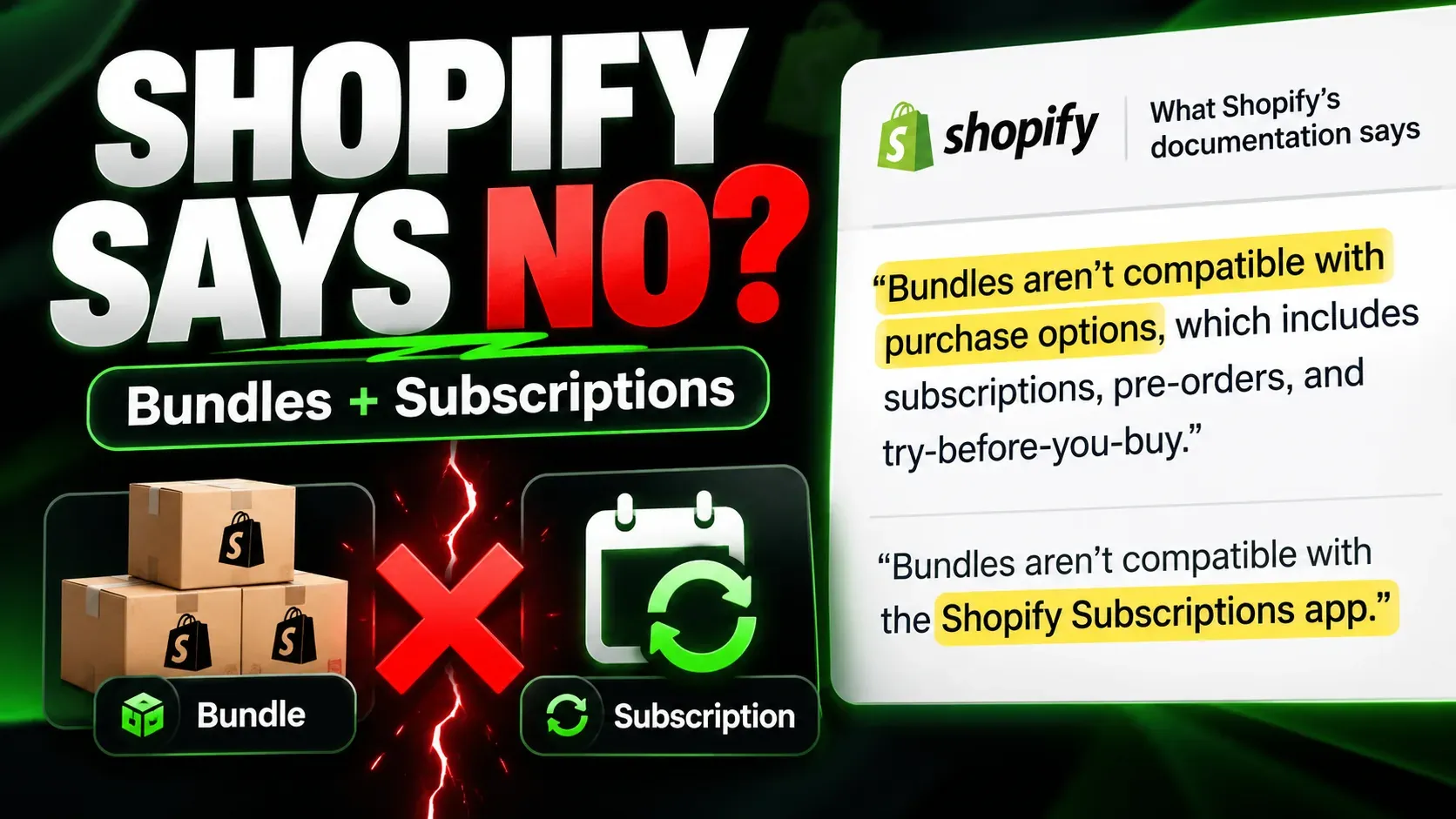
Not a box. Shopify’s free Subscriptions app documents no box or build-a-box feature, and its Help Center states that “Bundles aren’t compatible with the Shopify Subscriptions app” (Shopify Help Center, read 14 November 2026). The platform rule is wider than the free app: Shopify’s developer documentation says “Bundles can’t be sold with selling plans, such as subscriptions, pre-orders, and try-before-you-buy” (shopify.dev, About product bundles, read 13 November 2026). So a bundle made with Shopify’s own bundle tools cannot be the subscription product, and a box sold on subscription needs a subscription app that builds the box itself.
The free app does document a specific billing day, so a store can bill every subscriber on one date without a paid app. What it does not do is decide what goes in the box. The workarounds that stay inside Shopify’s own tools are covered in can you sell a bundle on subscription in Shopify?, and the wider limits of the free app in Shopify Subscriptions vs a subscription app.
Which apps run a box of the month planned on a calendar?
Three apps document a store-wide box chosen ahead by calendar period, in the documentation read on 13 November 2026.
| App | What its documentation describes | Plan and price, read 13 November 2026 | What it does not do, in the documentation read |
|---|---|---|---|
| Curobi | Curated Boxes: the box editor covers the current month and the next three. Each month is its own box, applied to each subscriber’s renewal before it bills, and a month never planned falls back to the latest published box. Publish shipment freezes a month’s contents; a packing-list CSV lists units needed, in stock and short by for each variant. The same box can be sold one-time. | Pro, $69.99 every 30 days; included in the one-time 14-day trial on the Free plan | Documents monthly boxes only, planned four months ahead, with no weekly boxes or per-size contents; subscribers cannot swap items inside a curated box; the packing list does not cover Build-a-Box or one-time box sales. A new app: on the App Store since 10 August 2026, with one review on 13 November 2026. |
| Easy Subscriptions | Time-based series, “also referred to by merchants as a calendar swap subscription”: a sequence of deliveries, commonly 10 to 12, each assigned a product by calendar date, so every customer gets the product for that date regardless of when they joined | Enterprise, $399 a month | The calendar series is not on its $39 or $99 plans; its series help page mentions no order cutoff |
| Supr | “Subscription box” type, shipped 7 October 2026: products chosen in advance “as far ahead as you like”, weekly or monthly. The page lists the current period and the next five, products can go to every size or one size, the box can be revealed in the portal from a set date or kept a mystery, and each box shows how many orders are due in it. | Every plan: free up to $1,000 of monthly Supr revenue, then $19, $29, $49, $99, $199 or $399 by revenue band | Customers “cannot swap, remove or change” box products; an order billed in a period with no box set “ships the box product alone”; its box article mentions no cutoff and no separate packing list (each order carries a note naming the box and its contents) |
Of the three, Supr documents the longest planning window and weekly boxes, Easy Subscriptions has the highest entry price for the feature, and Curobi documents a packing-list download and one-time sales of the same box, which Supr’s box article does not describe.
Not documented as a calendar box, in the documentation read on 13 November 2026: Appstle and Seal, which rotate contents per subscriber; Bold, Loop, Recharge and Skio, which document preset boxes or per-subscriber sequences. Ordergroove markets “rotating monthly clubs”, but publishes only a minimum price of $2,917 a month on its App Store listing, and the page read does not say how contents are planned. Joy lists a mystery subscription box on its Professional plan ($199 a month + 0.5% per transaction), and Subi’s Mystery Box article describes one box product on a selling plan with no tool for choosing each cycle’s contents.
Which apps rotate contents per subscriber?
| App | What its documentation describes | Plan and price, read 13 November 2026 | What it does not do, in the documentation read |
|---|---|---|---|
| Appstle | Product swap rules in Journeys: a rule runs after every recurring order or after a specific order, such as the 2nd, and can be limited by selling plan, customer tag, billing country or next order date. The change applies from the subscription’s next order. | Business Premium, $100 a month (up to $100,000 of monthly subscription revenue) | No month-by-month box planner in the help articles read; each step of a rotation is a separate rule |
| Awtomic | “Shuffles”: rotating sequences that loop through a list | One public plan, $299 a month + 1% per order | Its Shuffle docs (updated September 2025) say orders are placed regardless of inventory and customers cannot yet see or change what is coming up |
| Easy Subscriptions | Order-based series tied to each customer’s own order count, “always starting at order 1”, with an optional repeat | Enterprise, $399 a month | A subscriber who joins late starts at step one, not at the current calendar step |
| Kaching | “Schedule product swaps, starter kits and refills automatically” | Every band, $9.99 to $299.99 a month by subscription revenue | Only its product page was read; no set-up documentation for the rotation |
| Loop | Ongoing order sequence, fixed order sequence and starter-to-refill swap | Pro, $399 a month + 0.75% | Not on the $99 Starter plan |
| Recharge | “Product journeys & scheduled experiences”, with looping or fixed sequences | Every plan, from Starter at $149 a month + 1.50% + 20¢ per transaction (stores installing from 2 November 2026) | Preset and customizable bundles are not on Starter; they need Scale at $499 + 1.25% + 20¢ |
| Seal | Product chain: automated swaps keyed to each subscriber’s payment number, for example “Between initial order and 2nd payment” | Every plan, Free included (free up to 50 subscriptions, then $5.95 to $399 by subscription count) | Swaps follow each subscriber’s own payment count, not a shared month |
| Supr | “Rotating products” type, which ships the next step of a list with every order (changelog, 7 October 2026) | Every plan | Each subscription moves one step per order, so subscribers who joined at different times are on different steps |
Bold’s help centre says “Bold Subscriptions does not offer the ability to set up a subscription that alternates between different products on a set schedule” (6 July 2026). Curobi does not document a per-subscriber sequence: its curated box is the same for everyone billed in a given month.
Which apps sell a preset box at a fixed price?
| App | What its documentation describes | Plan and price, read 13 November 2026 | What it does not do, in the documentation read |
|---|---|---|---|
| Curobi | A curated box whose contents you publish once; later months fall back to the latest published box, so every subscriber keeps receiving it until you publish a change | Pro, $69.99 every 30 days | No preset box below Pro; Mix & Match on the Business plan is a discount bundle the customer fills, not a preset box |
| Easy Subscriptions | “Curated subscription boxes” | Growth, $39 a month, up to 1,000 subscription orders | Bundle presets and curated bundle sequences are on Enterprise ($399); its pricing page counts the order cap over the store’s lifetime, so the plan can change as orders accumulate |
| Joy | Fixed bundle: several products sold as one item at one price; Joy adds each child product to the order at $0 and every renewal includes the same bundle | Starter, $49 a month + 0.75% per transaction | Changing a fixed bundle’s contents by month is not described |
| Loop | Preset bundles, “pre-configured with a fixed set of child items defined by you”; customers “are not able to modify or change the products within the bundle” | Starter, $99 a month + 1.0% (plus 15¢ per loyalty order) | Its bundles FAQ (11 September 2026) does not cover changing preset contents for existing subscribers or scheduling them by month |
| Recharge | Preset Bundles, “pre-configured bundles of products at a set price”; fixed-price bundles gained full prepaid support on 2 November 2026 | Scale, $499 a month + 1.25% + 20¢ | Not on Starter ($149 + 1.50% + 20¢) |
| Skio | Preset boxes in Build-a-Box, added 12 October 2026: “Lock a box’s products, quantities, and price so every subscriber gets the same box” | Scale, $599 a month, or $499 a month billed annually, + 1.25% + 20¢ on orders involving a subscription | Its Build-a-Box FAQ (11 September 2026) says Build-a-Box isn’t compatible with Local Delivery and works only on the Online Store channel; no free plan |
| Supr | Fixed bundles, listed on its every-plan feature list | Every plan | Only the pricing page’s feature list was read for fixed bundles |
Stay AI lists “Bundles & Boxes” among the tools included in its Standard plan ($299 a month on an annual contract or $499 without one, + 1% + 19¢); the feature was not inspected beyond its name. Subi’s pricing page lists “Subscription bundles and box” and “Bundles” without saying which plan carries a fixed bundle.
Which apps let customers build their own box?

| App | What its documentation describes | Plan and price, read 13 November 2026 | What it does not do, in the documentation read |
|---|---|---|---|
| Appstle | Build-a-Box at a fixed price (set by a parent product) or a dynamic price (the sum of the items, with minimum and maximum counts and tiered discounts) | Business, $30 a month (up to $15,000 of monthly subscription revenue) | Product swaps need Business Premium ($100); a one-time box sale is a workaround that sets the maximum number of orders to 1 |
| Awtomic | Build-a-Box with fixed and dynamic pricing | $299 a month + 1% per order | No free or low-cost plan |
| Bold | Build-a-box “type subscriptions” through the separate Easy Bundles app | Bold from $24.99 a month + 2%, plus Easy Bundles (price not collected) | No builder inside Bold Subscriptions |
| Curobi | Build-a-Box: subscribers pick their items for each cycle before the cutoff, from one stable menu or a rotating monthly menu planned up to four months ahead; a whole-box configurator in the customer portal; the product page blocks Add to cart until the minimum is picked. Mix & Match, a bundle whose discount grows with its size, is on the Business plan at $29.99. | Pro, $69.99 every 30 days; included in the one-time 14-day trial on the Free plan | No packing list for Build-a-Box; a box program pauses when the trial ends unless the store moves to Pro |
| Easy Subscriptions | “Build a Box (BYOB) bundles” | Growth, $39 a month, up to 1,000 subscription orders | The order cap counts lifetime orders on its pricing page, so the plan can change as orders accumulate |
| Joy | Subscription Box: customers choose products, quantities and delivery frequency, with minimum and maximum rules | Starter, $49 a month + 0.75% per transaction | A percentage fee on every paid plan |
| Kaching | Build a box, launched 12 November 2026 in the separate Kaching Bundles app | Kaching Subscriptions from $9.99 a month, plus Kaching Bundles from $14.99 | Its launch note says “Subscriptions aren’t supported”: items are added as one-time purchases |
| Loop | Build-your-own bundles | Starter, $99 a month + 1.0% | No order sequences on Starter |
| Recharge | Customizable Bundles, “Allow customers to mix and match products” | Scale, $499 a month + 1.25% + 20¢ | Not on Starter ($149 + 1.50% + 20¢) |
| Recurpay | Build a box: a fixed box (a set number of products at a fixed price or discount) or a dynamic box; sold one-time, on subscription or both | Grow, $19 a month; its 0% fee is labelled a “BFCM Special” | No merchant-curated box documented; no revenue cap printed on Grow |
| Seal | A customer-built box through the separate Bundler app’s Mix & Match bundle, plus a Seal subscription rule | A Seal plan by subscription count (free up to 50, then $5.95 to $399) plus Bundler Premium at $9.99 a month | No builder inside Seal |
| Skio | Build-a-Box, static, dynamic or sectioned; in a static box customers can swap items as long as the total stays the same | Scale, $599 a month, or $499 billed annually, + 1.25% + 20¢ | Not compatible with Local Delivery; Online Store channel only |
| Smartrr | “Build-a-box bundles” | Excel, from $499 a month + 1% of subscriber GMV | Not on Launch ($99) or Grow ($299) |
| Subi | Build-a-Box: customers choose from a list you curate, at a fixed price such as “$40 for any 6 items” or at a discount, with a price per box size | Paid plans from $29 a month + 1.6% (stores installing from 2 November 2026); the pricing page does not say which plan carries it | A percentage fee on every paid plan |
| Supr | Build-your-own boxes on every plan; since 21 September 2026 a subscriber can open the box in the customer portal and change it | Every plan | Its price band counts subscription and bundle revenue, so the bill rises as the box program grows |
Several free apps on page 1 of the App Store search for “subscriptions” also list box features on their listings: Beez (“Mix & Match boxes and fixed bundles”), Fast Subscriptions (“subscription boxes”) and TA Subscriptions (“build-a-box”). Those claims come from the listings only and were not verified in documentation. Casa claims build-a-box on any plan, with no public feature documentation found.
What does a box app cost at four store sizes?
The table below is an illustrative model, not a quote. It assumes a store that runs a box program, a $40 average box, and one active subscriber per monthly order, so $5,000, $15,000, $50,000 and $100,000 of monthly subscription revenue mean 125, 375, 1,250 and 2,500 subscribers. It uses list prices on monthly billing read on 13 November 2026 and the cheapest plan that carries a box, and applies each percentage fee to subscription revenue only. It ignores trials, promotions, yearly discounts and negotiated rates. Shopify’s own payment processing fees apply on top with every app.
| App and plan (box program, monthly bill) | $5,000 (125 subscribers) | $15,000 (375) | $50,000 (1,250) | $100,000 (2,500) |
|---|---|---|---|---|
| Appstle (Business, then Business Premium) | $30 | $30 | $100 | $100 |
| Awtomic | $349 | $449 | $799 | $1,299 |
| Curobi (Pro) | $69.99 | $69.99 | $69.99 | $69.99 |
| Easy Subscriptions, calendar series (Enterprise) | $399 | $399 | $399 | $399 |
| Joy (Starter, or Professional where cheaper) | $86.50 | $161.50 | $424 | $699 |
| Loop (Starter) | $149 | $249 | $599 | $1,099 |
| Recharge (Scale) | $586.50 | $761.50 | $1,374 | $2,249 |
| Recurpay (Grow, then Scale) | $19 | $19 | $19 or $99 | $99 |
| Seal plus Bundler Premium | $19.94 | $34.94 | $99.94 | $208.99 |
| Skio (Scale, billed annually) | $586.50 | $761.50 | $1,374 | $2,249 |
| Skio (Scale, billed monthly) | $686.50 | $861.50 | $1,474 | $2,349 |
| Smartrr (Excel) | $549 | $649 | $999 | $1,499 |
| Supr | $29 | $49 | $99 | $199 |
Left out: Bold (the Easy Bundles price was not collected), Kaching (its box builder does not sell on subscription), and Stay AI and Subi (the plan and feature behind their boxes were not confirmed). Easy Subscriptions’ Growth plan, which carries its build-a-box and curated boxes, costs $39 until a store passes 1,000 orders, then $99, and its pages disagree on whether that cap is per month or lifetime. The model understates Recharge, whose fee is charged on shipping, taxes, refunded orders and one-time orders too, and Loop for stores that use its loyalty programme.
On these inputs, Curobi Pro at $69.99 costs more than Appstle, Supr and Seal with Bundler for a box program under about $15,000 a month, and less above that. At $5,000 and $15,000 a month Appstle is $30, Supr $29 or $49 and Seal with Bundler $19.94 or $34.94; at $50,000 they are $100, $99 and $99.94. Seal’s switch point is set by subscriber count rather than revenue, at 500 subscribers, which is $20,000 a month at a $40 box. Recurpay ($19 on its current promotion) and Easy Subscriptions’ Growth plan ($39) also cost less than Curobi Pro at the smaller sizes. Curobi Pro costs less than every percentage-fee app in the table at every size modelled.
Order value moves every one of these switch points, because Appstle and Supr price by revenue while Curobi prices by plan. At a $25 box, Appstle’s $15,000 band holds 600 orders a month rather than 375; at an $80 box, a store with 190 subscribers is already past it. To compare apps for your own store you need three numbers: your subscriber count, your average order value, and whether you run boxes at all. Costs for plain subscriptions without boxes, where the ranking changes, are worked through in the best Shopify subscription apps, with real costs, and the fee models themselves in flat fee vs percentage of revenue.
What do box operators say is hard?
App Store reviews and forum threads from August to November 2026 show where box operators get stuck. These are individual accounts, not a measurement:
- Changing what is in the box. A wine club on Shopify’s free app wanted a seasonal switch from reds to whites without members cancelling and resubscribing (App Store review, 12 September 2026).
- Setting up a builder alone. Merchants describe build-a-box set-ups completed with the vendor’s support team, on Appstle (14 August and 1 September 2026), Joy (5 September), Recurpay (8 October) and Subi (12 November), and a Loop reviewer said the bundle builder changed without warning (15 September 2026).
- Stock for customer-chosen contents. A store owner said Shopify’s free Bundles app broke at “pick any 3 of 8 flavours” because of its variant and option limits (r/ecommerce, 2 November 2026), and a soap club asked how to deduct inventory reliably for subscription bundles (Shopify Community, 8 October 2026).
- It works for some. A merchant running two monthly boxes on Appstle said it “works seamlessly” (26 September 2026).
The common thread is that the hard parts are contents changes, dates and stock, and that merchants often lean on a support person to get there. Billing dates and cutoffs are the subject of the one-billing-date how-to.
What should you ask a box app before choosing it?
- Is the box chosen by calendar period or by each subscriber’s order count? If you announce “the March box”, you need the first.
- What ships if a period is never planned? The answers differ: Supr ships the box product alone, and Curobi falls back to the latest published box.
- Can subscribers change items inside the box, and do you want them to? Curated boxes are usually locked; built boxes are usually editable until a cutoff.
- Is the box in the subscription app, or in a second app with its own bill and its own support?
- Which plan carries the box, and what makes the price rise: revenue, subscriber count, order count or a percentage?
- Can the same box be sold one-time as a gift or trial? Some apps document it directly, others through a workaround.
What Curobi documents for boxes
Curobi’s box features sit on its Pro plan at $69.99 every 30 days, with 0% Curobi transaction fees; Shopify’s payment processing fees still apply. Pro carries Curated Boxes, Build-a-Box, one-time box sales, and fixed-calendar billing schedules, which bill every subscriber on the same date and are limited to monthly plans. The one-time 14-day trial on the Free plan includes Curated Boxes and Build-a-Box, and either box can be sold on subscription or one-time during it; fixed-calendar schedules are not part of the trial. When the trial ends, or after a downgrade below Pro, a box program pauses: subscribers keep renewing with their current items, no new months are applied, and new box checkouts are refused. Mix & Match bundles are on the Business plan at $29.99. Plan limits count active subscriptions created through Curobi, not orders or revenue, and Pro has no subscription limit.
In the Curated Boxes editor, each month from the current one to three months ahead is its own box, and the right month’s contents are applied to each subscriber’s renewal before it bills. Publish shipment freezes a month, and Send now previews which month’s box each group of subscribers gets before anything changes. A packing-list download lists each variant with the units needed, the stock on hand and the shortfall, counted at the moment of download. Subscribers cannot swap items inside a curated box. Build-a-Box uses one stable menu or a rotating monthly menu, and subscribers change their picks in the customer portal before the cutoff. Every in-app feature is free on a Shopify development store, so a box can be set up and tested there before a live cycle.
Frequently asked questions
Does Shopify have a built-in subscription box feature?
No. Shopify’s free Subscriptions app documents no box or build-a-box feature, and its Help Center states that bundles aren’t compatible with the app. Shopify’s developer documentation also says bundles can’t be sold with selling plans such as subscriptions. A box sold on subscription therefore needs a subscription app with its own box feature. The free app does document a specific billing day for every subscriber on a plan.
Which Shopify apps let you plan a box of the month ahead?
In the documentation read on 13 November 2026, three: Curobi, whose box editor covers the current month and the next three on its Pro plan at $69.99 every 30 days; Easy Subscriptions, whose time-based series assigns a product to each delivery by calendar date on its Enterprise plan at $399 a month; and Supr, which sets weekly or monthly boxes as far ahead as you like on every plan, free up to $1,000 of monthly Supr revenue and then $19 to $399. Other apps rotate contents through a sequence that starts at each subscriber’s first order, or keep one preset box.
What is the cheapest app for a subscription box on Shopify?
It depends on the kind of box and the size of the program. On list prices read on 13 November 2026, for a program of 125 subscribers at $40 a box, Recurpay ($19), Seal with the Bundler app ($19.94), Supr ($29) and Appstle ($30) are the lowest-priced paid routes to a build-your-own box, and Supr is the lowest-priced app that documents a box of the month planned on a calendar. Appstle and Supr price by revenue, so their bills rise as the program grows: at $50,000 a month they reach $100 and $99. Several free apps list box features, but their claims were not verified.
Do I need a second app for a build-your-own box?
With most subscription apps, no: Appstle, Awtomic, Curobi, Easy Subscriptions, Joy, Loop, Recharge, Recurpay, Skio, Smartrr, Subi and Supr document a builder inside the app, each on a specific plan. Bold relies on the separate Easy Bundles app, and Seal on the separate Bundler app with its Mix & Match bundle type. Kaching launched a box builder in its separate Bundles app on 12 November 2026, and its launch note says subscriptions are not supported there: items are added as one-time purchases.
What is the difference between a box of the month and a product rotation?
A box of the month is planned on the calendar: everyone billed in March receives the March box, whenever they joined. A product rotation is a sequence that starts at each subscriber’s first order, so in the same month a subscriber who joined in January receives a different step from one who joined in March. A box of the month suits a seasonal, curated or roaster’s-choice program; a rotation suits a starter kit followed by refills, or products every subscriber should receive in order.
Sources
- Shopify: Help Center, Shopify Subscriptions eligibility considerations (read 14 November 2026); developer documentation, About product bundles (read 13 November 2026).
- Calendar boxes, read 13 and 14 November 2026: Supr, Subscription boxes, pricing and changelog; Easy Subscriptions, time-based series and pricing.
- Rotation, read 13 and 14 November 2026: Appstle, product swap automation with Journeys; Awtomic, Shuffle bundles and pricing; Easy Subscriptions, order-based series; Kaching, Subscriptions; Bold, alternating coffee schedule; Seal, product chains and pricing.
- Preset and customer-built boxes, read 13 and 14 November 2026: Appstle, App Store listing and Build-a-Box types; Bold, build-a-box using Easy Bundles; Bundler, App Store listing; Joy, App Store listing, Subscription Box and fixed bundle; Kaching, Build a box changelog; Loop, pricing and Bundles FAQs; Recharge, pricing; Recurpay, pricing and Build-A-Box guide; Seal, How to offer your customers a subscription box; Skio, pricing, changelog and Build-a-Box FAQ; Smartrr, pricing; Stay AI, pricing; Subi, pricing, Build-a-Box and Mystery Box.
- Ordergroove, Bundles & Clubs and App Store listing, read 13 November 2026.
- Merchant accounts: the App Store reviews and threads linked in the section on what box operators say is hard, dated 14 August to 12 November 2026. These are individual accounts, not measurements.
Prices and plan gates read on 13 and 14 November 2026. Subscription apps changed their published terms often in late 2026, so re-check before you decide.