
How to start a subscription box business on Shopify (2027)

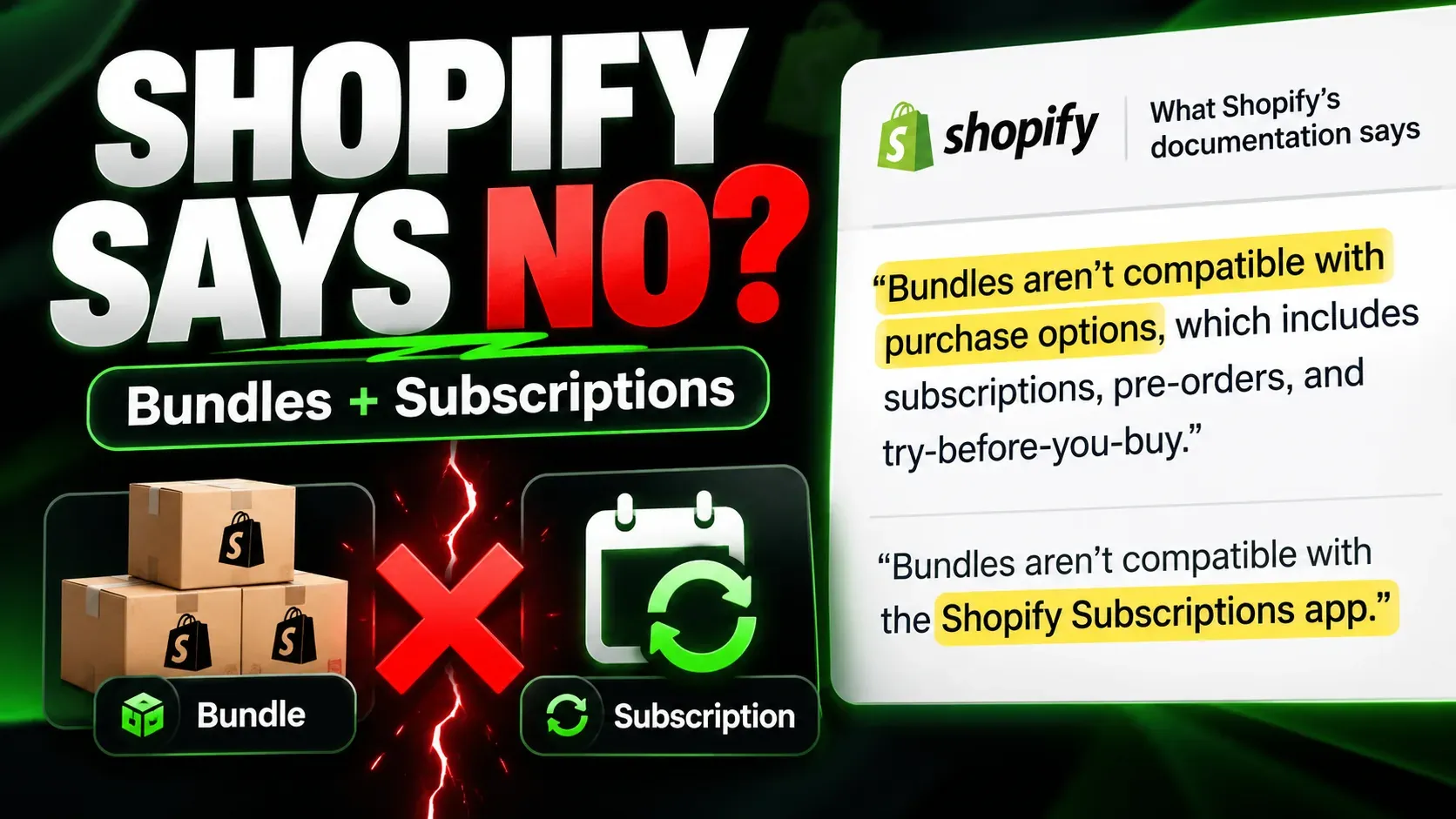
To start a subscription box business on Shopify, make the decisions in this order: choose the kind of box, price it from the full cost of one delivered box and check how many boxes it takes to earn back what you spend winning a subscriber, choose between rolling billing and one shared charge day, set the order cutoff and ship day, plan stock from the count at the cutoff, launch with a waitlist or paid founding sign-ups, and work on retention from the first box. On Shopify you also need a subscription app that builds the box, because Shopify’s own bundles cannot be sold on subscription.
Most guides to this question stop at “pick a niche, source products, find packaging, build a store”. This one adds three things those guides leave out: a worked cost sheet for three example boxes with every assumption stated, the order in which the decisions constrain each other, and the problems that only appear at the second, third and fourth boxes. The examples come from several categories (snacks, beauty, kids’ activity kits, pet, books and coffee) because the arithmetic and the failure points are the same shape in all of them.
Last checked: 17 November 2026. Curobi, which publishes this page, sells a Shopify subscription app. The cost sheet is our arithmetic on assumptions we chose, labelled as such; it is not a benchmark. Third-party figures carry their source and date.
Quick answer: how do you start a subscription box business on Shopify?
- Pick the kind of box first. A box of the month, a fixed sequence, a preset box or a customer-built box each lead to different billing, stock and app choices.
- Price from the full cost of one delivered box, not from product cost. Postage and pick and pack can cost more than the products.
- Check payback before you spend on ads: how many boxes it takes to earn back the cost of winning one subscriber, counting the ones who cancel.
- Decide how billing works: each subscriber on their own date, or everyone on one charge day with an order cutoff and a ship day.
- Buy stock for the count at the cutoff, plus a small buffer, and know what ships if something runs short.
- Launch with a waitlist or paid founding sign-ups with a ship date you can meet.
- Expect the hard months to be 2 to 4. On Recharge’s data, most voluntary cancellations happen at the first two renewals.
How do you start a subscription box business, step by step?
- Choose the kind of box. Decide who chooses the contents: you, on a calendar (a box of the month), a fixed sequence each subscriber moves through, one preset box, or the subscriber picking from a menu you set. Every later decision depends on this one.
- Price it from the full cost of one box, then check payback. Add products, packaging, pick and pack, postage, the payment fee and your app’s cost per box, and subtract them from the price. Then work out how many boxes it takes to earn back what you spend to win a subscriber, allowing for the subscribers who cancel.
- Choose how subscribers are billed. Bill each subscriber on their own sign-up date (rolling), or bill everyone on one charge day so the whole batch is bought, packed and shipped together.
- Set the order cutoff and the ship day. On one charge day, work back from the ship day: the charge day comes early enough to pack and retry failed payments, and the cutoff comes a few days before that.
- Plan stock from the count at the cutoff. Buy for the subscribers due at the cutoff plus a small buffer, check supplier lead times against the cycle, and decide what ships if an item runs short.
- Launch with a waitlist or paid founding sign-ups. Collect emails before you have stock, or take paid sign-ups with a stated first ship date that you can meet, then size the first batch from real orders.
- Work on retention from the first box. Plan the first three boxes before launch, make skip and pause easy to find, and watch renewals 1 and 2, where most cancellations happen.
The order matters because each step narrows the next. A box of the month almost always wants one charge day; a customer-built box needs an edit cutoff whichever way it bills; and the price you can charge decides whether paid acquisition works at all. The sections below take each step in turn.
Which kind of subscription box should you start with?
“Subscription box” covers four set-ups that work differently once subscribers start renewing.
| Kind of box | Who chooses the contents | Category examples | Main operating risk |
|---|---|---|---|
| Box of the month, planned on a calendar | You, for each month, for every subscriber at once | A themed snack box, a seasonal beauty box, a book club’s monthly pick | Planning a new box every month on time, and repeats for long-standing subscribers |
| Sequence per subscriber | You, once, as an ordered series each subscriber starts at step one | A kids’ activity kit series, a starter kit then refills | Subscribers at different steps need different stock each month |
| Preset box | You, once, the same for everyone until you change it | A pet treat refill box, a fixed coffee sampler | The box gets familiar, so perceived value can fall |
| Customer-built box | The subscriber, within rules you set, such as “any 6 of these 12” | A snack box with flavour picks, a coffee box choosing beans | Stock for choices you don’t control, and subscribers who never pick |
Choose a box of the month when the surprise is the product and you can plan ahead. Choose a sequence when the box is a journey, such as a skill or a course of kits, that should be taken in order. Choose a preset box when the box is really a refill of things people use up. Choose a customer-built box when subscribers have strong preferences, such as flavours, shades or dietary needs, that a single box would get wrong.
The difference between merchant-curated and customer-built boxes, and when to run each, is set out in build-your-own vs curated subscription boxes. The mechanics of a built box (menu, pick limit, price and what ships when nobody picks) are in build-your-own boxes on Shopify, and which apps support which kind is in Shopify subscription box apps, compared by box type.
What does one subscription box really earn? A worked example
The quickest way to find out whether a box business can work is to cost one delivered box and then ask how many boxes a subscriber has to stay for before the box has paid for the cost of winning them. The three boxes below are hypothetical examples with numbers we chose, to show the method. They are not benchmarks, and none of them is a real company’s costs.
The assumptions
- Price includes shipping, so the subscriber sees one number.
- Products are the landed cost of what goes in the box.
- Packaging is the mailer, filler and printed insert.
- Pick and pack is a 3PL’s per-order fee, or your own packing time costed at a wage.
- Postage is a placeholder for a domestic parcel of the box’s weight. Quote your own: it depends on weight, size, zones and carrier.
- Payment fee is 2.9% + 30¢ a charge, the US online card rate Shopify lists for its Basic plan (November 2026). Rates vary by plan, country and card.
- App fee is a flat $70 a month spread over 200 subscribers, $0.35 a box. Box-app list prices at roughly that size run from about $20 to several hundred dollars a month, and some apps add a percentage of each order instead; see what box apps cost at four store sizes.
- Customer acquisition cost (CAC) is $40 per new subscriber, for all three boxes.
- Left out on purpose: the Shopify plan, design, photography, returns, replacements, your own time and tax. Those are real costs, but they don’t change with each box shipped.
The cost of one delivered box
| Per box, in US dollars | Snack box | Kids’ activity box | Beauty sample box |
|---|---|---|---|
| Price, shipping included | 32.00 | 38.00 | 25.00 |
| Products | 10.00 | 12.00 | 6.00 |
| Packaging | 2.00 | 2.50 | 1.50 |
| Pick and pack | 3.00 | 3.00 | 2.50 |
| Postage | 9.00 | 10.00 | 5.50 |
| Payment fee (2.9% + 30¢) | 1.23 | 1.40 | 1.03 |
| App fee ($70 a month over 200 subscribers) | 0.35 | 0.35 | 0.35 |
| Contribution per box | 6.42 | 8.75 | 8.12 |
| Product margin (price less products only) | 69% | 68% | 76% |
| Contribution margin (price less every per-box cost) | 20% | 23% | 32% |
Look at the gap between the last two rows. Every box clears a 50% margin on product cost alone, but after the costs of getting it to the door, the snack box keeps 20 cents of each dollar. Postage and pick and pack together are $12 on the snack box, more than the $10 of snacks inside it. Not everyone counts shipping in the cost base: Cratejoy’s guide to pricing a box recommends “at least a 50% profit margin” and includes shipping, while noting that some owners leave it out. Leave it out and a box can look healthy on paper while losing money on every order.
How many boxes until a subscriber pays back?
A subscriber pays back when the contribution from their boxes adds up to what it cost to win them. If nobody ever cancelled, that is simply CAC divided by contribution. Subscribers do cancel, so the second row uses a churn curve: of the subscribers who receive the first box, 24.1% cancel before the second and 27.1% of those left cancel before the third, the rates Recharge published in July 2026 for the first two renewals across its brands. After that we assume 8% a month, which is our assumption, not a published figure. On that curve, 75.9% of subscribers pay for box 2, 55.3% for box 3 and 26.1% for box 12.
| Payback at $40 CAC | Snack box | Kids’ activity box | Beauty sample box |
|---|---|---|---|
| If nobody cancels | Box 7 | Box 5 | Box 5 |
| With the churn curve | Box 15 | Box 9 | Box 10 |
| Contribution from the first 12 months, per subscriber won | $36.41 | $49.62 | $46.05 |
On these assumptions the snack box does not earn back its $40 within a year: the average subscriber won brings in $36.41 of contribution over 12 months. The kids’ box and the beauty box pay back in the ninth and tenth months. A box that looks fine on a “boxes until payback” sum that ignores cancellations can be a box that loses money on paid acquisition.
Which change helps the snack box most?
| Change to the snack box, one at a time | Contribution per box | Payback with the churn curve |
|---|---|---|
| As above | $6.42 | Box 15 |
| Postage $2 lower (a smaller, lighter box) | $8.42 | Box 9 |
| Price $4 higher ($36) | $10.31 | Box 7 |
| Cancellations at the first two renewals cut to 15% each | $6.42 | Box 10 |
| CAC $25 instead of $40 | $6.42 | Box 7 |
| First box at 50% off ($16) | −$9.11 on box 1, then $6.42 | Not within five years |
Three things come out of this, all from our arithmetic rather than measurement. A small change in price or postage moves payback by months, because contribution is thin and both changes land on it in full. Keeping more subscribers past the first two renewals is worth as much as a lower postage bill. And a deep first-box discount can wipe out a box’s economics: at 50% off, the first snack box loses $9.11, and on the same churn curve the subscriber does not earn that back, plus the $40, within five years. Recharge’s data also links deeper first-order discounts to fewer subscribers reaching the first renewal: 65.0% with no first-order discount against 53.4% at 90% off or more (July 2026, an association, not proof of cause). How a discount code behaves on renewals is in does a subscription discount apply to the first order or every renewal?
Running the sum with your own numbers
- Contribution per box = price − products − packaging − pick and pack − postage − payment fee − (app fee ÷ subscribers).
- Simple payback = CAC ÷ contribution per box. The version with cancellations is always longer, and the gap widens the longer simple payback is.
- Payback with cancellations: multiply each box’s contribution by the share of subscribers still paying for it, and add them up until the total passes CAC. Use your own renewal data once you have three months of it; until then, a curve like the one above is a reasonable stress test.
Measuring your real retention by cohort is covered in Shopify subscription analytics.
Should you bill every subscriber on one date?
There are two ways to bill a box. Rolling billing charges each subscriber on the anniversary of their own sign-up, so renewals and packing are spread across the month. A fixed calendar charges everyone on one charge day, so the month’s stock is bought once and the batch is packed and shipped together.
Choose rolling for a preset box or a refill that each subscriber uses at their own pace, and when you would rather pack a few boxes every day than a big batch once a month. Choose one charge day for a box of the month, where everyone should receive the same box at the same time, and when buying stock once a month matters more than a quick first delivery. The cost of one charge day is the wait: someone who subscribes just after the cutoff either waits for the next batch or receives a first box outside it.
On one charge day, work back from the ship day: set the charge day early enough to pack the batch and retry failed payments, and put the order cutoff a few days before it. The full procedure, including how a new subscriber’s first box avoids being paid for twice, is in how to run a subscription box on one billing date.
How much stock should you buy for the first boxes?
Buy for the number of subscribers due at the cutoff, plus a small buffer for replacements and damaged items, and count again just before packing. The count moves between the cutoff and the pack date: skips, pauses and failed payments take boxes out, and on a customer-built box the mix of items changes until picks lock.
Three timing points catch new box businesses out:
- Supplier lead times longer than the cycle. If a product takes six weeks to arrive, you are ordering month 3’s stock before month 2’s renewals have told you how many subscribers stayed. Order the long-lead items with a range in mind, not a single number.
- Cash comes in after stock goes out. On a monthly box, you usually pay for a month’s products before that month’s charges settle. The first two or three months need working capital even if every box is profitable.
- An empty shelf can look like a payment failure. In Shopify, a renewal that fails because of inventory is recorded with the other failed billing attempts, so a stock problem can be counted as churn. How to tell the two apart is in how to recover failed subscription payments on Shopify.
Each category adds its own variable to the count. These are our observations of where boxes get complicated, not measurements:
| Category | What multiplies the stock plan |
|---|---|
| Snacks | Shelf life, allergens and dietary swaps, and heat during summer transit |
| Beauty | Shades and skin types turn one box into several variants; check your carrier’s rules for liquids and aerosols |
| Kids’ activity | Age bands, and children who outgrow the box, which gives every subscription a natural end |
| Pet | Animal size and dietary needs, which change the product and the postage |
| Books | Subscribers who already own the month’s title, and genre preferences |
| Coffee | Roast date and freshness, and whole bean or ground |

Should you launch with a waitlist or pre-orders?
Before you have stock, there are three ways to start taking interest or money.
| Way to launch | What the customer does | What it tells you | What to watch |
|---|---|---|---|
| Waitlist | Leaves an email address and pays nothing | Interest, not willingness to pay | Some of the list will never buy; treat it as a ceiling |
| Paid founding sign-ups with a stated first ship date | Subscribes and pays now; the first box ships on your date | Real demand, and the count to buy the first batch for | You must be able to meet the date, and the first renewal must fall after the first box ships |
| One-time first box | Buys box 1 as a single order and is invited to subscribe after | Product feedback before any recurring commitment | Turning a buyer into a subscriber is a second sale |
Use a waitlist while the box is still being designed. Once you can name a first ship date you are confident of, move to paid sign-ups, because a payment is the only reliable measure of demand. Size the first batch from paid orders, not from the list.
If you take money before stock exists in the US, the FTC’s Mail, Internet, or Telephone Order Merchandise Rule applies: you need a reasonable basis for any ship date you state (or for shipping within 30 days if you state none), and if you can’t ship on time you must ask the customer to consent to the delay and offer a cancellation with a full refund. Put the first ship date on the product page in plain words.
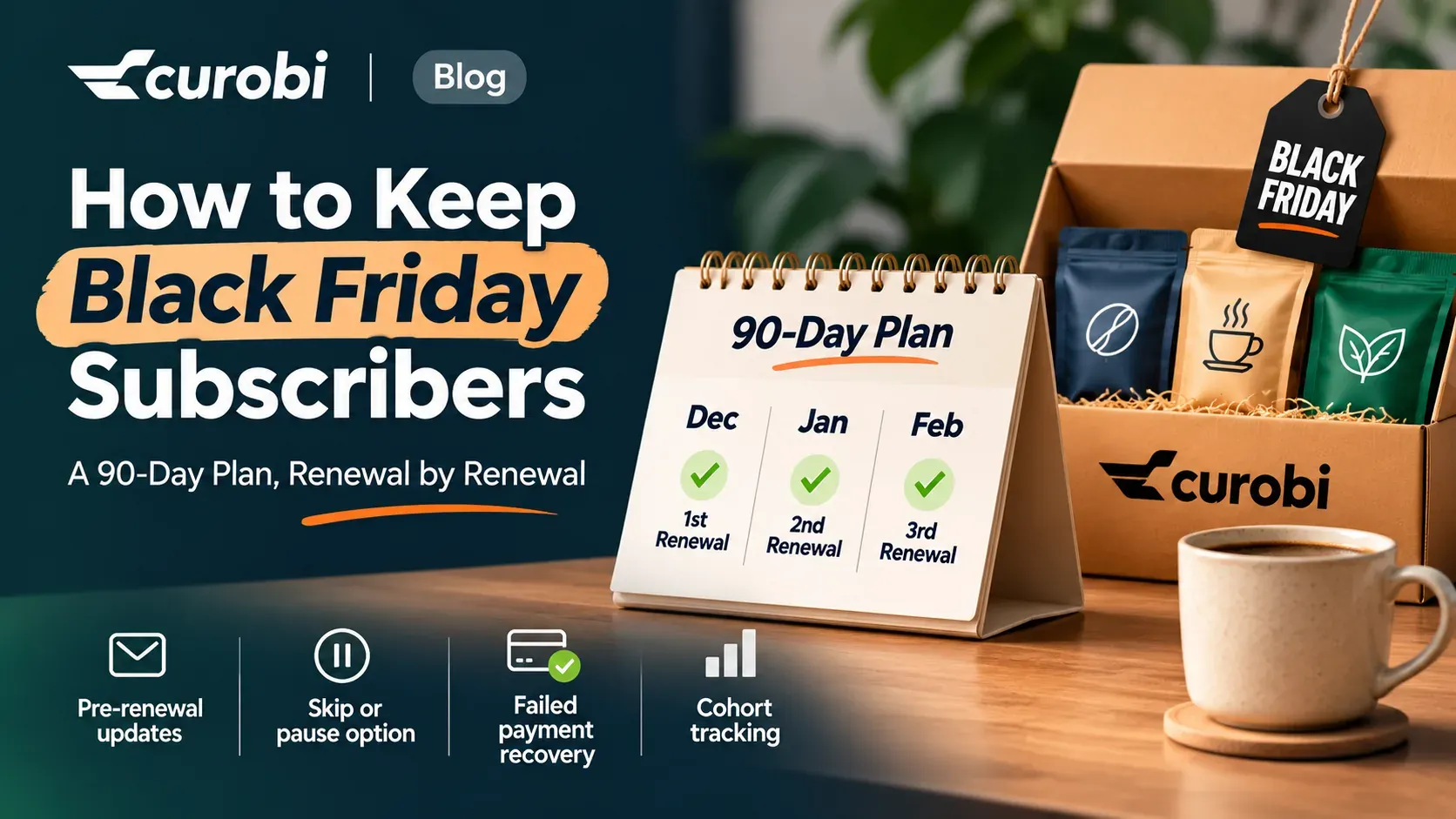
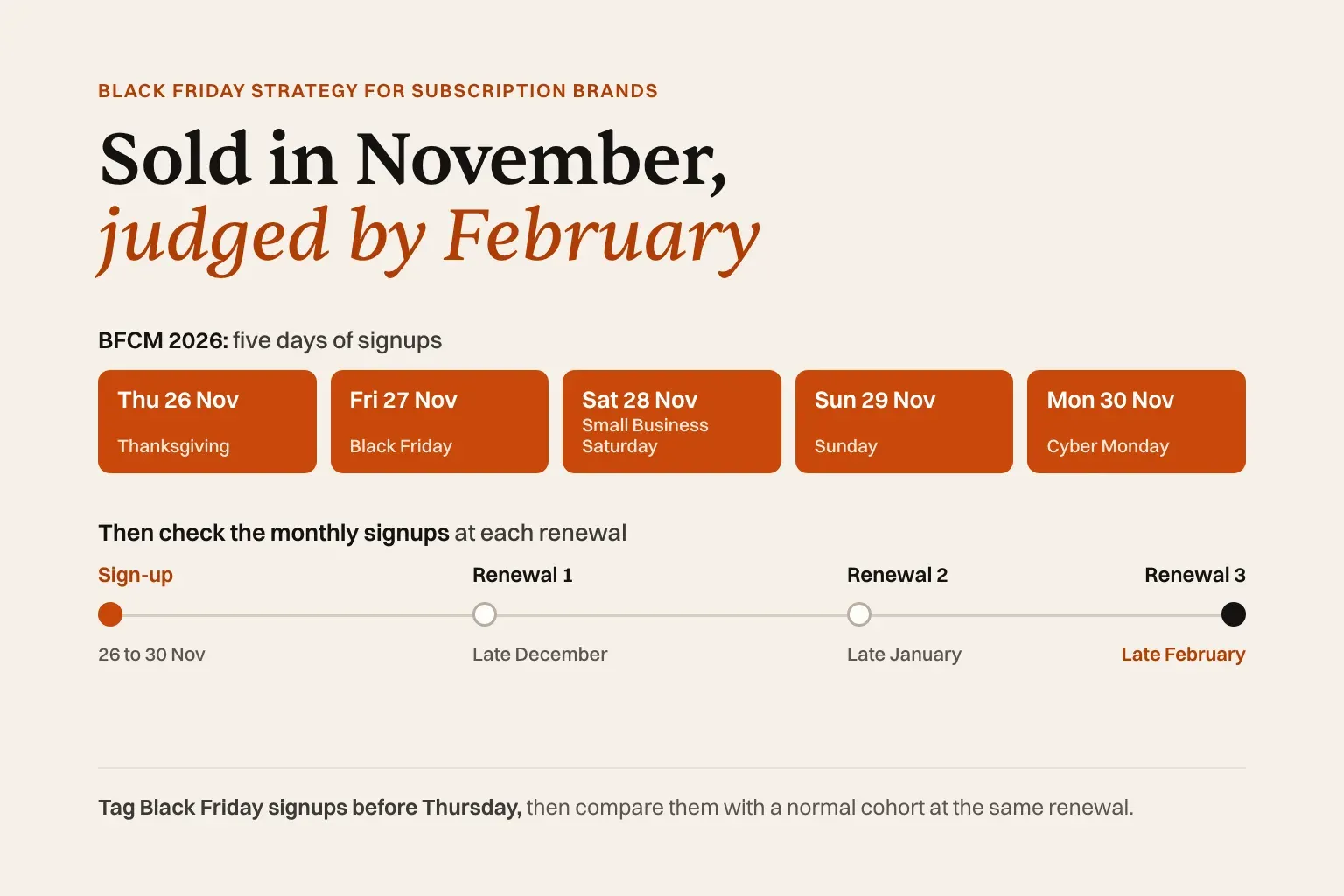
Launching in November or December brings gift buyers. A gift with a fixed number of boxes ends on its own, so a December cohort of gifts can shrink in February and March without anyone cancelling; plan the message that invites recipients to subscribe before the last box. The gift formats and that conversion message are in selling gift subscriptions on Shopify, and what to do with subscribers who joined on a holiday offer is in how to keep Black Friday subscribers.

What goes wrong in months 2 to 4 of a subscription box?
The first box is a launch; the second, third and fourth are the business. Problems that don’t show up at launch tend to arrive in this order.
- Month 2, the first renewal: cancellations. Across Recharge brands, 24.1% of subscribers who reached the first renewal cancelled at it, and about 61% of all voluntary cancellations happened at the first two renewals (Recharge, July 2026). The first box needs to make the second feel worth paying for, and the email before the first renewal should say what is coming.
- Month 2: the first card charged without the customer present. Checkout charges are made with the customer at the screen; renewals are not, and some fail. On Recurly’s July 2026 ecommerce data, failed payments cause about a third of subscription churn. Set up retries and an update-card email before the first renewal, not after it.
- Month 2: late joiners asking where their box is. On one charge day, someone who subscribed after the cutoff can wait more than a month for a first box. Say so on the product page and in the confirmation email.
- Month 3, the second renewal: the box starts to feel familiar. Recharge’s data puts the cancellation peak here, at 27.1% of subscribers who reached the second renewal. A preset box is most exposed, and a box of the month is exposed if it repeats items a subscriber has already had. Why value perception slips around the third delivery is in the month-3 churn cliff.
- Month 3: the count stops matching the order. Skips, pauses and failed payments mean the subscribers you bought for are not the subscribers you ship to. Count at the cutoff and again before packing.
- Month 3 to 4: costs move. Supplier prices, packaging re-orders and carrier rates change, and pick and pack takes longer at volume than it did for 50 boxes. Re-run the cost sheet after the third batch with real numbers.
- Month 4: preferences catch up with you. The wrong shade, the wrong dog size, a book the subscriber owns or an allergen in the snack mix shows up as a cancellation reason after a couple of boxes. Collect preferences at sign-up and read the cancellation reasons every month.
Two tools reduce the cost of all of these: a skip or pause option that is easy to find, so a subscriber who doesn’t want this month’s box doesn’t cancel the whole subscription, and a cancellation reason survey, so you know which of the above is happening. The case for skip and pause is in why the skip button is your best retention tool, and the wider retention plan in how to reduce subscription churn.
Which rules apply to a subscription box in the US and the UK?
In the US, the federal Restore Online Shoppers’ Confidence Act requires clear terms before billing details are taken, express consent and a simple way to stop charges, and many states add renewal reminders and online cancellation; the state-by-state checklist, including the cancel path in the customer portal, is in US auto-renewal and click-to-cancel laws. In the UK, new subscription rules under the Digital Markets, Competition and Consumers Act are due to apply to contracts made from 1 January 2027; on 17 November 2026 Parliament’s record of the regulations showed them laid and considered by committees but not yet approved. They add reminder notices, an easy online exit and a 14-day cooling-off period that for goods starts at the first delivery, and they cover stores abroad that sell to UK consumers. What a box store must do is in the UK’s new subscription rules.
This is a summary, not legal advice.
What do you need on Shopify to sell a subscription box?
- A paid Shopify plan and a supported payment gateway. Shopify’s Help Center lists the gateways that work with subscription apps: Shopify Payments, PayPal Express, Authorize.net, Adyen and Stripe, with Stripe limited to select merchants and Adyen to organisations it has already approved.
- A subscription app that builds the box. Shopify’s developer documentation says “Bundles can’t be sold with selling plans, such as subscriptions, pre-orders, and try-before-you-buy”, so a bundle made with Shopify’s own tools cannot be the subscription product. Shopify’s free Subscriptions app sells plain subscriptions and can bill on a specific day, but documents no box feature. The trade-offs are in Shopify Subscriptions vs a subscription app.
- A test store. Run a full cycle (sign-up before and after the cutoff, a skip, a failed payment, a renewal) on a development store before taking real money.
Where Curobi fits
Curobi is a Shopify subscription app. Its box features are on the Pro plan, at $69.99 every 30 days: Curated Boxes, Build-a-Box and one-time box sales. Every plan has 0% Curobi transaction fees; Shopify’s payment processing fees still apply. The Free plan’s one-time 14-day trial includes Curated Boxes and Build-a-Box, sold on subscription or one-time; after the trial, a box program pauses until the store moves to Pro: subscribers keep renewing with their current items, no new months are applied, and new box checkouts are refused.
For the steps on this page: the box editor covers this month and the next three, so boxes can be planned up to four months ahead, and the right month is applied to each subscriber’s renewal before it bills; a month you never plan falls back to the latest published box. Once a curated subscription box’s month is published, a packing list download gives the units needed, the stock on hand and any shortfall per variant, counted when you download it. Fixed-calendar billing, Pro only, for monthly plans, and not part of the trial, sets a charge day from the 1st to the 28th, an order cutoff, an optional ship day and whether a new subscriber’s first box ships at once or waits for the batch; every plan bills on a rolling schedule. Subscribers cannot swap items inside a curated box. Every in-app feature is free on a Shopify development store, which is where to run the test cycle. Plans are on the pricing page.
Frequently asked questions
Is a subscription box business profitable?
It can be, but product margin is the wrong test. In our worked example, a $32 snack box with $10 of products has a 69% product margin and keeps $6.42, or 20%, once packaging, pick and pack, postage, the payment fee and the app fee are paid. With a $40 cost to win each subscriber and cancellations at the rates Recharge publishes for the first two renewals, that box earns back its acquisition cost at the 15th box. These are our assumptions, not benchmarks; the same sum with your own costs is the test.
Do I need an app to sell a subscription box on Shopify?
Yes. Shopify sells subscriptions through subscription apps, and its developer documentation says bundles can’t be sold with selling plans such as subscriptions, so a box made with Shopify’s own bundle tools cannot be the subscription product. You need a subscription app that builds the box itself, a paid Shopify plan, and one of the payment gateways Shopify supports for subscriptions: Shopify Payments, PayPal Express, Authorize.net, Adyen or Stripe.
Should I launch a subscription box with a waitlist or pre-orders?
Use a waitlist while the box is still being designed, because it costs nothing to join and tells you who is interested. Once you can name a first ship date you are confident of, take paid founding sign-ups instead, because a payment is the only reliable measure of demand and gives you the count to buy stock for. In the US, the FTC’s Mail Order Rule requires a reasonable basis for any ship date you state and the customer’s consent to a delay.
When do subscription box customers usually cancel?
Early. Across Recharge brands, about 61% of voluntary cancellations happened at the first two renewals, according to Recharge’s July 2026 analysis. Of subscribers who reached each renewal, 24.1% cancelled at the first and 27.1% at the second. Those are all of Recharge’s brands, not only boxes, but they show where a new box business should put its effort: the second and third boxes.
What laws apply to a subscription box?
In the US, the federal Restore Online Shoppers’ Confidence Act requires clear terms before billing, express consent and a simple way to stop charges, and many states add renewal reminders and online cancellation. In the UK, new subscription rules are due to apply to contracts made from 1 January 2027, subject to parliamentary approval, with reminders, an easy online exit and a cooling-off period that starts at the first delivery.
Sources
- Shopify: Help Center, considerations and payment gateways for subscriptions, read 17 November 2026; developer documentation, About product bundles, read 17 November 2026; pricing (US Basic online card rate), checked November 2026.
- Recharge, Subscription churn is front-loaded (July 2026; renewal cycles July 2025 to March 2026) and The first-order discount sweet spot (July 2026). Vendor platform data; Recharge competes with Curobi.
- Recurly, churn rate benchmarks, July 2026 data. Vendor platform data.
- Cratejoy, How to price your subscription box, read 17 November 2026.
- Federal Trade Commission, Business guide to the Mail, Internet, or Telephone Order Merchandise Rule, read 17 November 2026.
- UK Parliament, procedure record for the draft subscription contracts regulations, checked 17 November 2026.
- More figures, each with its source and date: subscription commerce statistics.
- Curobi’s plans and features: the pricing page, from Curobi’s product documentation as of 13 November 2026.
Last checked 17 November 2026. The cost sheet and payback figures are our arithmetic on stated assumptions, not measurements.